What does 1 Chronicles 14:11 mean?
“So they came up to Baal-perazim; and David smote them there. Then David said, God hath broken in upon mine enemies by mine hand like the breaking forth of waters: therefore they called the name of that place Baal-perazim.” — 1 Chronicles 14:11
The Bible verse 1 Chronicles 14:11 from the King James Version (KJV) states: "So they came up to Baalperazim; and David smote them there. Then David said, God hath broken in upon mine enemies by mine hand like the breaking forth of waters: therefore they called the name of that place Baalperazim."
This verse is part of the historical narrative of King David's reign as the ruler of Israel. In this particular passage, David and his army have just defeated the Philistines in a place called Baalperazim. The name Baalperazim means "Lord of the Breakthrough," and it was given to this site to commemorate God's intervention and victory over the enemies of Israel.
The context of this verse is important to understand the significance of David's actions and words. At this point in the biblical narrative, David had been anointed as king over all of Israel, and he was facing threats and opposition from various neighboring nations, including the Philistines. The Philistines were a formidable enemy, and they had been a thorn in the side of Israel for many years. However, David's faith in God and his leadership as a warrior and king enabled him to secure a significant victory over the Philistine forces at Baalperazim.
The themes of this verse revolve around the power and intervention of God on behalf of His people. The name "Baalperazim" itself signifies the Lord's breakthrough, indicating that it was God who broke through the enemy lines and gave David and his army the victory. This theme of divine intervention and triumph over enemies is a recurring motif throughout the Bible, and it serves to demonstrate the sovereignty and power of God in the midst of human conflicts and struggles.
The symbolism in this verse is rich and multifaceted. The name "Baalperazim" itself is symbolic of God's ability to break through any obstacle or opposition that His people may face. It serves as a reminder that God is the ultimate source of victory and deliverance, and that He is able to accomplish His purposes in ways that surpass human understanding.
Furthermore, the imagery of "the breaking forth of waters" used by David to describe God's intervention is significant. Water is often used symbolically in the Bible to represent life, purification, and renewal. In this context, the breaking forth of waters can be seen as a metaphor for the overwhelming force and abundance of God's power when He moves on behalf of His people. It is a vivid and evocative image that conveys the unstoppable nature of God's intervention and the thorough defeat of His enemies.
In addition, the fact that David attributes the victory to God's intervention "by mine hand" reflects his understanding of his own role as a leader and warrior under the authority and guidance of God. It demonstrates humility and acknowledgment of God's sovereignty, as well as a recognition of the partnership between God and His human servants in accomplishing His purposes.
Overall, 1 Chronicles 14:11 is a powerful and inspiring verse that highlights the themes of divine intervention, victory over enemies, and the sovereignty of God. It serves as a reminder of God's faithfulness to His people and His ability to overcome any obstacle or opposition that they may face. The symbolism and imagery used in this verse further reinforce the message of God's overwhelming power and the ultimate triumph of His will.
Get our apps


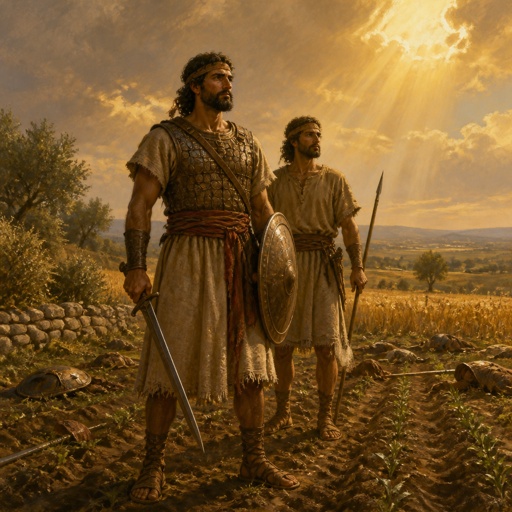
Artwork for 1 Chronicles 14:11

1 Chronicles 14:11 - "So they came up to Baal-perazim; and David smote them there. Then David said, God hath broken in upon mine enemies by mine hand like the breaking forth of waters: therefore they called the name of that place Baal-perazim."

"So they came up to Baal-perazim; and David smote them there. Then David said, God hath broken in upon mine enemies by mine hand like the breaking forth of waters: therefore they called the name of that place Baal-perazim." - 1 Chronicles 14:11

1 Chronicles 11:14 - "And they set themselves in the midst of that parcel, and delivered it, and slew the Philistines; and the LORD saved them by a great deliverance."

1 Chronicles 14:7 - "And Elishama, and Beeliada, and Eliphalet."

1 Chronicles 14:6 - "And Nogah, and Nepheg, and Japhia,"

Nehemiah 11:11-14

1 Chronicles 1:14 - "The Jebusite also, and the Amorite, and the Girgashite,"

1 Chronicles 14:5 - "And Ibhar, and Elishua, and Elpalet,"
"And they set themselves in the midst of that parcel, and delivered it, and slew the Philistines; and the LORD saved them by a great deliverance." - 1 Chronicles 11:14

1 Chronicles 8:14 - "And Ahio, Shashak, and Jeremoth,"

"And Elishama, and Beeliada, and Eliphalet." - 1 Chronicles 14:7

"And Nogah, and Nepheg, and Japhia," - 1 Chronicles 14:6

1 Chronicles 1:11 - "And Mizraim begat Ludim, and Anamim, and Lehabim, and Naphtuhim,"

1 Chronicles 14:13 - "And the Philistines yet again spread themselves abroad in the valley."

1 Chronicles 24:14 - "The fifteenth to Bilgah, the sixteenth to Immer,"

1 Chronicles 2:14 - "Nethaneel the fourth, Raddai the fifth,"

1 Chronicles 11:29 - "Sibbecai the Hushathite, Ilai the Ahohite,"

1 Chronicles 12:11 - "Attai the sixth, Eliel the seventh,"

1 Chronicles 24:11 - "The ninth to Jeshua, the tenth to Shecaniah,"

1 Chronicles 11:40 - "Ira the Ithrite, Gareb the Ithrite,"

1 Chronicles 11:27 - "Shammoth the Harorite, Helez the Pelonite,"

1 Chronicles 11:36 - "Hepher the Mecherathite, Ahijah the Pelonite,"

"And Ibhar, and Elishua, and Elpalet," - 1 Chronicles 14:5

1 Chronicles 11:47 - "Eliel, and Obed, and Jasiel the Mesobaite."

1 Chronicles 11:33 - "Azmaveth the Baharumite, Eliahba the Shaalbonite,"

Luke 11:14-15

1 Chronicles 8:11 - "And of Hushim he begat Abitub, and Elpaal."

1 Chronicles 11:43 - "Hanan the son of Maachah, and Joshaphat the Mithnite,"

Luke 11:1-14

1 Chronicles 6:14 - "And Azariah begat Seraiah, and Seraiah begat Jehozadak,"