What does 1 Chronicles 20:3 mean?
“And he brought out the people that were in it, and cut them with saws, and with harrows of iron, and with axes. Even so dealt David with all the cities of the children of Ammon. And David and all the people returned to Jerusalem.” — 1 Chronicles 20:3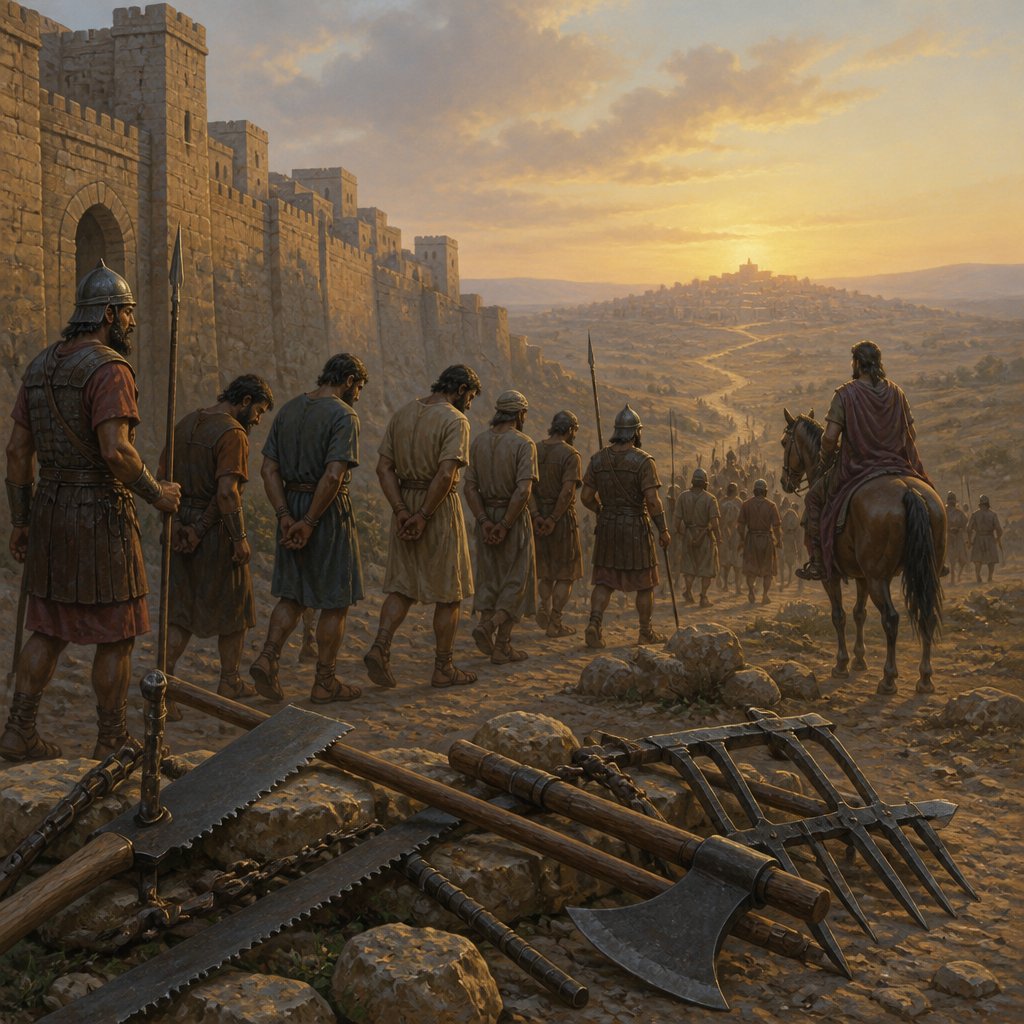
1 Chronicles 20:3 (KJV) reads, "And he brought out the people that were in it, and cut them with saws, and with harrows of iron, and with axes. Even so dealt David with all the cities of the children of Ammon. And David and all the people returned to Jerusalem."
This verse comes from a chapter that describes King David's military victories and conquests. In this particular verse, David has just defeated the Ammonites and is dealing with the people of their conquered cities.
In this passage, we see a brutal and harsh treatment of the Ammonite people by David. He subjected them to cruel forms of torture and execution, using saws, harrows of iron, and axes. This kind of violence and brutality may seem shocking to modern readers, and it is important to approach this passage with sensitivity and understanding of the historical and cultural context in which it was written.
One interpretation of this verse is that it serves as a reminder of the harsh realities of war and the consequences of rebellion against God's chosen people. The Ammonites were enemies of Israel, and in the ancient world, the treatment of conquered peoples was often ruthless and unforgiving. The language used in this verse reflects the brutal nature of warfare in that time period.
Another interpretation is that this passage illustrates the strength and power of David as a military leader. It emphasizes his ability to subdue and conquer his enemies, demonstrating his authority and prowess in battle. It also serves as a reminder of the violent and chaotic nature of the ancient world, where military might and conquest were central to establishing and maintaining power.
Symbolically, this verse can also be interpreted as a reflection of the spiritual warfare and conflict between good and evil. The Ammonites represent the forces of darkness and opposition to God's people, while David symbolizes the strength and resolve of those who are faithful to God. The harsh treatment of the Ammonites serves as a warning of the consequences of turning away from God and the destructive nature of sin.
Overall, this verse presents a complex and challenging depiction of war and conquest in the ancient world. It prompts readers to grapple with the difficult themes of violence, power, and the consequences of disobedience. It also provides insight into the historical context of the Old Testament and the cultural norms of the time. While the imagery may be difficult to reconcile with modern values, it offers an opportunity for reflection on the complexities of human nature and the ongoing struggle between good and evil.
Get our apps


Artwork for 1 Chronicles 20:3

1 Chronicles 20:3 - "And he brought out the people that were in it, and cut them with saws, and with harrows of iron, and with axes. Even so dealt David with all the cities of the children of Ammon. And David and all the people returned to Jerusalem."
"And he brought out the people that were in it, and cut them with saws, and with harrows of iron, and with axes. Even so dealt David with all the cities of the children of Ammon. And David and all the people returned to Jerusalem." - 1 Chronicles 20:3

1 Chronicles 3:20 - "And Hashubah, and Ohel, and Berechiah, and Hasadiah, Jushab-hesed, five."

2 Chronicles 20:3 - "And Jehoshaphat feared, and set himself to seek the LORD, and proclaimed a fast throughout all Judah."

"And Hashubah, and Ohel, and Berechiah, and Hasadiah, Jushab-hesed, five." - 1 Chronicles 3:20

1 Chronicles 1:20 - "And Joktan begat Almodad, and Sheleph, and Hazarmaveth, and Jerah,"

"And Jehoshaphat feared, and set himself to seek the LORD, and proclaimed a fast throughout all Judah." - 2 Chronicles 20:3

1 Chronicles 8:20 - "And Elienai, and Zilthai, and Eliel,"

1 Chronicles 1:3 - "Henoch, Methuselah, Lamech,"

1 Chronicles 23:20 - "Of the sons of Uzziel; Michah the first, and Jesiah the second."

1 Chronicles 2:20 - "And Hur begat Uri, and Uri begat Bezaleel."

Revelation 3:20

Revelation 3:20

1 Chronicles 3:3 - "The fifth, Shephatiah of Abital: the sixth, Ithream by Eglah his wife."

1 Chronicles 3:7 - "And Nogah, and Nepheg, and Japhia,"

1 Chronicles 25:20 - "The thirteenth to Shubael, he, his sons, and his brethren, were twelve:"

"And Elienai, and Zilthai, and Eliel," - 1 Chronicles 8:20

1 Chronicles 6:20 - "Of Gershom; Libni his son, Jahath his son, Zimmah his son,"

1 Chronicles 15:20 - "And Zechariah, and Aziel, and Shemiramoth, and Jehiel, and Unni, and Eliab, and Maaseiah, and Benaiah, with psalteries on Alamoth;"

1 Chronicles 16:20 - "And when they went from nation to nation, and from one kingdom to another people;"

1 Chronicles 9:20 - "And Phinehas the son of Eleazar was the ruler over them in time past, and the LORD was with him."

1 Chronicles 3:8 - "And Elishama, and Eliada, and Eliphelet, nine."

1 Chronicles 3:6 - "Ibhar also, and Elishama, and Eliphelet,"

1 Chronicles 24:20 - "¶ And the rest of the sons of Levi were these: Of the sons of Amram; Shubael: of the sons of Shubael; Jehdeiah."

1 Chronicles 26:20 - "¶ And of the Levites, Ahijah was over the treasures of the house of God, and over the treasures of the dedicated things."

1 Chronicles 20:8 - "These were born unto the giant in Gath; and they fell by the hand of David, and by the hand of his servants."

1 Chronicles 20:7 - "But when he defied Israel, Jonathan the son of Shimea David's brother slew him."

1 Chronicles 27:20 - "Of the children of Ephraim, Hoshea the son of Azaziah: of the half tribe of Manasseh, Joel the son of Pedaiah:"

"And Joktan begat Almodad, and Sheleph, and Hazarmaveth, and Jerah," - 1 Chronicles 1:20

"Henoch, Methuselah, Lamech," - 1 Chronicles 1:3