What does 1 Chronicles 21:16 mean?
“And David lifted up his eyes, and saw the angel of the LORD stand between the earth and the heaven, having a drawn sword in his hand stretched out over Jerusalem. Then David and the elders of Israel, who were clothed in sackcloth, fell upon their faces.” — 1 Chronicles 21:16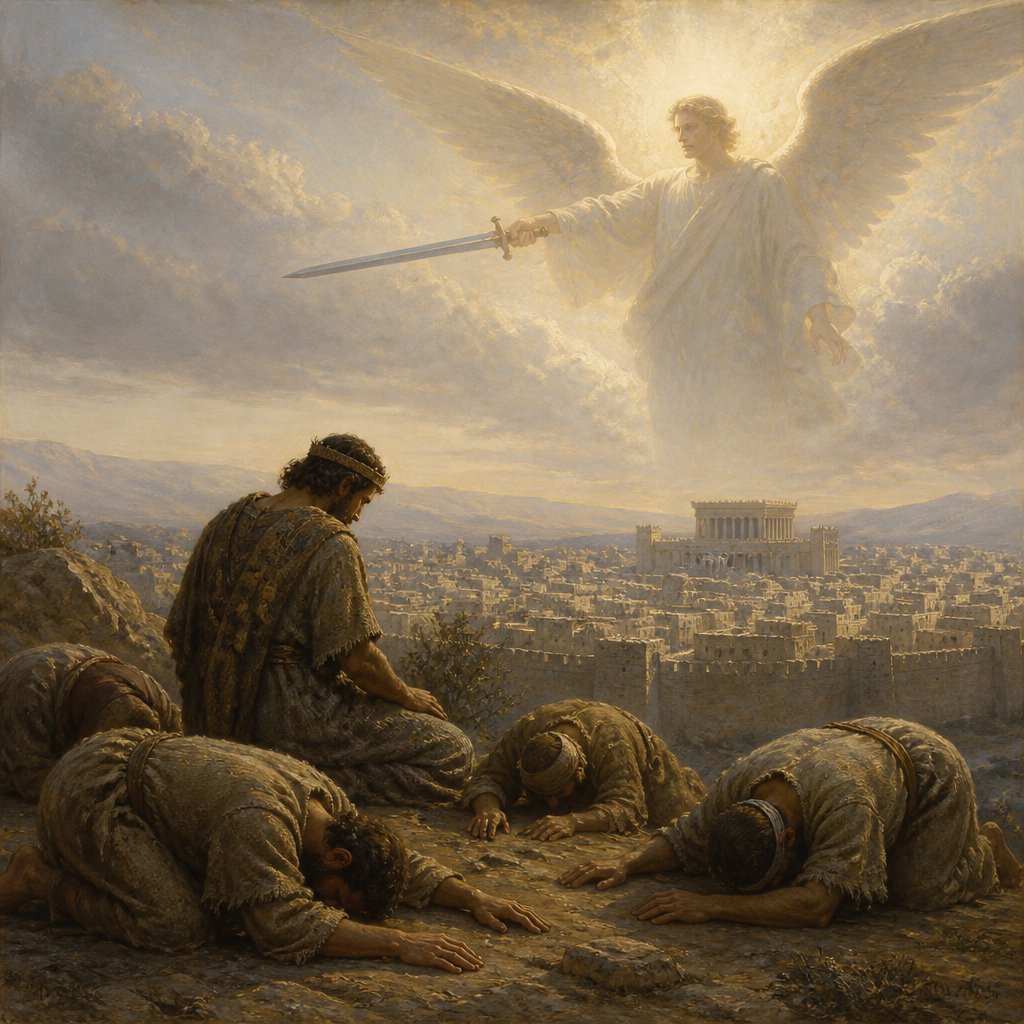
In 1 Chronicles 21, David has numbered Israel, an act that in this chapter is treated not as a neutral administrative choice but as a sinful reliance on visible strength. The narrative presents the numbering as something that provokes divine displeasure, and it sets in motion a chain of events in which David is brought to see the spiritual cost of exalting national power above humble dependence upon the LORD. By the time you arrive at 1 Chronicles 21:16, the judgment has already begun, and the verse opens a window into the invisible reality behind the calamity: “And David lifted up his eyes, and saw the angel of the LORD stand between the earth and the heaven, having a drawn sword in his hand stretched out over Jerusalem. Then David and the elders of Israel, who were clothed in sackcloth, fell upon their faces.”
The immediate meaning of the scene is that the disaster afflicting the nation is not random and not merely political or biological; it is presented as a holy judgment administered by “the angel of the LORD.” The wording “stand between the earth and the heaven” places the angel in a liminal, judicial position, as though he is an emissary from the heavenly court executing a sentence upon the earthly city. The “drawn sword” symbolizes imminent, active wrath. It is not sheathed, and it is “stretched out over Jerusalem,” which concentrates the reader’s attention on the capital, the center of the kingdom and the seat of David’s rule. The sword over Jerusalem indicates that the judgment that has already struck the people is approaching the heart of the nation, and it underscores that no human status, not even the royal city, is immune when sin is dealt with by divine righteousness.
David’s action, “lifted up his eyes,” is more than physical sight. In the flow of the chapter it functions as a moment of revelation and confrontation. David is made to see what is ordinarily unseen: the spiritual agency of judgment. That visibility heightens David’s responsibility; he cannot dismiss the consequences as unfortunate circumstance. He is faced with the personal and communal implications of his sin, and the vision compels a response of repentance rather than explanation or self-defense.
The response is equally significant: “Then David and the elders of Israel, who were clothed in sackcloth, fell upon their faces.” Sackcloth in the KJV is a recognizable emblem of mourning, humiliation, and penitence. It signals that the leaders do not treat the event as a mere crisis to be managed but as an occasion for deep contrition before God. That “the elders of Israel” join David shows that this is not only the king’s private spiritual reckoning; the leadership of the nation identifies with the nation’s distress and submits with David under God’s hand. Their posture, “fell upon their faces,” is the physical expression of fear, reverence, submission, and pleading. In the presence of the drawn sword, the only fitting human stance is lowliness.
Symbolically, the angel’s position “between the earth and the heaven” can also be read as a vivid portrayal of mediation and accountability. Heaven’s verdict is being applied to earth; the vertical relationship between God and his people is being pressed into view. Jerusalem, often associated with God’s dwelling and the focal point of worship, is here under threat, which intensifies the theological point: the place connected with God’s name does not function as a talisman. The city must be aligned with God’s will, and the king must lead in faith rather than presumption.
In the larger context of the chapter, this verse also serves as a turning point that prepares for mercy. The drawn sword indicates that judgment is deserved and imminent, yet David’s repentance and the humbling of the elders set the stage for the LORD’s relenting and for the identification of the site where sacrifice will be offered. The narrative movement from sin, to judgment, to confession, to sacrifice reveals a central theme: God is righteous to judge, yet he provides a way for judgment to be stayed. Thus 1 Chronicles 21:16 is not merely an image of terror; it is a theological unveiling. It shows sin’s seriousness, the reality of divine oversight, the vulnerability even of Jerusalem, and the proper human response of repentance and worshipful submission when confronted with God’s holiness.
Get our apps


Artwork for 1 Chronicles 21:16

1 Chronicles 21:16 - "And David lifted up his eyes, and saw the angel of the LORD stand between the earth and the heaven, having a drawn sword in his hand stretched out over Jerusalem. Then David and the elders of Israel, who were clothed in sackcloth, fell upon their faces."
!["And David lifted up his eyes, and saw the angel of the LORD stand between the earth and the heaven, having a drawn sword in his hand stretched out over Jerusalem. Then David and the elders [of Israel, who were] clothed in sackcloth, fell upon their faces." - 1 Chronicles 21:16](https://media.bible.art/19dd3e30-472d-4952-97fd-8dab1856a4f1-thumbnail.jpg)
"And David lifted up his eyes, and saw the angel of the LORD stand between the earth and the heaven, having a drawn sword in his hand stretched out over Jerusalem. Then David and the elders [of Israel, who were] clothed in sackcloth, fell upon their faces." - 1 Chronicles 21:16
"And David lifted up his eyes, and saw the angel of the LORD stand between the earth and the heaven, having a drawn sword in his hand stretched out over Jerusalem. Then David and the elders of Israel, who were clothed in sackcloth, fell upon their faces." - 1 Chronicles 21:16

1 Chronicles 16:21 - "He suffered no man to do them wrong: yea, he reproved kings for their sakes,"

1 Chronicles 1:21 - "Hadoram also, and Uzal, and Diklah,"

2 Chronicles 21:16 - "¶ Moreover the LORD stirred up against Jehoram the spirit of the Philistines, and of the Arabians, that were near the Ethiopians:"
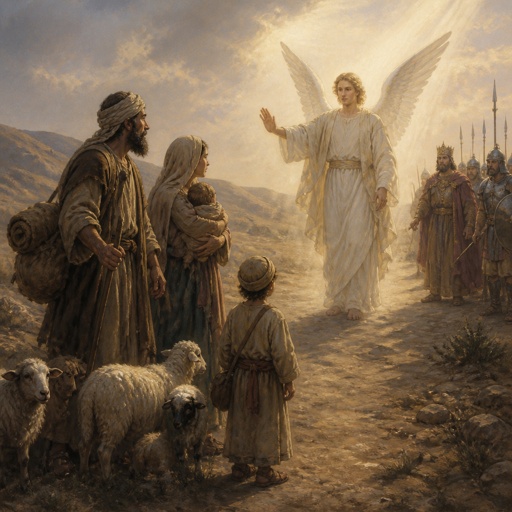
"He suffered no man to do them wrong: yea, he reproved kings for their sakes," - 1 Chronicles 16:21

1 Chronicles 1:16 - "And the Arvadite, and the Zemarite, and the Hamathite."

1 Chronicles 16:16 - "Even of the covenant which he made with Abraham, and of his oath unto Isaac;"

1 Chronicles 8:21 - "And Adaiah, and Beraiah, and Shimrath, the sons of Shimhi;"

1 Chronicles 21:1 - "And Satan stood up against Israel, and provoked David to number Israel."

1 Chronicles 24:16 - "The nineteenth to Pethahiah, the twentieth to Jehezekel,"

1 Chronicles 23:16 - "Of the sons of Gershom, Shebuel was the chief."

1 Chronicles 24:21 - "Concerning Rehabiah: of the sons of Rehabiah, the first was Isshiah."

1 Chronicles 9:21 - "And Zechariah the son of Meshelemiah was porter of the door of the tabernacle of the congregation."

1 Chronicles 6:16 - "¶ The sons of Levi; Gershom, Kohath, and Merari."

1 Chronicles 8:16 - "And Michael, and Ispah, and Joha, the sons of Beriah;"

1 Chronicles 21:7 - "And God was displeased with this thing; therefore he smote Israel."

1 Chronicles 21:9 - "¶ And the LORD spake unto Gad, David's seer, saying,"

1 Corinthians 16:21 - "The salutation of me Paul with mine own hand."

"Hadoram also, and Uzal, and Diklah," - 1 Chronicles 1:21

"And the Arvadite, and the Zemarite, and the Hamathite." - 1 Chronicles 1:16

1 Chronicles 21:21 - "And as David came to Ornan, Ornan looked and saw David, and went out of the threshingfloor, and bowed himself to David with his face to the ground."

1 Chronicles 11:16 - "And David was then in the hold, and the Philistines' garrison was then at Beth-lehem."

1 Chronicles 4:16 - "And the sons of Jehaleleel; Ziph, and Ziphah, Tiria, and Asareel."

1 Chronicles 23:21 - "¶ The sons of Merari; Mahli, and Mushi. The sons of Mahli; Eleazar, and Kish."

1 Chronicles 16:19 - "When ye were but few, even a few, and strangers in it."

1 Chronicles 12:16 - "And there came of the children of Benjamin and Judah to the hold unto David."

1 Chronicles 16:26 - "For all the gods of the people are idols: but the LORD made the heavens."

1 Chronicles 25:21 - "The fourteenth to Mattithiah, he, his sons, and his brethren, were twelve:"