What does 1 Chronicles 29:29 mean?
“Now the acts of David the king, first and last, behold, they are written in the book of Samuel the seer, and in the book of Nathan the prophet, and in the book of Gad the seer,” — 1 Chronicles 29:29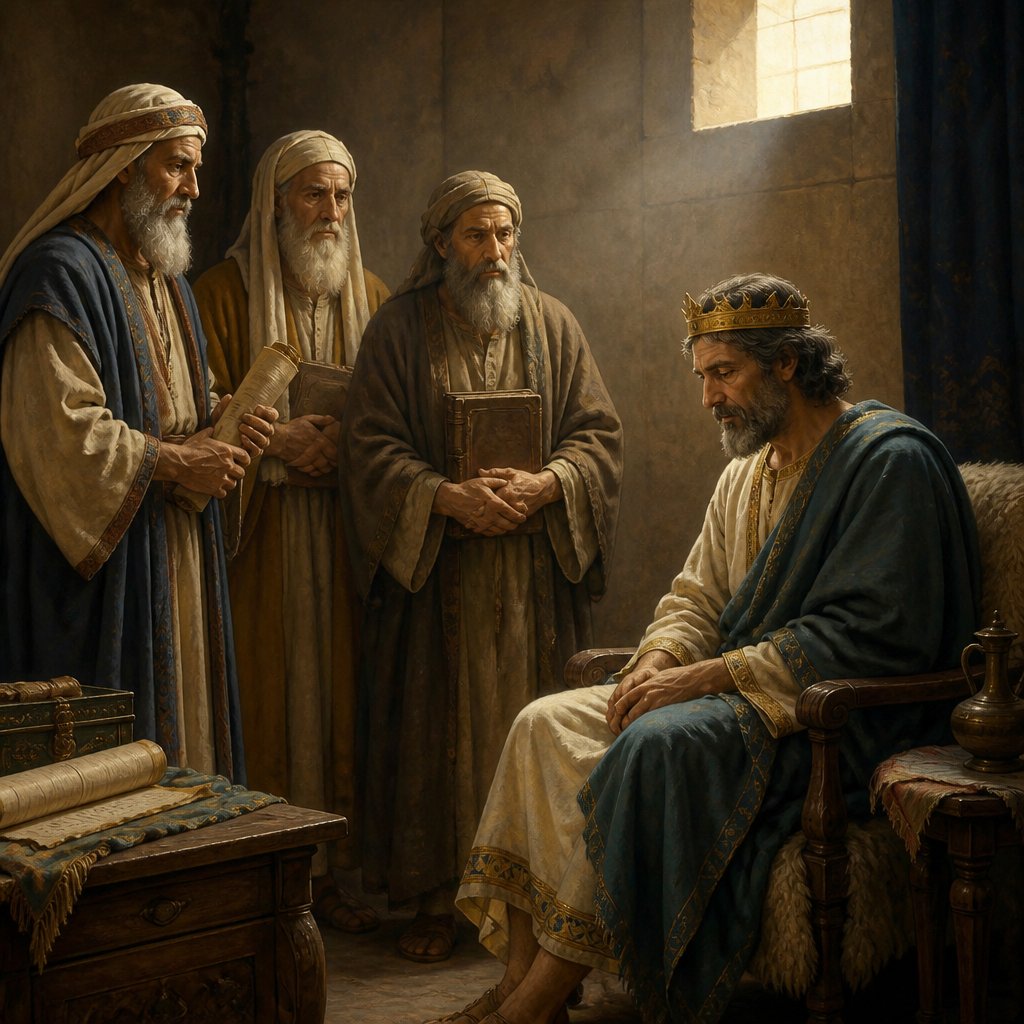
1 Chronicles 29:29 in the King James Version reads, "Now the acts of David the king, first and last, behold, they are written in the book of Samuel the seer, and in the book of Nathan the prophet, and in the book of Gad the seer." This verse serves as the conclusion to the account of King David's reign, summarizing the records of his life and accomplishments.
The book of 1 Chronicles is a genealogical and historical record of the descendants of Adam through the line of Israel, focusing specifically on the reign of King David. The passage leading up to 1 Chronicles 29:29 details the extensive preparations David made for the construction of the temple and his deep desire to build a house for the Lord. However, God ultimately chose David's son, Solomon, to carry out this task, but David generously provided his own resources to ensure the temple's completion. The verse in question serves as a reminder of the historical records that exist to document the life and achievements of King David, highlighting his legacy as a powerful and faithful leader for the people of Israel.
The verse also underscores the reliability and authenticity of the historical records contained in the biblical books of Samuel, Nathan, and Gad. These men were prominent prophets and sources of divine revelation during David's reign, and their writings provide a comprehensive account of the events and deeds of this time. By referencing these books, the verse establishes the credibility and authority of the historical information presented in 1 Chronicles, reaffirming its status as an accurate and reliable record of Israel's history.
From a thematic perspective, 1 Chronicles 29:29 emphasizes the importance of historical remembrance and documentation. The verse demonstrates the value of preserving and recording the actions and decisions of prominent leaders, ensuring that future generations have access to this valuable information. This theme also aligns with the broader biblical emphasis on the importance of remembering and learning from the past, as a means of honoring God's faithfulness and understanding His continuing work in the world.
The verse also highlights the significance of prophetic authority and revelation in the biblical narrative. The books of Samuel, Nathan, and Gad represent key sources of divine guidance and insight during David's reign, and their writings are considered authoritative and inspired by God. As such, the verse underscores the pivotal role that prophetic voices play in conveying God's will and preserving the historical record of His interactions with His people.
In terms of symbolism, 1 Chronicles 29:29 symbolizes the enduring legacy of King David and the importance of chronicling and honoring the achievements and contributions of influential leaders. David's reign is remembered as a time of great prosperity and spiritual renewal for Israel, and the verse reflects the significance of preserving this historical legacy for future generations. Additionally, the mention of the books of Samuel, Nathan, and Gad symbolizes the interconnectedness of prophetic revelation and historical documentation within the biblical narrative, highlighting the unified and cohesive nature of God's plan for His people.
In conclusion, 1 Chronicles 29:29 serves as a fitting conclusion to the historical account of King David's reign, emphasizing the importance of historical remembrance, prophetic authority, and the enduring legacy of influential leaders. The verse reinforces the credibility of the historical records presented in 1 Chronicles and underscores the significance of preserving these accounts for future generations. As a result, this verse holds deep thematic and symbolic significance within the broader biblical narrative, highlighting the ongoing relevance of the historical and prophetic record for God's people.
Get our apps


Artwork for 1 Chronicles 29:29

1 Chronicles 29:29 - "Now the acts of David the king, first and last, behold, they are written in the book of Samuel the seer, and in the book of Nathan the prophet, and in the book of Gad the seer,"
"Now the acts of David the king, first and last, behold, they are written in the book of Samuel the seer, and in the book of Nathan the prophet, and in the book of Gad the seer," - 1 Chronicles 29:29

1 Chronicles 4:29 - "And at Bilhah, and at Ezem, and at Tolad,"

1 Chronicles 11:29 - "Sibbecai the Hushathite, Ilai the Ahohite,"

1 Chronicles 1:29 - "¶ These are their generations: The firstborn of Ishmael, Nebaioth; then Kedar, and Adbeel, and Mibsam,"

1 Chronicles 24:29 - "Concerning Kish: the son of Kish was Jerahmeel."

1 Chronicles 29:26 - "¶ Thus David the son of Jesse reigned over all Israel."

1 Chronicles 8:29 - "And at Gibeon dwelt the father of Gibeon; whose wife's name was Maachah:"

"And at Bilhah, and at Ezem, and at Tolad," - 1 Chronicles 4:29

1 Chronicles 2:29 - "And the name of the wife of Abishur was Abihail, and she bare him Ahban, and Molid."

1 Chronicles 25:29 - "The two and twentieth to Giddalti, he, his sons, and his brethren, were twelve:"

1 Chronicles 16:29 – "Ascribe to the Lord the glory due his name; bring an offering and come before him."

1 Chronicles 29:13 - "Now therefore, our God, we thank thee, and praise thy glorious name."

1 Chronicles 26:29 - "¶ Of the Izharites, Chenaniah and his sons were for the outward business over Israel, for officers and judges."

"Sibbecai the Hushathite, Ilai the Ahohite," - 1 Chronicles 11:29

2 Chronicles 29:29 - "And when they had made an end of offering, the king and all that were present with him bowed themselves, and worshipped."

1 Chronicles 6:29 - "The sons of Merari; Mahli, Libni his son, Shimei his son, Uzza his son,"

1 Kings 14:29 - "¶ Now the rest of the acts of Rehoboam, and all that he did, are they not written in the book of the chronicles of the kings of Judah?"

1 Chronicles 29:6 - "¶ Then the chief of the fathers and princes of the tribes of Israel, and the captains of thousands and of hundreds, with the rulers of the king's work, offered willingly,"

1 Chronicles 29:8 - "And they with whom precious stones were found gave them to the treasure of the house of the LORD, by the hand of Jehiel the Gershonite."

1 Chronicles 27:29 - "And over the herds that fed in Sharon was Shitrai the Sharonite: and over the herds that were in the valleys was Shaphat the son of Adlai:"

"Concerning Kish: the son of Kish was Jerahmeel." - 1 Chronicles 24:29

1 Chronicles 21:29 - "For the tabernacle of the LORD, which Moses made in the wilderness, and the altar of the burnt offering, were at that season in the high place at Gibeon."

1 Chronicles 29:24 - "And all the princes, and the mighty men, and all the sons likewise of king David, submitted themselves unto Solomon the king."

1 Chronicles 29:23 - "Then Solomon sat on the throne of the LORD as king instead of David his father, and prospered; and all Israel obeyed him."

"¶ These are their generations: The firstborn of Ishmael, Nebaioth; then Kedar, and Adbeel, and Mibsam," - 1 Chronicles 1:29

1 Chronicles 29:15 - "For we are strangers before thee, and sojourners, as were all our fathers: our days on the earth are as a shadow, and there is none abiding."

1 Chronicles 29:28 - "And he died in a good old age, full of days, riches, and honour: and Solomon his son reigned in his stead."

1 Chronicles 29:30 - "With all his reign and his might, and the times that went over him, and over Israel, and over all the kingdoms of the countries."

1 Chronicles 12:29 - "And of the children of Benjamin, the kindred of Saul, three thousand: for hitherto the greatest part of them had kept the ward of the house of Saul."