What does 1 Corinthians 3:11 mean?
“For other foundation can no man lay than that is laid, which is Jesus Christ.” — 1 Corinthians 3:11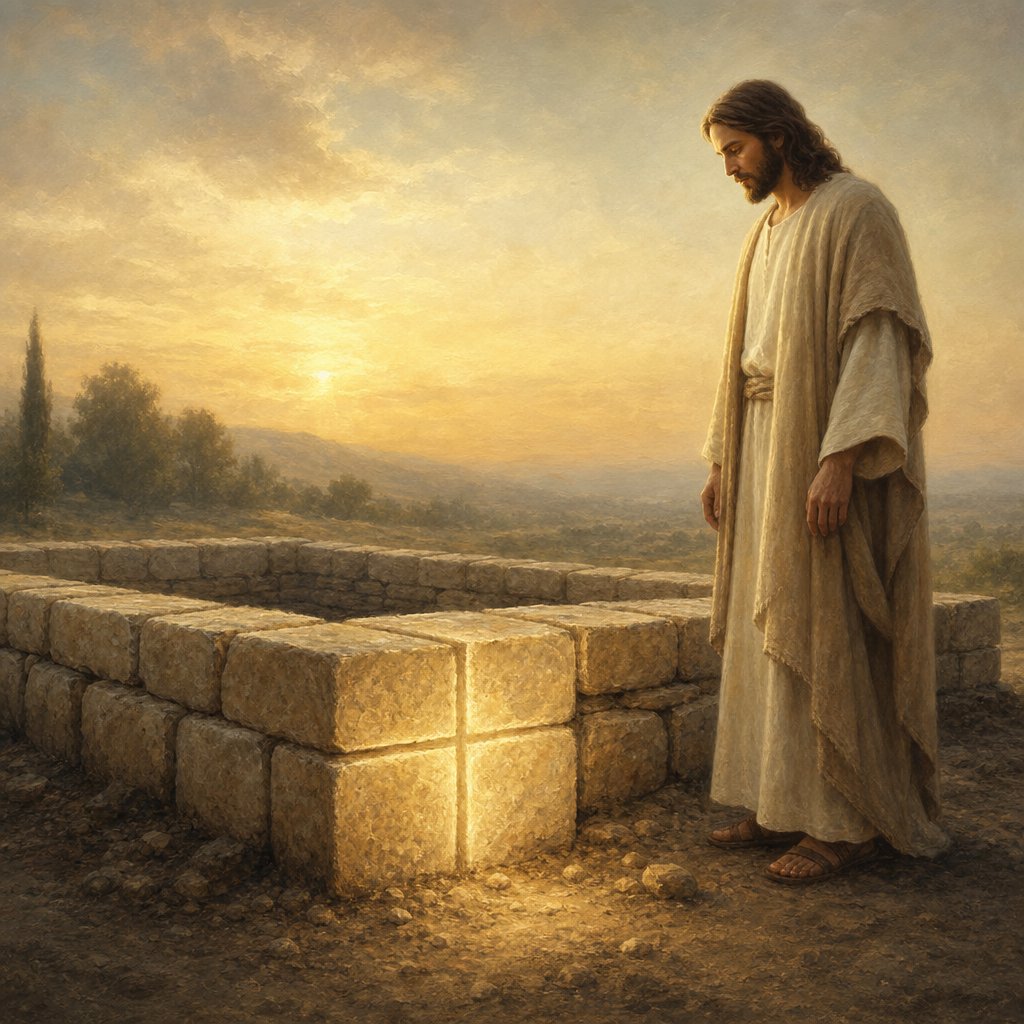
“Other foundation can no man lay than that is laid, which is Jesus Christ.” In 1 Corinthians 3:11 the apostle Paul speaks into a church that had begun to think of spiritual life as something built on impressive personalities, preferred teachers, and party-like loyalties. Earlier in the chapter he names the fracture plainly: some were saying, “I am of Paul; and I of Apollos; and I of Cephas; and I of Christ.” Paul answers that this kind of boasting is a mark of carnality, not maturity, because it treats ministers as if they were the source of life rather than servants through whom God works. Within that immediate context, 1 Corinthians 3:11 stands as the fixed center of Paul’s correction. The Corinthians may admire a preacher, follow a style, or attach themselves to a name, but none of that can function as the church’s base. There is only one foundation already set down, and it is not an apostle, not a gifted speaker, not a spiritual experience, not a tradition, not a movement, and not the wisdom of men; “the foundation” is “Jesus Christ.”
The verse assumes the imagery Paul has been developing: the church as God’s building. Paul has just said, “I have planted, Apollos watered; but God gave the increase,” and then he moves from farming to construction: “ye are God’s building.” In that picture, apostles and teachers are “labourers together with God,” working on something that does not belong to them. A builder’s skill matters, but the success of the whole structure finally depends on whether it stands on the right base. Paul calls himself “a wise masterbuilder,” not because he wants a title, but because God gave him grace to lay a true beginning among them by preaching Christ. Yet even then, the foundation is not Paul’s personal achievement. It is “laid” already in the sense that God has appointed and established it in the gospel itself. Paul is not inventing the base; he is declaring what God has set. His warning, “let every man take heed how he buildeth thereupon,” gains its weight from this: the foundation is settled and exclusive, so everything that follows must correspond to it.
The themes gathered into this single sentence are both doctrinal and pastoral. Doctrinally, it declares the uniqueness and sufficiency of Christ. A foundation determines what a building can bear; it is the part you do not casually replace. By saying “other foundation can no man lay,” Paul is not merely ranking Christ above other options; he is excluding every rival. Whatever else people try to rest the Christian life upon—human wisdom, moral achievement, spiritual elitism, rhetorical brilliance, or even attachment to orthodox leaders—cannot carry the weight of salvation, unity, holiness, or endurance. Christ alone is able to bear the structure of the church because the church is his by purchase and by presence. The Corinthians’ problem was not that they had no interest in Christ, but that they were treating Christ as one name among other names, one banner among other banners. Paul’s sentence snaps that illusion: Christ is not one piece of the building; he is the only foundation of it.
Pastorally, the verse aims at humility and unity. Foundations do not invite competition. If a church is built on Christ, then no minister can claim ownership, and no congregation can boast as if it were the product of its preferred leader. That is why Paul immediately diminishes the cult of personalities: “Who then is Paul, and who is Apollos, but ministers by whom ye believed, even as the Lord gave to every man?” The symbolism is clear. Paul and Apollos may be builders working on the structure, but they are not the ground it stands on. In the same way, spiritual gifts, learning, and leadership are real and valuable, yet they are secondary, dependent, and accountable. The church becomes stable when it is not perched on shifting preferences but anchored to the person and work of Christ.
The verse also carries a sober implication about judgment and permanence. In the lines that follow, Paul speaks of building with “gold, silver, precious stones, wood, hay, stubble,” and he says, “every man’s work shall be made manifest.” The foundation being Christ does not mean every kind of ministry, doctrine, or lifestyle is equally sound. Rather, because the foundation is Christ, what is built upon it will be tested for congruence with him. The foundation is unburnable; Christ does not fail. But what is erected on top of that foundation may prove weighty and lasting, or it may prove light and combustible. The symbolism of fire is not random. It expresses that the day of God’s evaluation exposes what is truly of Christ and what merely borrowed Christian language while being driven by pride, novelty, or human ambition. Thus 1 Corinthians 3:11 is both comfort and warning: comfort because the foundation is secure and not dependent on human greatness; warning because the only safe building is that which truly aligns with Christ.
Within the broader message of 1 Corinthians, this verse also pushes back against the Corinthian fascination with “wisdom” and “excellency of speech.” Earlier Paul had insisted that God saves through what the world calls foolishness, “Christ crucified,” so that faith would not stand “in the wisdom of men, but in the power of God.” When he says in 3:11 that no other foundation can be laid, he is reinforcing the same point in architectural terms. The Christian faith is not ultimately grounded in argument, culture, or charisma, but in Christ himself, proclaimed in the gospel and known by faith. The church can appreciate learning and eloquence, but it cannot rest on them. They can decorate a building; they cannot replace the foundation.
The significance of 1 Corinthians 3:11, then, is that it names the nonnegotiable base of Christian identity and church life. It relocates confidence away from human leaders and human constructions and fixes it in the one person God has appointed as the church’s ground and beginning: “Jesus Christ.” It tells the divided, immature church in Corinth—and by extension every church—that true growth is God’s work, true unity is Christ-centered, and true endurance comes only from being built upon the foundation that God has already laid and that no man can improve, duplicate, or substitute.
Get our apps


Artwork for 1 Corinthians 3:11

1 Corinthians 3:11 - "For other foundation can no man lay than that is laid, which is Jesus Christ."
"For other foundation can no man lay than that is laid, which is Jesus Christ." - 1 Corinthians 3:11

1 Corinthians 11:3 - "But I would have you know, that the head of every man is Christ; and the head of the woman is the man; and the head of Christ is God."

1 Corinthians 3:16

1 Corinthians 3:16

1 corinthians 3:16-17

1 Corinthians 3:16

1 corinthians 3:16-17

1 corinthians 3:16-17

2 Corinthians 3:11 - "For if that which is done away was glorious, much more that which remaineth is glorious."

1 Corinthians 11:8 - "For the man is not of the woman; but the woman of the man."

1 Corinthians 11:1 - "Be ye followers of me, even as I also am of Christ."

1 Corinthians 11:11 - "Nevertheless neither is the man without the woman, neither the woman without the man, in the Lord."

1 Corinthians 15:8-11

1 Corinthians 11:26-29

1 Corinthians 11:26-29

1 Corinthians 11:9 - "Neither was the man created for the woman; but the woman for the man."

1 Corinthians 11:31 - "For if we would judge ourselves, we should not be judged."

1 Corinthians 3:23 - "And ye are Christ's; and Christ is God's."

1 Corinthians 12:3-13

2 Corinthians 1:3-4

1 Corinthians 11:30 - "For this cause many are weak and sickly among you, and many sleep."

1 Corinthians 10:3 - "And did all eat the same spiritual meat;"

1 Corinthians 3:20 - "And again, The Lord knoweth the thoughts of the wise, that they are vain."

1 Corinthians 11:13 - "Judge in yourselves: is it comely that a woman pray unto God uncovered?"

1 Corinthians 11:10 - "For this cause ought the woman to have power on her head because of the angels."

1 Corinthians 9:3 - "Mine answer to them that do examine me is this,"

1 Corinthians 2:3 - "And I was with you in weakness, and in fear, and in much trembling."

1 Corinthians 11:20 - "When ye come together therefore into one place, this is not to eat the Lord's supper."

1 Corinthians 3:3 - "For ye are yet carnal: for whereas there is among you envying, and strife, and divisions, are ye not carnal, and walk as men?"