What does 1 John 3:14 mean?
“We know that we have passed from death unto life, because we love the brethren. He that loveth not his brother abideth in death.” — 1 John 3:14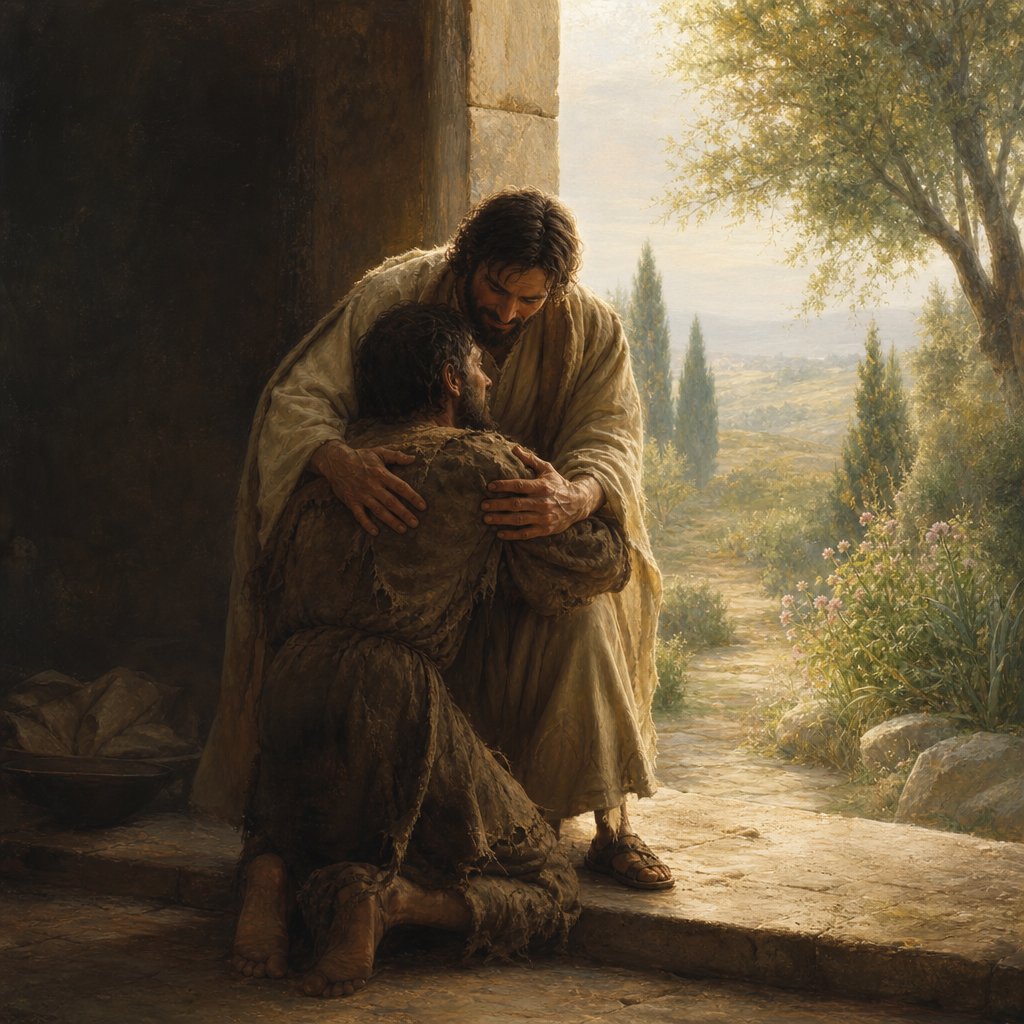
“1 John 3:14” in the King James Version reads: “We know that we have passed from death unto life, because we love the brethren. He that loveth not his brother abideth in death.”
In its plain sense, the verse speaks with the certainty of inward assurance: “We know.” John is not describing a vague hope or a merely external badge of religion, but a knowable reality that becomes evident in the life of a person. The knowledge he describes is not rooted in pride or self-congratulation; it is the kind of moral and spiritual certainty that arises when the character of God’s work shows itself in a person’s affections and actions. The statement is simple but weighty: the evidence that one “have passed from death unto life” is that one “love the brethren.” In other words, the transition from spiritual death to spiritual life is not presented as a private mystical claim detached from daily conduct; it manifests itself in a new orientation of the heart toward God’s people.
The phrase “passed from death unto life” is rich with biblical meaning. “Death” here is not merely the end of physical life, but a state of spiritual separation, a condition in which a person remains under the dominion of sin and alienation from the life of God. To “pass” from that death “unto life” suggests a decisive crossing, like leaving one realm and entering another. John presents this as a completed movement with abiding consequences; it implies that true spiritual life is not simply an improvement of the old self but a change of state. “Life” in Johannine language is not bare existence but fellowship with God, a living participation in what God is and gives. This is why the verse treats love not as an optional ornament but as a sign of the new realm: life produces love because God is love, and those who live in him begin to reflect what he is.
The ground John gives for this assurance is “because we love the brethren.” “Brethren” in the epistle is not a sentimental term for humanity in general, though love is never meant to be narrow or cruel; it is primarily the family language of those who belong to God, those begotten of him. John’s emphasis is that the new birth creates a new family, and love is the family resemblance. The believer’s love for “the brethren” is therefore symbolic and revelatory: it symbolizes shared life and reveals shared origin. It is not simply liking people with similar personalities or preferences; it is the practical, chosen goodwill that expresses itself in faithfulness, mercy, patience, and a readiness to do good, because the objects of that love belong to the same Father. By pointing to “the brethren,” John also insists that love must be concrete and relational, tested in the sometimes difficult realities of proximity, differences, offenses, and needs. Love that cannot survive contact with actual people is not the love John is speaking about.
The second sentence sharpens the contrast and gives the verse its solemn edge: “He that loveth not his brother abideth in death.” John is not describing a momentary failure or a believer’s lapse into impatience, as though every cold hour cancels salvation. His language is about a settled condition and an abiding posture. “Abideth” is one of John’s key words, suggesting remaining, dwelling, continuing. To “abide” in death is to remain in the sphere where death rules, where the absence of love is not merely a struggle but a characteristic. The symbolism here is stark: death is pictured as a realm one can inhabit. Love, then, is not just a virtue among others; it is an indicator of the realm to which a person belongs. Where love for the brother is absent as a consistent reality, John says the person remains where they were, in death, regardless of claims to light, knowledge, or spirituality.
The immediate context around 1 John 3:14 deepens its meaning. In the chapter, John is concerned with distinguishing the children of God from the children of the devil by what is practiced and loved. The epistle repeatedly insists that truth is not merely confessed but lived. Nearby, John sets forth the example of Cain, whose lack of love culminated in hatred and murder, and he contrasts that murderous spirit with the self-giving love seen in Christ. This context shows why John chooses love as a test: hatred is not a small defect but a sign of alignment with the wrong spirit, the spirit of death. Love is not an abstraction but is measured against the pattern of Christ, who laid down his life. Thus, “passed from death unto life” echoes not only a personal conversion but the gospel’s great reversal: Christ’s life overcoming death, and that victory being evidenced in a community that loves rather than devours one another.
The themes in the verse interweave assurance, transformation, and communal holiness. Assurance appears in “We know,” but it is assurance grounded in a moral fruit—love—that reflects God’s nature. Transformation appears in “passed from death unto life,” portraying salvation as a change of domain and vitality. Communal holiness appears in “love the brethren,” because John’s vision of Christian life is not isolated individualism but a family marked by active love. There is also a theme of moral clarity: John divides the world into two abodes, life and death, and he makes love the living boundary marker between them. This is not to reduce Christianity to mere social kindness, but to show that the God who gives life also gives a new heart, and that heart inevitably bends toward love.
The significance of 1 John 3:14, then, lies in its insistence that spiritual life is recognizable. John offers a searching but practical criterion. If a person finds within themselves a real love for God’s people—a love that endures, forgives, serves, and seeks their good—John says this is a sign that they have crossed from death into life. If, however, a person remains in a settled lovelessness toward “his brother,” John warns that such a person “abideth in death,” whatever religious language they may use. The verse therefore comforts by giving a mark of life, and it warns by exposing the deadly seriousness of lovelessness. In John’s theology, love is not merely the consequence of life; it is also the visible evidence that life has truly begun.
Get our apps


Artwork for 1 John 3:14

1 John 3:14 - "We know that we have passed from death unto life, because we love the brethren. He that loveth not his brother abideth in death."

"We know that we have passed from death unto life, because we love the brethren. He that loveth not his brother abideth in death." - 1 John 3:14
"We know that we have passed from death unto life, because we love the brethren. He that loveth not his brother abideth in death." - 1 John 3:14

John 3:14

numbers 21:8-9 & John 3:14

1 John 3:1-3

3 John 1:14 - "But I trust I shall shortly see thee, and we shall speak face to face. Peace be to thee. Our friends salute thee. Greet the friends by name."

John 3:3

John 14:16

John 3:3-8

John 14:15-21

1 John 2:14

1 John 2:14

John 14:1-2

John 3:14 - "¶ And as Moses lifted up the serpent in the wilderness, even so must the Son of man be lifted up:"

1 John 3:4 - "Whosoever committeth sin transgresseth also the law: for sin is the transgression of the law."

1 John 3:13 - "Marvel not, my brethren, if the world hate you."

Matthew 3:14 - "But John forbad him, saying, I have need to be baptized of thee, and comest thou to me?"

John 3:16

John 1:3

John 1:3

John 3:16

John 3:16

John 3:16

John 3-16

John 3:16

John 3:16

John 12:3

1 John 3:3 - "And every man that hath this hope in him purifieth himself, even as he is pure."

1 John 3:6 - "Whosoever abideth in him sinneth not: whosoever sinneth hath not seen him, neither known him."