What does 1 Kings 20:18 mean?
“And he said, Whether they be come out for peace, take them alive; or whether they be come out for war, take them alive.” — 1 Kings 20:18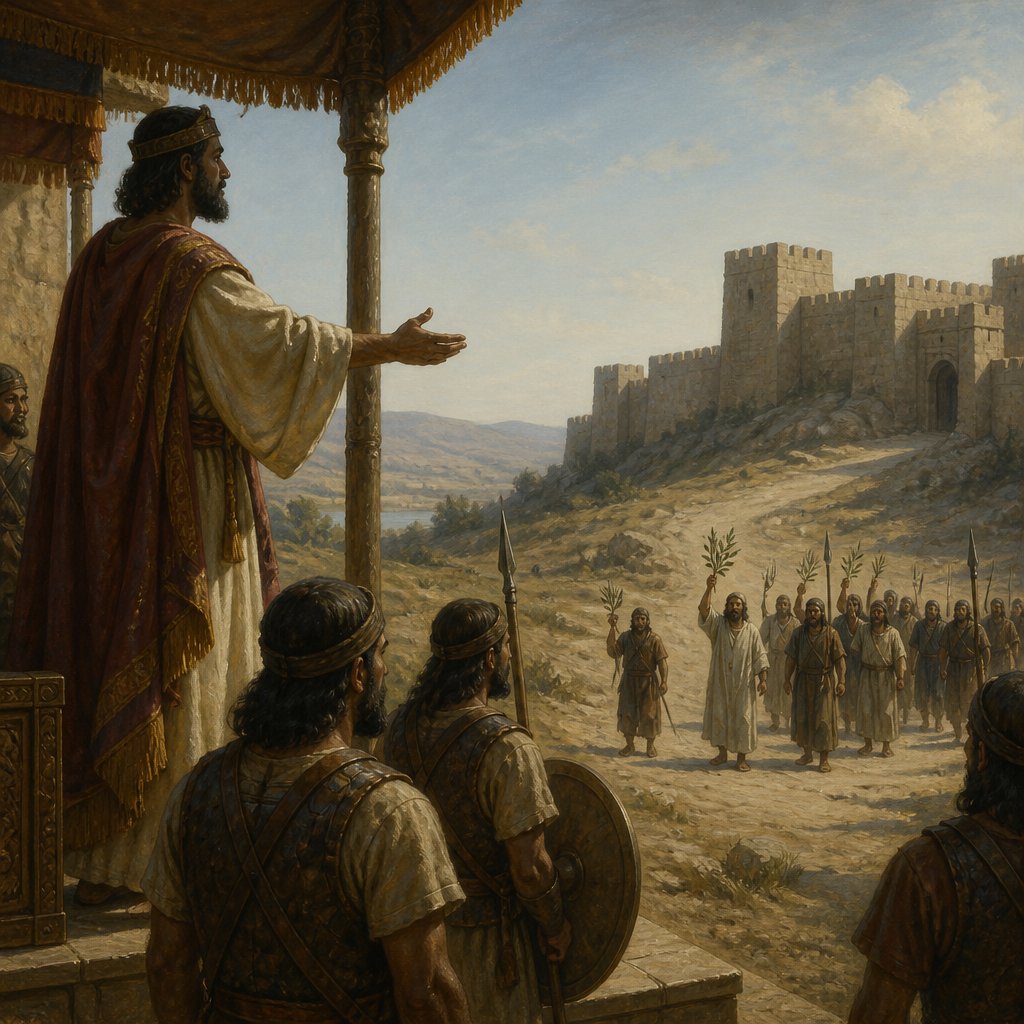
The passage 1 Kings 20:18 in the King James Version reads: "And he said, Whether they be come out for peace, take them alive; or whether they be come out for war, take them alive." This verse is part of the story of the prophet Elijah and King Ahab, and it comes in the context of a confrontation between the Israelites and the Arameans.
The broader context of this verse is as follows: Ben-Hadad, the king of Aram, had besieged Samaria and demanded the surrender of Ahab's wives and children and the treasures of his palace. When Ahab refused, Ben-Hadad threatened to utterly destroy the city. Ahab, feeling helpless in the face of Ben-Hadad's threats, seeks the advice of the elders and ultimately decides to resist the Arameans. This decision brings him into contact with the prophet Elijah, who delivers a message from God promising to deliver the Arameans into Ahab's hands.
In verse 18, a certain prophet comes to Ahab with instructions on how to deal with the Arameans. The prophet mentions the option of taking them "alive," whether they come out for peace or for war. Here, the prophet is advising Ahab to show mercy and restraint even in the face of aggression. He is suggesting that Ahab should be willing to extend a hand of peace, even to his enemies, in the hope of resolving the conflict without unnecessary bloodshed.
One of the key themes of this passage is the idea of mercy and justice, as well as the wisdom of seeking peaceful resolutions to conflicts. Ahab is faced with a difficult decision – whether to respond to the aggressions of the Arameans with further violence or to seek a peaceful solution. The prophet's advice suggests that there is always an opportunity for reconciliation, and that it is important to consider all options before resorting to war.
Another important theme in this passage is the role of faith and trust in God's guidance. Ahab is initially hesitant and fearful in the face of Ben-Hadad's threats, but he turns to the prophet and ultimately receives a promise of deliverance from God. This demonstrates the importance of seeking divine counsel and trusting in God's plan, even in the midst of conflict and uncertainty.
In terms of symbolism, the "alive" in the verse could be seen as representing the preservation of life and the potential for reconciliation. It embodies the idea that even in the midst of war and conflict, there is an opportunity to extend mercy and seek peace, rather than simply seeking to destroy one's enemies.
Overall, 1 Kings 20:18 offers valuable lessons about the importance of seeking peaceful resolutions to conflicts, showing mercy to one's enemies, and placing one's trust in God's guidance. It reminds us that even in the midst of adversity, there is always an opportunity for reconciliation and a path towards peace.
Get our apps


Artwork for 1 Kings 20:18

1 Kings 20:18 - "And he said, Whether they be come out for peace, take them alive; or whether they be come out for war, take them alive."

"And he said, Whether they be come out for peace, take them alive; or whether they be come out for war, take them alive." - 1 Kings 20:18

1 Kings 18:20 - "So Ahab sent unto all the children of Israel, and gathered the prophets together unto mount Carmel."

2 Kings 20:18 - "And of thy sons that shall issue from thee, which thou shalt beget, shall they take away; and they shall be eunuchs in the palace of the king of Babylon."

1 Kings 14:1-20

1 Kings 19:1-18

"So Ahab sent unto all the children of Israel, and gathered the prophets together unto mount Carmel." - 1 Kings 18:20

1 Kings 4:18 - "Shimei the son of Elah, in Benjamin:"

1 Kings 9:18 - "And Baalath, and Tadmor in the wilderness, in the land,"

1 Kings 20:16 - "And they went out at noon. But Ben-hadad was drinking himself drunk in the pavilions, he and the kings, the thirty and two kings that helped him."

2 Kings 1:18 - "Now the rest of the acts of Ahaziah which he did, are they not written in the book of the chronicles of the kings of Israel?"

1 Kings 1:18 - "And now, behold, Adonijah reigneth; and now, my lord the king, thou knowest it not:"

2 Kings 18:20 - "Thou sayest, (but they are but vain words,) I have counsel and strength for the war. Now on whom dost thou trust, that thou rebellest against me?"

1 Kings 20:24 - "And do this thing, Take the kings away, every man out of his place, and put captains in their rooms:"

1 Kings 16:20 - "Now the rest of the acts of Zimri, and his treason that he wrought, are they not written in the book of the chronicles of the kings of Israel?"

1 Kings 20:20 - "And they slew every one his man: and the Syrians fled; and Israel pursued them: and Ben-hadad the king of Syria escaped on an horse with the horsemen."

1 Kings 20:1 - "And Ben-hadad the king of Syria gathered all his host together: and there were thirty and two kings with him, and horses, and chariots: and he went up and besieged Samaria, and warred against it."

1 Kings 20:43 - "And the king of Israel went to his house heavy and displeased, and came to Samaria."

1 Kings 10:18 - "¶ Moreover the king made a great throne of ivory, and overlaid it with the best gold."

1 Kings 2:18 - "And Bath-sheba said, Well; I will speak for thee unto the king."

1 Kings 20:21 - "And the king of Israel went out, and smote the horses and chariots, and slew the Syrians with a great slaughter."

1 Kings 18:2 - "And Elijah went to shew himself unto Ahab. And there was a sore famine in Samaria."

1 Samuel 18:20 - "And Michal Saul's daughter loved David: and they told Saul, and the thing pleased him."

Elijah in the scene 1 Kings 18:36–38

1 Kings 20:38 - "So the prophet departed, and waited for the king by the way, and disguised himself with ashes upon his face."

1 Kings 18:35 - "And the water ran round about the altar; and he filled the trench also with water."

1 Kings 18:11 - "And now thou sayest, Go, tell thy lord, Behold, Elijah is here."

1 Kings 18:18 - "And he answered, I have not troubled Israel; but thou, and thy father's house, in that ye have forsaken the commandments of the LORD, and thou hast followed Baalim."

"Shimei the son of Elah, in Benjamin:" - 1 Kings 4:18

"And Baalath, and Tadmor in the wilderness, in the land," - 1 Kings 9:18