What does 1 Kings 9:25 mean?
“And three times in a year did Solomon offer burnt offerings and peace offerings upon the altar which he built unto the LORD, and he burnt incense upon the altar that was before the LORD. So he finished the house.” — 1 Kings 9:25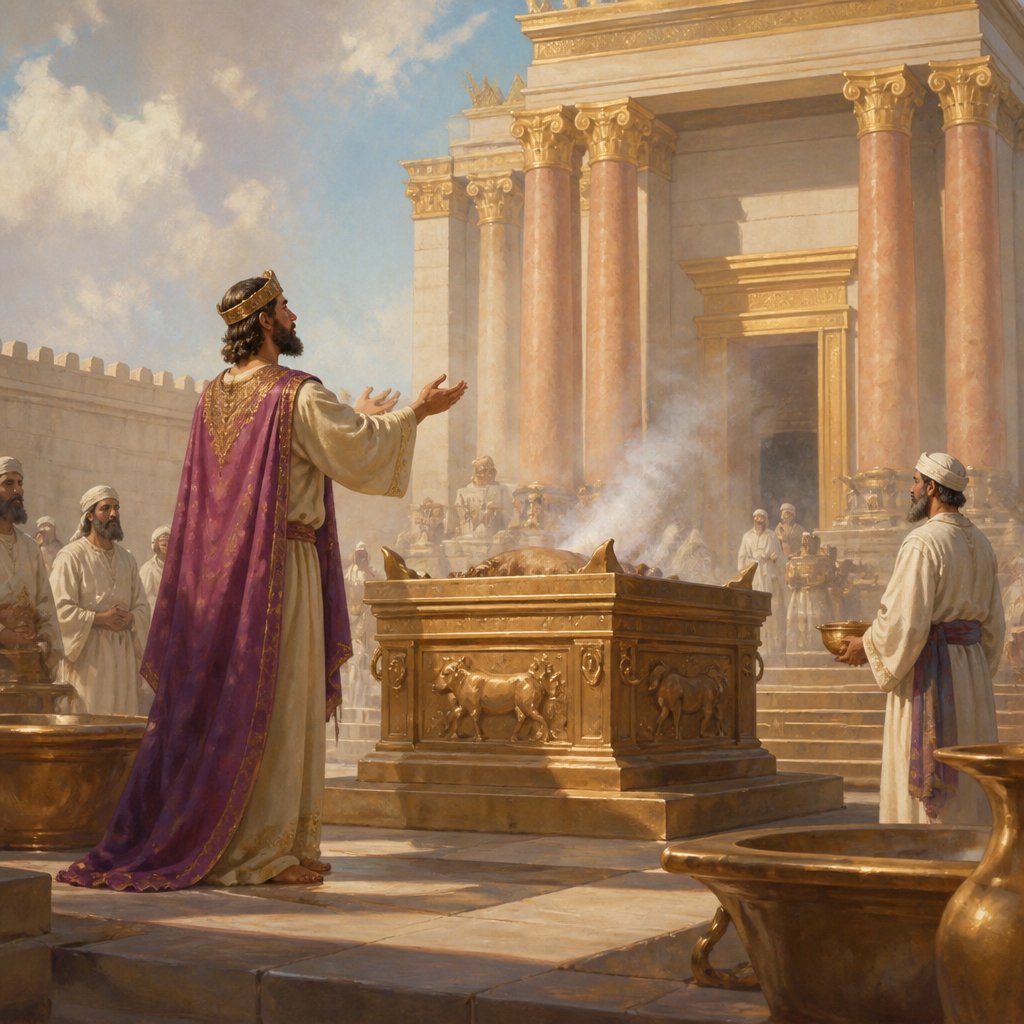
1 Kings 9:25 (KJV) - “And three times in a year did Solomon offer burnt offerings and peace offerings upon the altar which he built unto the Lord, and he burnt incense upon the altar that was before the Lord. So he finished the house.”
This verse describes the religious practices of King Solomon, who was known for his wisdom and wealth. In this verse, we see that Solomon offered burnt offerings and peace offerings to the Lord three times a year. This act of worship was done at the altar that he had built unto the Lord, and he also burned incense upon the altar that was before the Lord.
Contextually, this verse takes place after the completion of the construction of the Temple in Jerusalem. Solomon had been instructed by his father, King David, to build a house for the Lord, and after many years of meticulous work, the temple was finally finished. This verse illustrates the dedication of the temple and the start of its religious use.
One of the key themes in this verse is the importance of worship and religious ceremony. Solomon's commitment to offer burnt offerings and peace offerings three times a year shows his dedication to honoring and worshiping the Lord. It also highlights the centrality of the temple in the religious life of the Israelites. The temple was not only a physical structure but a spiritual center where the people could connect with God through worship and sacrifice.
The offering of burnt offerings and peace offerings was a fundamental part of the Israelite religious tradition. Burnt offerings were a way for the people to demonstrate their complete devotion and surrender to God, as the entire animal or offering was burned on the altar. Peace offerings, on the other hand, were a way for the people to express gratitude, make vows, or fulfill a vow to the Lord. These sacrifices were a tangible way for the people to express their faith and devotion to God.
The act of burning incense was also a significant element of the Israelite worship. Incense was seen as a symbol of prayer and was often used to create a fragrant aroma that was pleasing to the Lord. Burning incense was a way to purify the air in the temple and create a sacred environment for worship.
Symbolically, this verse represents the fulfillment of a promise and the beginning of a new chapter in the religious life of the Israelites. The completion of the temple was a significant milestone in the history of Israel, and the offering of sacrifices and burning of incense marked the beginning of the regular religious practices that would take place in the temple.
Overall, 1 Kings 9:25 offers a glimpse into the religious life of ancient Israel and the significance of the temple in their worship. It reflects the importance of dedication, worship, and sacrifice in the Israelite religious tradition. This verse also provides a powerful image of the commitment of King Solomon to honor and serve the Lord in his newly finished temple.
Get our apps


Artwork for 1 Kings 9:25

1 Kings 9:25 - "¶ And three times in a year did Solomon offer burnt offerings and peace offerings upon the altar which he built unto the LORD, and he burnt incense upon the altar that was before the LORD. So he finished the house."
"¶ And three times in a year did Solomon offer burnt offerings and peace offerings upon the altar which he built unto the LORD, and he burnt incense upon the altar that was before the LORD. So he finished the house." - 1 Kings 9:25

1 Corinthians 9:25-27

1 Corinthians 9:25-27

1 Corinthians 9:25-27

1 Corinthians 9:25-27

2 Kings 25:9 - "And he burnt the house of the LORD, and the king's house, and all the houses of Jerusalem, and every great man's house burnt he with fire."
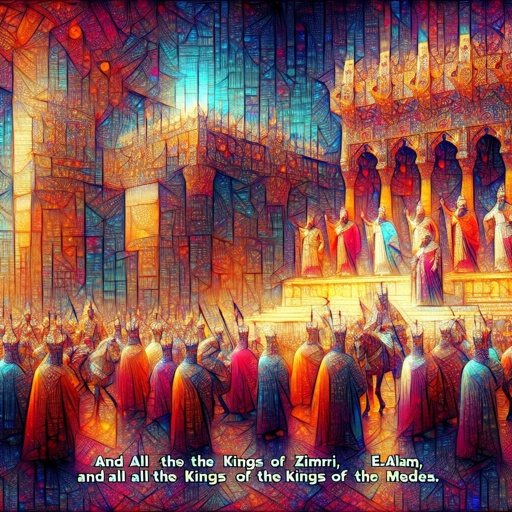
Jeremiah 25:25 - "And all the kings of Zimri, and all the kings of Elam, and all the kings of the Medes,"

1 Kings 3:9

1 Kings 3:25 - "And the king said, Divide the living child in two, and give half to the one, and half to the other."

1 Kings 9:18 - "And Baalath, and Tadmor in the wilderness, in the land,"

1 Kings 14:25 - "¶ And it came to pass in the fifth year of king Rehoboam, that Shishak king of Egypt came up against Jerusalem:"

1 Kings 6:25 - "And the other cherub was ten cubits: both the cherubims were of one measure and one size."

2 Kings 25:1 show King Nebuchadnezzar in war zone

2 Kings 25:1 show King Nebuchadnezzar and the army and the Temple

1 Kings 9:14 - "And Hiram sent to the king sixscore talents of gold."

Eternal Victor's Crown: 1 Corinthians 9:25

1 Kings 2:25 - "And king Solomon sent by the hand of Benaiah the son of Jehoiada; and he fell upon him that he died."

1 Kings 16:25 - "¶ But Omri wrought evil in the eyes of the LORD, and did worse than all that were before him."

"And all the kings of Zimri, and all the kings of Elam, and all the kings of the Medes," - Jeremiah 25:25

1 Kings 9:17 - "And Solomon built Gezer, and Beth-horon the nether,"

1 Kings 12:25 - "¶ Then Jeroboam built Shechem in mount Ephraim, and dwelt therein; and went out from thence, and built Penuel."

2 Kings 9:25 - "Then said Jehu to Bidkar his captain, Take up, and cast him in the portion of the field of Naboth the Jezreelite: for remember how that, when I and thou rode together after Ahab his father, the LORD laid this burden upon him;"

1 Kings 15:9 - "¶ And in the twentieth year of Jeroboam king of Israel reigned Asa over Judah."

1 Kings 22:25 - "And Micaiah said, Behold, thou shalt see in that day, when thou shalt go into an inner chamber to hide thyself."

1 Kings 15:25 - "¶ And Nadab the son of Jeroboam began to reign over Israel in the second year of Asa king of Judah, and reigned over Israel two years."

1 Kings 22:9 - "Then the king of Israel called an officer, and said, Hasten hither Micaiah the son of Imlah."

1 Chronicles 9:25 - "And their brethren, which were in their villages, were to come after seven days from time to time with them."

1 Kings 11:25 - "And he was an adversary to Israel all the days of Solomon, beside the mischief that Hadad did: and he abhorred Israel, and reigned over Syria."

1 Kings 4:9 - "The son of Dekar, in Makaz, and in Shaalbim, and Beth-shemesh, and Elon-beth-hanan:"