What does 1 Samuel 17:40 mean?
“And he took his staff in his hand, and chose him five smooth stones out of the brook, and put them in a shepherd’s bag which he had, even in a scrip; and his sling was in his hand: and he drew near to the Philistine.” — 1 Samuel 17:40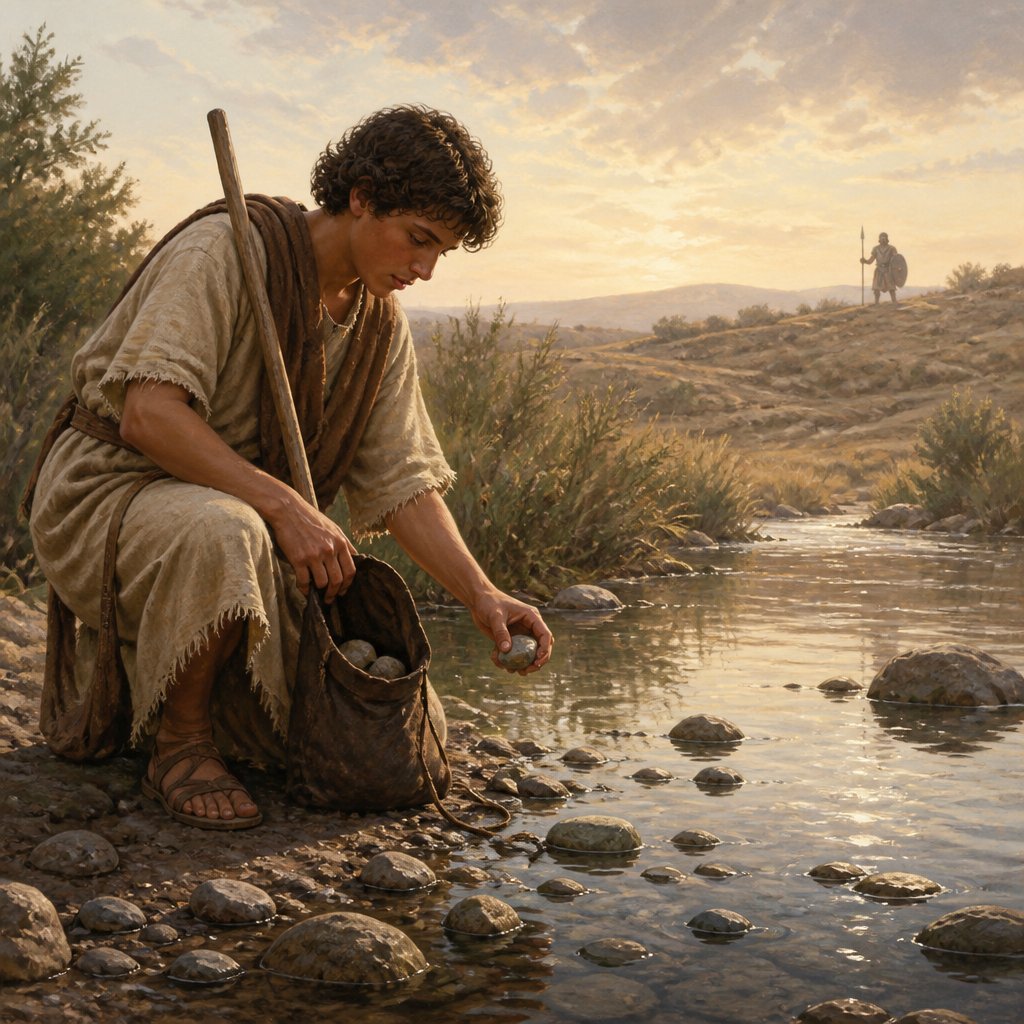
The Bible verse 1 Samuel 17:40 in the King James Version (KJV) reads: "And he took his staff in his hand, and chose him five smooth stones out of the brook, and put them in a shepherd's bag which he had, even in a scrip; and his sling was in his hand: and he drew near to the Philistine."
This verse comes from the famous story of David and Goliath. The context of this verse is set during a time of war between the Israelites and the Philistines. The Philistine army had a champion named Goliath, who was a giant of great strength and warrior skill. Goliath was challenging the Israelites to send out a champion to fight him, with the winner dictating the outcome of the war. The Israelites were filled with fear and no one was willing to face Goliath, until David, the youngest son of Jesse, stepped forward.
The verse describes the moment just before David stepped onto the battlefield to face Goliath. Rather than wearing heavy armor and wielding a sword like a typical warrior, David chose to approach the giant with just a staff, five smooth stones, and a sling. This decision is significant and reveals several themes and symbolism within the verse.
One theme present in this verse is the idea of faith and reliance on God. David's decision to use a staff, stones, and a sling instead of traditional weapons symbolizes his trust in God's strength and guidance. It is an act of defiance against the expectation of what a warrior should be equipped with, and an affirmation of his belief that God is the source of his power and victory. This theme of faith echoes throughout the entire story of David and Goliath, as it is ultimately David's unwavering trust in God that leads to his triumph over the giant.
Additionally, the use of the number five, in the five smooth stones that David chooses, has symbolic significance as well. In biblical numerology, the number five often represents God's grace and goodness. This suggests that David's victory over Goliath was not solely due to his skill or bravery, but rather it was through the grace of God that he was able to overcome such a formidable opponent.
The choice of smooth stones is also symbolic. In biblical times, smooth stones were often used to represent purity and innocence. David's selection of these stones may be seen as a representation of his moral righteousness and integrity in contrast to the arrogance and cruelty of Goliath. It also symbolizes David's resourcefulness and ability to utilize simple and humble tools to achieve great feats, highlighting the theme of the underdog prevailing against all odds.
Furthermore, the use of a sling as a weapon is significant in the context of the verse. In ancient times, slings were a commonly used weapon by shepherds to defend their flocks from predators. By using a sling, David is embracing his identity as a shepherd and demonstrating that he is confident in his abilities to protect and defend, even in the face of overwhelming opposition. This ties back to the theme of faith, as David's identity as a shepherd is a reminder that God is his ultimate protector and provider.
In conclusion, 1 Samuel 17:40 in the King James Version is a powerful and emblematic verse that captures the essence of the story of David and Goliath. The themes of faith, reliance on God, and the symbolism of the chosen instruments all contribute to the larger narrative of the underdog prevailing against the mighty through the grace and guidance of God. This verse continues to resonate with believers as a timeless example of courage, trust, and the triumph of good over evil.
Get our apps


Artwork for 1 Samuel 17:40

1 Samuel 17:40 - "And he took his staff in his hand, and chose him five smooth stones out of the brook, and put them in a shepherd's bag which he had, even in a scrip; and his sling was in his hand: and he drew near to the Philistine."
"And he took his staff in his hand, and chose him five smooth stones out of the brook, and put them in a shepherd's bag which he had, even in a scrip; and his sling was in his hand: and he drew near to the Philistine." - 1 Samuel 17:40

1 Samuel 17:38-40

1 Samuel 10:17 - "¶ And Samuel called the people together unto the LORD to Mizpeh;"

1 Samuel 17:33

1 Samuel 20:40 - "And Jonathan gave his artillery unto his lad, and said unto him, Go, carry them to the city."

1 Samuel 1:15-17

1 Samuel 17:49

1 Samuel 17:34-35

1 Samuel 17:45

1 Samuel 17:49

1 Samuel 17:45

1 samuel 17:3

1 Samuel 17:49

1 Samuel 17:45
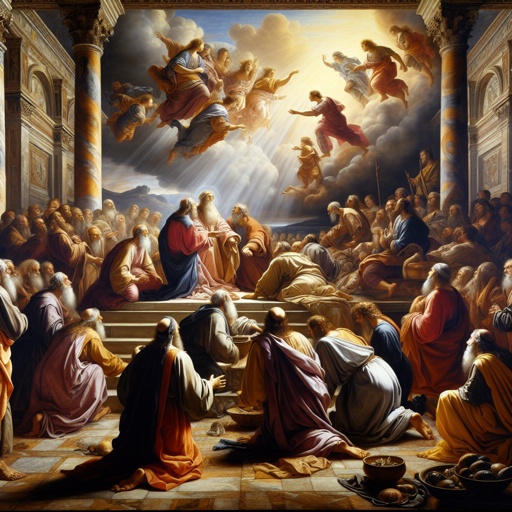
1 Samuel 17:49

2 Samuel 1. 17-27
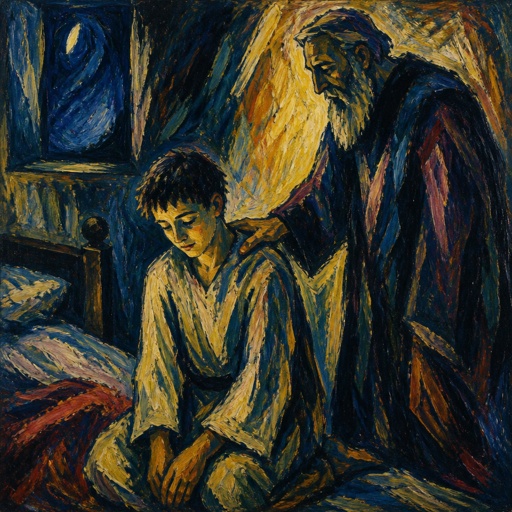
1 Samuel 3:17-18

1 Samuel 17:14 - "And David was the youngest: and the three eldest followed Saul."

1 Samuel 17:45-49

1 Samuel 25:40 - "And when the servants of David were come to Abigail to Carmel, they spake unto her, saying, David sent us unto thee, to take thee to him to wife."

1 Samuel 17:56 - "And the king said, Enquire thou whose son the stripling is."

1 Samuel 9:17 - "And when Samuel saw Saul, the LORD said unto him, Behold the man whom I spake to thee of! this same shall reign over my people."

2 Samuel 1:17 - "¶ And David lamented with this lamentation over Saul and over Jonathan his son:"

1 Samuel 17:19 - "Now Saul, and they, and all the men of Israel, were in the valley of Elah, fighting with the Philistines."

1 Samuel 17:29 - "And David said, What have I now done? Is there not a cause?"
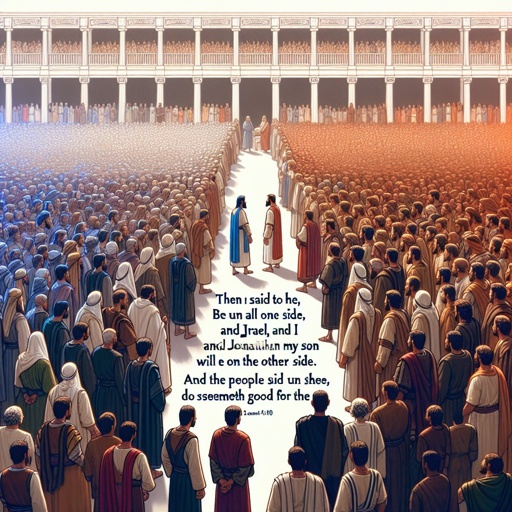
1 Samuel 14:40 - "Then said he unto all Israel, Be ye on one side, and I and Jonathan my son will be on the other side. And the people said unto Saul, Do what seemeth good unto thee."

"¶ And Samuel called the people together unto the LORD to Mizpeh;" - 1 Samuel 10:17

1 Samuel 17:53 - "And the children of Israel returned from chasing after the Philistines, and they spoiled their tents."

1 Samuel 17:21 - "For Israel and the Philistines had put the battle in array, army against army."