What does 2 Chronicles 9:28 mean?
“And they brought unto Solomon horses out of Egypt, and out of all lands.” — 2 Chronicles 9:28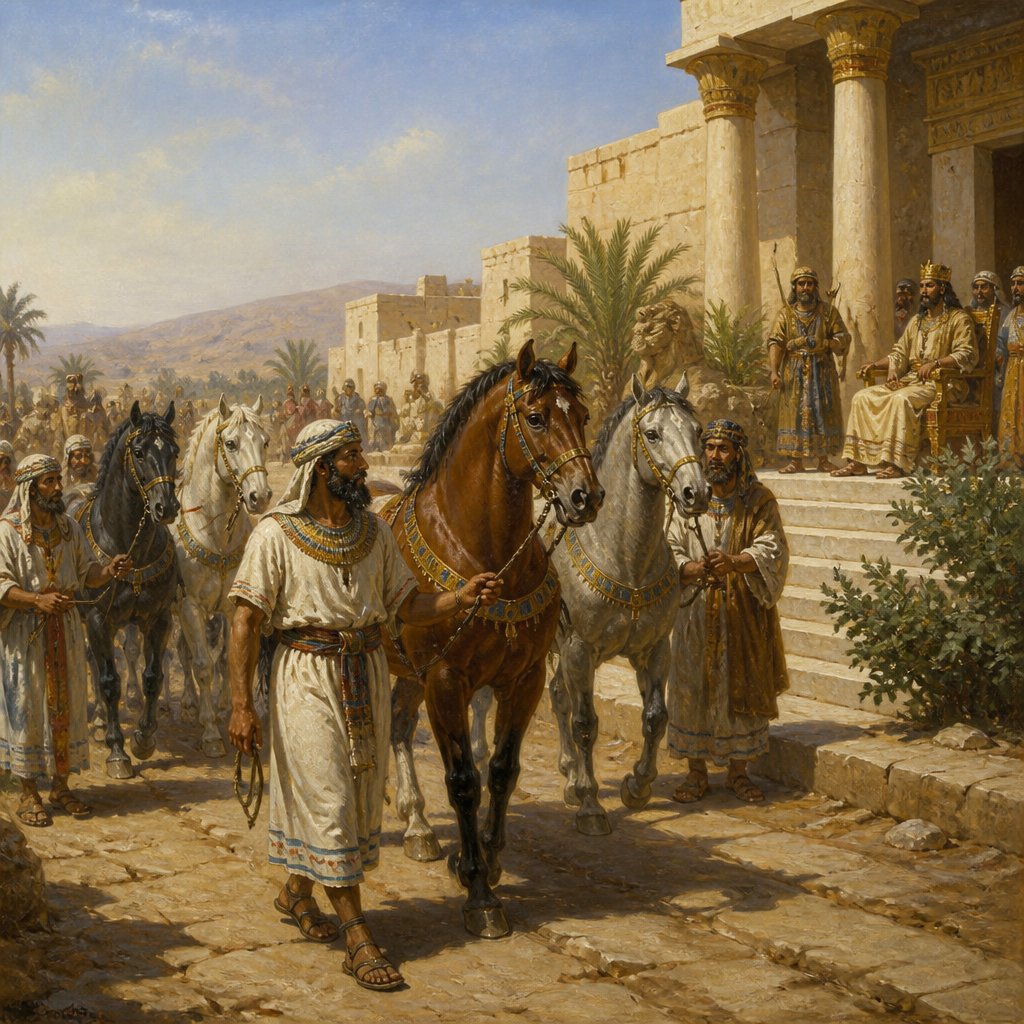
2 Chronicles 9:28 (KJV) reads, "And they brought unto Solomon horses out of Egypt, and out of all lands."
This verse comes from the Old Testament in the Bible, specifically from the book of 2 Chronicles, which is part of the historical books. This verse is part of the description of Solomon's prosperity and wisdom, and it highlights the extent of his wealth and influence.
In this verse, the mention of horses being brought to Solomon from Egypt and "all lands" serves as a demonstration of the vast resources and power at Solomon's disposal. Horses were highly prized and valuable in ancient times, and having them brought from Egypt and other lands indicates the extent of Solomon's reach and authority. It was common for kings and rulers to acquire horses from foreign countries to strengthen their military and demonstrate their wealth and influence. The presence of these horses in Solomon's kingdom would have been a symbol of his power and prestige.
In a broader context, this verse speaks to the themes of wealth, power, and international relations. Solomon was known for his wisdom and his ability to govern and lead his kingdom effectively. His success and prosperity were attributed to his close relationship with God and his adherence to God's commandments. The mention of the horses being brought from Egypt and other lands underscores Solomon's authority and influence as a king, as well as his ability to maintain positive relationships with neighboring nations.
The symbolism of the horses can also be interpreted in a spiritual sense. Horses are often associated with strength, speed, and freedom. In ancient times, they were essential for transportation, trade, and warfare. In the Bible, horses are mentioned in various contexts, often symbolizing strength and military power. In this verse, the horses brought to Solomon could symbolize the strength and security of his kingdom, as well as the prosperity and blessings that God had bestowed upon him.
Furthermore, the mention of horses being brought from Egypt holds symbolic significance. In the Bible, Egypt is often associated with bondage, captivity, and the struggle for liberation. The Israelites were enslaved in Egypt before their exodus, and Egypt frequently represents the forces of oppression and hardship. Solomon's ability to acquire horses from Egypt could be seen as a demonstration of his triumph over adversity and his ability to overcome the challenges of the world.
Overall, 2 Chronicles 9:28 is a testament to Solomon's wealth, power, and influence as a king. It showcases the extent of his resources and the relationships he maintained with other nations. The symbolism of the horses being brought from Egypt and other lands speaks to the themes of strength, prosperity, and triumph over adversity. This verse serves as a reminder of God's faithfulness and the rewards that come from following His commandments. It also underscores the importance of wise and diplomatic leadership in international relations.
Get our apps


Artwork for 2 Chronicles 9:28

2 Chronicles 9:28 - "And they brought unto Solomon horses out of Egypt, and out of all lands."

"And they brought unto Solomon horses out of Egypt, and out of all lands." - 2 Chronicles 9:28

1 Chronicles 9:28 - "And certain of them had the charge of the ministering vessels, that they should bring them in and out by tale."

2 Chronicles 28:3

2 Chronicles 20:28

2 Chronicles 28:2 - "For he walked in the ways of the kings of Israel, and made also molten images for Baalim."

2 Chronicles 20:28 - "And they came to Jerusalem with psalteries and harps and trumpets unto the house of the LORD."

1 Chronicles 2:28 - "And the sons of Onam were, Shammai, and Jada. And the sons of Shammai; Nadab, and Abishur."

2 Chronicles 28:17 - "For again the Edomites had come and smitten Judah, and carried away captives."

2 Chronicles 28:14 - "So the armed men left the captives and the spoil before the princes and all the congregation."

2 Chronicles 18:28 - "So the king of Israel and Jehoshaphat the king of Judah went up to Ramoth-gilead."

2 Chronicles 28:16 - "¶ At that time did king Ahaz send unto the kings of Assyria to help him."

2 Chronicles 25:28 - "And they brought him upon horses, and buried him with his fathers in the city of Judah."

2 Chronicles 18:9

2 Chronicles 18:9

2 Chronicles 21:9

2 Chronicles 11:9 - "And Adoraim, and Lachish, and Azekah,"

2 Chronicles 28:20 - "And Tilgath-pilneser king of Assyria came unto him, and distressed him, but strengthened him not."

2 Chronicles 28:9 - "But a prophet of the LORD was there, whose name was Oded: and he went out before the host that came to Samaria, and said unto them, Behold, because the LORD God of your fathers was wroth with Judah, he hath delivered them into your hand, and ye have slain them in a rage that reacheth up unto heaven."

2 Chronicles 28:22 - "¶ And in the time of his distress did he trespass yet more against the LORD: this is that king Ahaz."

2 Chronicles 28:4 - "He sacrificed also and burnt incense in the high places, and on the hills, and under every green tree."

2 Kings 23:28 - "Now the rest of the acts of Josiah, and all that he did, are they not written in the book of the chronicles of the kings of Judah?"

2 Chronicles 32:28 - "Storehouses also for the increase of corn, and wine, and oil; and stalls for all manner of beasts, and cotes for flocks."

2 Chronicles 29:28 - "And all the congregation worshipped, and the singers sang, and the trumpeters sounded: and all this continued until the burnt offering was finished."

2 Chronicles 28:7 - "And Zichri, a mighty man of Ephraim, slew Maaseiah the king's son, and Azrikam the governor of the house, and Elkanah that was next to the king."

"And certain of them had the charge of the ministering vessels, that they should bring them in and out by tale." - 1 Chronicles 9:28

2 Chronicles 31:9 - "Then Hezekiah questioned with the priests and the Levites concerning the heaps."

2 Chronicles 28:26 - "¶ Now the rest of his acts and of all his ways, first and last, behold, they are written in the book of the kings of Judah and Israel."

2 Chronicles 9:30 - "And Solomon reigned in Jerusalem over all Israel forty years."

2 Chronicles 6:28 - "¶ If there be dearth in the land, if there be pestilence, if there be blasting, or mildew, locusts, or caterpillers; if their enemies besiege them in the cities of their land; whatsoever sore or whatsoever sickness there be:"