What does 2 Kings 10:1 mean?
“And Ahab had seventy sons in Samaria. And Jehu wrote letters, and sent to Samaria, unto the rulers of Jezreel, to the elders, and to them that brought up Ahab’s children, saying,” — 2 Kings 10:1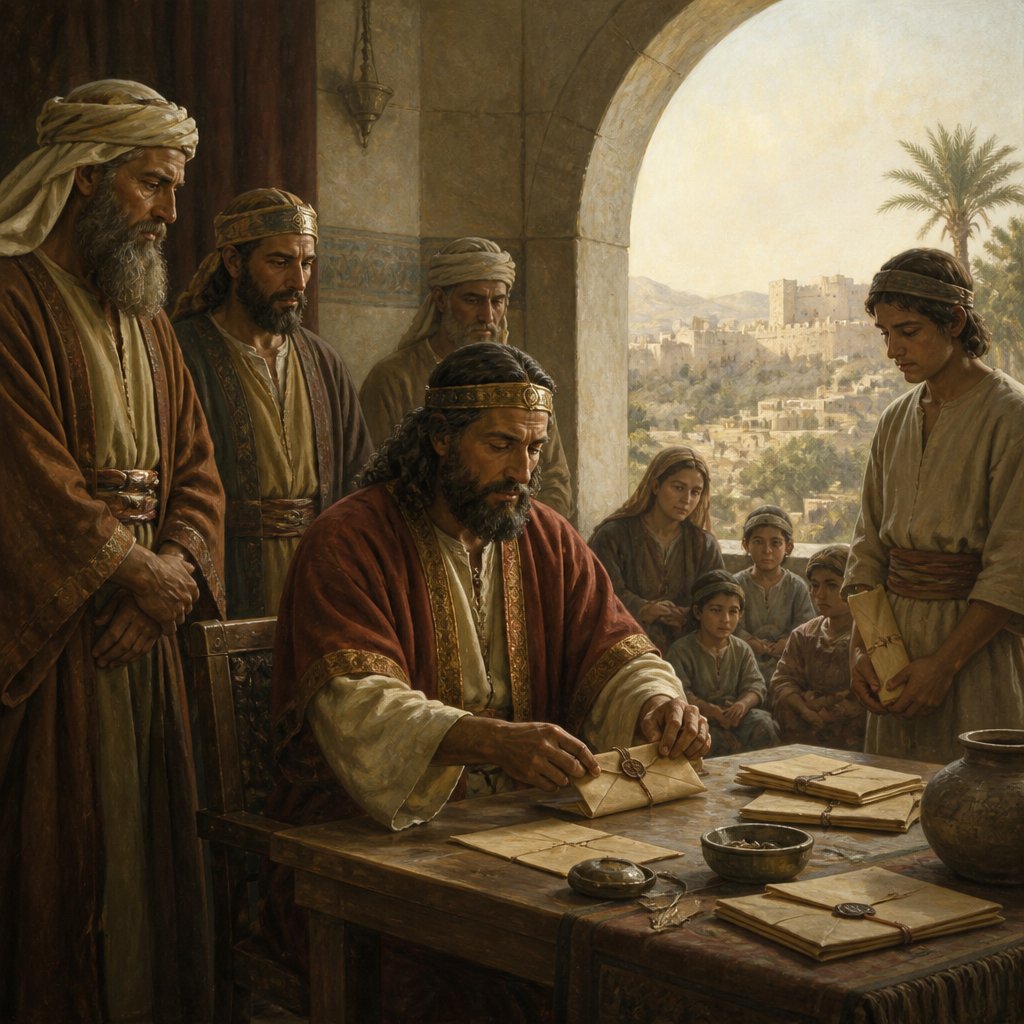
The verse 2 Kings 10:1 in the King James Version of the Bible states: "And Ahab had seventy sons in Samaria. And Jehu wrote letters, and sent to Samaria, unto the rulers of Jezreel, to the elders, and to them that brought up Ahab's children, saying," This verse is part of the larger narrative in the book of 2 Kings recounting the reign of the kings of Israel and Judah, particularly during the time of the prophet Elisha.
In this verse, we are presented with a complex and politically charged situation. Ahab, the king of Israel, had seventy sons in Samaria. This large number of sons indicates wealth, power, and a strong royal lineage. However, the presence of so many sons also hints at potential political instability and struggle for power within the kingdom.
Jehu, who was anointed as king of Israel by the prophet Elisha, saw the potential threat posed by Ahab's sons. To consolidate his own power and eliminate any potential rivals, Jehu took a bold and decisive action. He wrote letters to the rulers of Jezreel, the elders, and those who brought up Ahab's children, likely instructing them to take action against Ahab's sons.
The context of this verse is crucial to understanding its significance. Ahab and his wife Jezebel were infamous for promoting the worship of Baal and Asherah, two false gods, and for their oppression of the prophets of the true God, Yahweh. Under Ahab's rule, Israel had strayed far from the worship of Yahweh and was steeped in idolatry and corruption.
Jehu's rise to power was marked by his zealous commitment to purging the land of idolatry and upholding the worship of Yahweh. His actions, including the destruction of the temple of Baal and the slaughter of the priests and followers of Baal, were carried out with ruthless determination. In this context, his decision to eliminate Ahab's sons serves the purpose of eradicating any remaining vestiges of Ahab and Jezebel's influence from the kingdom.
Symbolically, this verse demonstrates the consequences of disobedience and idolatry. Ahab and his descendants faced the judgment of God due to their rejection of the true God and their leading the people of Israel into sin. The number seventy is significant in biblical numerology, symbolizing completeness and perfection. The large number of Ahab's sons suggests a full measure of his posterity, and Jehu's actions can be seen as the decisive end to Ahab's dynasty.
The themes of divine judgment, political power, and the sovereignty of God are central to this verse. Ahab's reign and his descendants' subsequent fate serve as a cautionary tale of the consequences of turning away from God and embracing idolatry. Jehu's actions, though brutal, can be interpreted as an instrument of God's justice and a means of restoring the purity of worship in Israel.
In conclusion, 2 Kings 10:1 presents a pivotal moment in the biblical narrative, reflecting the interplay of power, politics, and divine judgment. It offers a cautionary tale about the dangers of idolatry and the certainty of God's judgment. The verse also highlights the complex dynamics of leadership and the ruthless measures taken to secure and maintain power. Ultimately, it serves as a reminder of the sovereignty of God and the importance of obedience to His commandments.
Get our apps


Artwork for 2 Kings 10:1

2 Kings 10:1 - "And Ahab had seventy sons in Samaria. And Jehu wrote letters, and sent to Samaria, unto the rulers of Jezreel, to the elders, and to them that brought up Ahab's children, saying,"
"And Ahab had seventy sons in Samaria. And Jehu wrote letters, and sent to Samaria, unto the rulers of Jezreel, to the elders, and to them that brought up Ahab's children, saying," - 2 Kings 10:1

1 Kings 10:1

1 kings 10:1

1 Kings 10:1

1 Kings 2:10 - "So David slept with his fathers, and was buried in the city of David."

1 Kings 10:1 - "And when the queen of Sheba heard of the fame of Solomon concerning the name of the LORD, she came to prove him with hard questions."

1 Kings 10:23 - "So king Solomon exceeded all the kings of the earth for riches and for wisdom."

"So David slept with his fathers, and was buried in the city of David." - 1 Kings 2:10

1 Kings 8:10

1 Kings 12:10

1 Kings 12:10

1 Kings 8:10

1 Kings 8:10

1 Kings 12:10

1 Kings 8:10

1 Kings 8:10

1 Kings 12:10

1 Kings 8:10

1 Kings 8:10

2 Kings 3:10 - "And the king of Israel said, Alas! that the LORD hath called these three kings together, to deliver them into the hand of Moab!"

2 Kings 10:28 - "Thus Jehu destroyed Baal out of Israel."

2 Kings 21:10 - "¶ And the LORD spake by his servants the prophets, saying,"

2 Kings 10:4 - "But they were exceedingly afraid, and said, Behold, two kings stood not before him: how then shall we stand?"

1 Kings 10:15 - "Beside that he had of the merchantmen, and of the traffick of the spice merchants, and of all the kings of Arabia, and of the governors of the country."

2 Kings 10:34 - "Now the rest of the acts of Jehu, and all that he did, and all his might, are they not written in the book of the chronicles of the kings of Israel?"

2 Kings 10:20 - "And Jehu said, Proclaim a solemn assembly for Baal. And they proclaimed it."

1 Kings 10:2 - "And she came to Jerusalem with a very great train, with camels that bare spices, and very much gold, and precious stones: and when she was come to Solomon, she communed with him of all that was in her heart."

1 Kings 1:10 - "But Nathan the prophet, and Benaiah, and the mighty men, and Solomon his brother, he called not."

"Thus Jehu destroyed Baal out of Israel." - 2 Kings 10:28