What does 2 Kings 10:9 mean?
“And it came to pass in the morning, that he went out, and stood, and said to all the people, Ye be righteous: behold, I conspired against my master, and slew him: but who slew all these?” — 2 Kings 10:9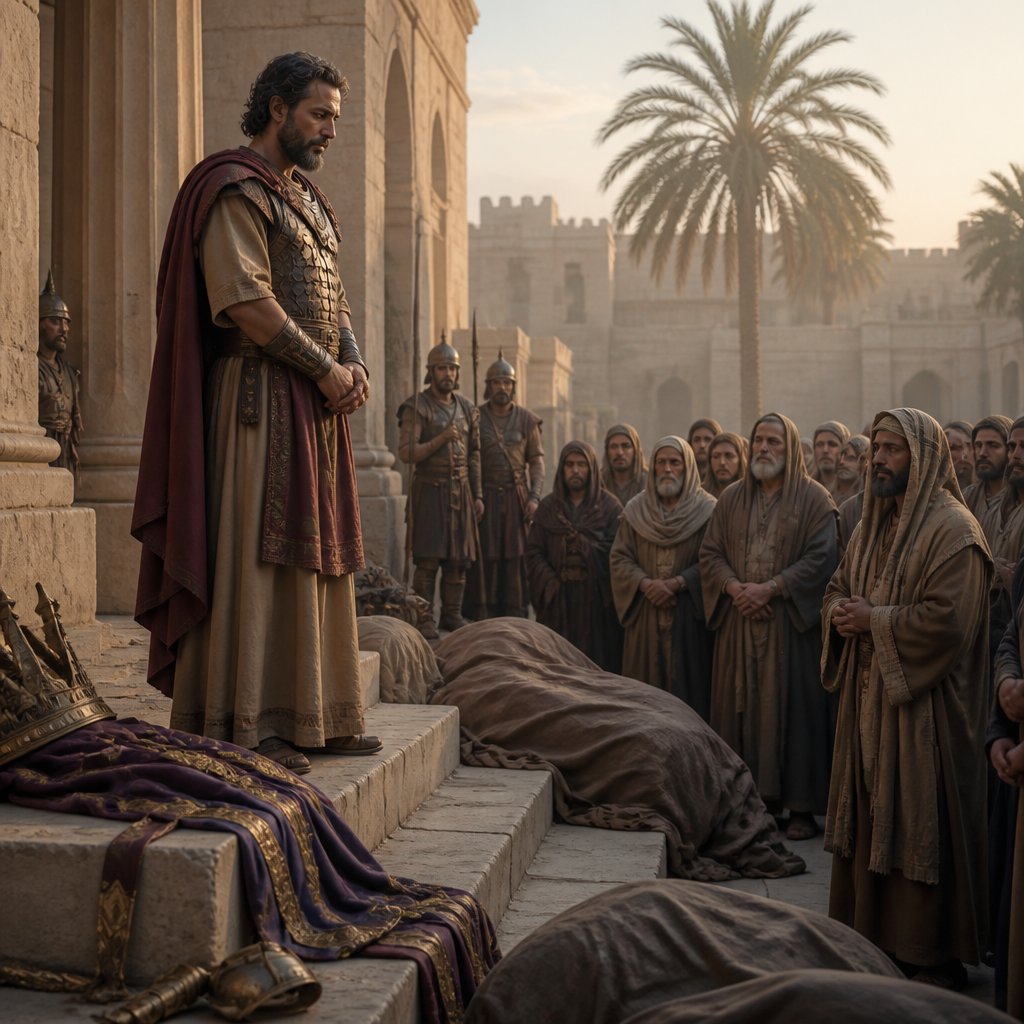
The Bible verse 2 Kings 10:9, found in the Old Testament, states: "And it came to pass in the morning, that he went out, and stood, and said to all the people, Ye be righteous: behold, I conspired against my master, and slew him: but who slew all these?"
This verse is part of the story of Jehu, who was anointed as king of Israel by the prophet Elisha. Jehu was given a specific mission to carry out God's judgment against the house of Ahab, specifically to eliminate all of Ahab's descendants, as well as the prophets and followers of Baal. In this particular verse, Jehu is using deceptive tactics to gather the followers of Baal in order to execute them.
The themes present in this verse include deception, judgement, and obedience to God. Throughout the chapter, Jehu is seen as carrying out the will of God by eliminating the followers of Baal, but he does so through deceit and manipulation. This raises questions about the morality of his actions and whether the end justifies the means. It also serves as a warning about the dangers of using deception in the service of what one believes to be a righteous cause.
The context of this verse is important for understanding its significance. Jehu's actions are part of a larger narrative of the struggle between the worship of Yahweh and the worship of Baal in ancient Israel. Ahab and his wife Jezebel had promoted the worship of Baal, and their influence had led many Israelites astray. Jehu's mission to eradicate the worship of Baal is thus seen as crucial for the spiritual purity and obedience of the people of Israel.
The imagery and symbolism in this verse also hold significance. The use of the morning as the setting for Jehu's speech to the people is symbolic of a new beginning, a new era for Israel. Jehu's words are a call for righteousness and an assertion of his own righteousness, despite the deceitful means by which he has carried out his mission. This reflects the theme of moral ambiguity and the complex nature of carrying out God's will in a fallen world.
The act of Jehu conspiring against his master and slaying him, as mentioned in the verse, is a symbol of the judgment and punishment that God has decreed for the house of Ahab. Jehu sees himself as an instrument of God's justice, despite the deceit and violence involved in his actions. This raises important questions about the nature of divine judgment and the role of human agency in carrying out God's will.
In conclusion, 2 Kings 10:9 is a verse that raises important moral, ethical, and theological questions. It speaks to the themes of deception, judgment, and obedience to God, within the context of the larger narrative of the struggle between the worship of Yahweh and the worship of Baal in ancient Israel. The imagery and symbolism in the verse highlight the complexity of carrying out God's will and the moral ambiguity that can arise in the process. It serves as a reminder of the need for discernment and ethical integrity in the service of righteousness.
Get our apps


Artwork for 2 Kings 10:9

2 Kings 10:9 - "And it came to pass in the morning, that he went out, and stood, and said to all the people, Ye be righteous: behold, I conspired against my master, and slew him: but who slew all these?"
"And it came to pass in the morning, that he went out, and stood, and said to all the people, Ye be righteous: behold, I conspired against my master, and slew him: but who slew all these?" - 2 Kings 10:9

2 Kings 9:10 - "And the dogs shall eat Jezebel in the portion of Jezreel, and there shall be none to bury her. And he opened the door, and fled."

2 kings 9:34-36

2 Kings 3:10 - "And the king of Israel said, Alas! that the LORD hath called these three kings together, to deliver them into the hand of Moab!"

1 Kings 10:9 - "Blessed be the LORD thy God, which delighted in thee, to set thee on the throne of Israel: because the LORD loved Israel for ever, therefore made he thee king, to do judgment and justice."

Titus 2:9-10

Titus 2:9-10

1 Kings 9:10 - "¶ And it came to pass at the end of twenty years, when Solomon had built the two houses, the house of the LORD, and the king's house,"

2 Kings 10:28 - "Thus Jehu destroyed Baal out of Israel."

Joshua 9:10 - "And all that he did to the two kings of the Amorites, that were beyond Jordan, to Sihon king of Heshbon, and to Og king of Bashan, which was at Ashtaroth."

"And the dogs shall eat Jezebel in the portion of Jezreel, and there shall be none to bury her. And he opened the door, and fled." - 2 Kings 9:10

2 Chronicles 9:22 - "And king Solomon passed all the kings of the earth in riches and wisdom."

2 Kings 21:10 - "¶ And the LORD spake by his servants the prophets, saying,"

2 Kings 10:4 - "But they were exceedingly afraid, and said, Behold, two kings stood not before him: how then shall we stand?"

2 Kings 9:9 - "And I will make the house of Ahab like the house of Jeroboam the son of Nebat, and like the house of Baasha the son of Ahijah:"

2 Kings 10:34 - "Now the rest of the acts of Jehu, and all that he did, and all his might, are they not written in the book of the chronicles of the kings of Israel?"

2 Kings 10:20 - "And Jehu said, Proclaim a solemn assembly for Baal. And they proclaimed it."
2 Corinthians 12:9-10

"Thus Jehu destroyed Baal out of Israel." - 2 Kings 10:28

1 Kings 2:10 - "So David slept with his fathers, and was buried in the city of David."

2 Kings 10:26 - "And they brought forth the images out of the house of Baal, and burned them."

2 Kings 10:12 - "¶ And he arose and departed, and came to Samaria. And as he was at the shearing house in the way,"

Psalms 2:10 - "Be wise now therefore, O ye kings: be instructed, ye judges of the earth."

2 Kings 10:36 - "And the time that Jehu reigned over Israel in Samaria was twenty and eight years."

2 Kings 24:10 - "¶ At that time the servants of Nebuchadnezzar king of Babylon came up against Jerusalem, and the city was besieged."

2 Kings 9:4 - "¶ So the young man, even the young man the prophet, went to Ramoth-gilead."

2 Kings 9:23 - "And Joram turned his hands, and fled, and said to Ahaziah, There is treachery, O Ahaziah."

2 Kings 9:29 - "And in the eleventh year of Joram the son of Ahab began Ahaziah to reign over Judah."

2 Corinthians 10:9 - "That I may not seem as if I would terrify you by letters."