What does 2 Kings 21:3 mean?
“For he built up again the high places which Hezekiah his father had destroyed; and he reared up altars for Baal, and made a grove, as did Ahab king of Israel; and worshipped all the host of heaven, and served them.” — 2 Kings 21:3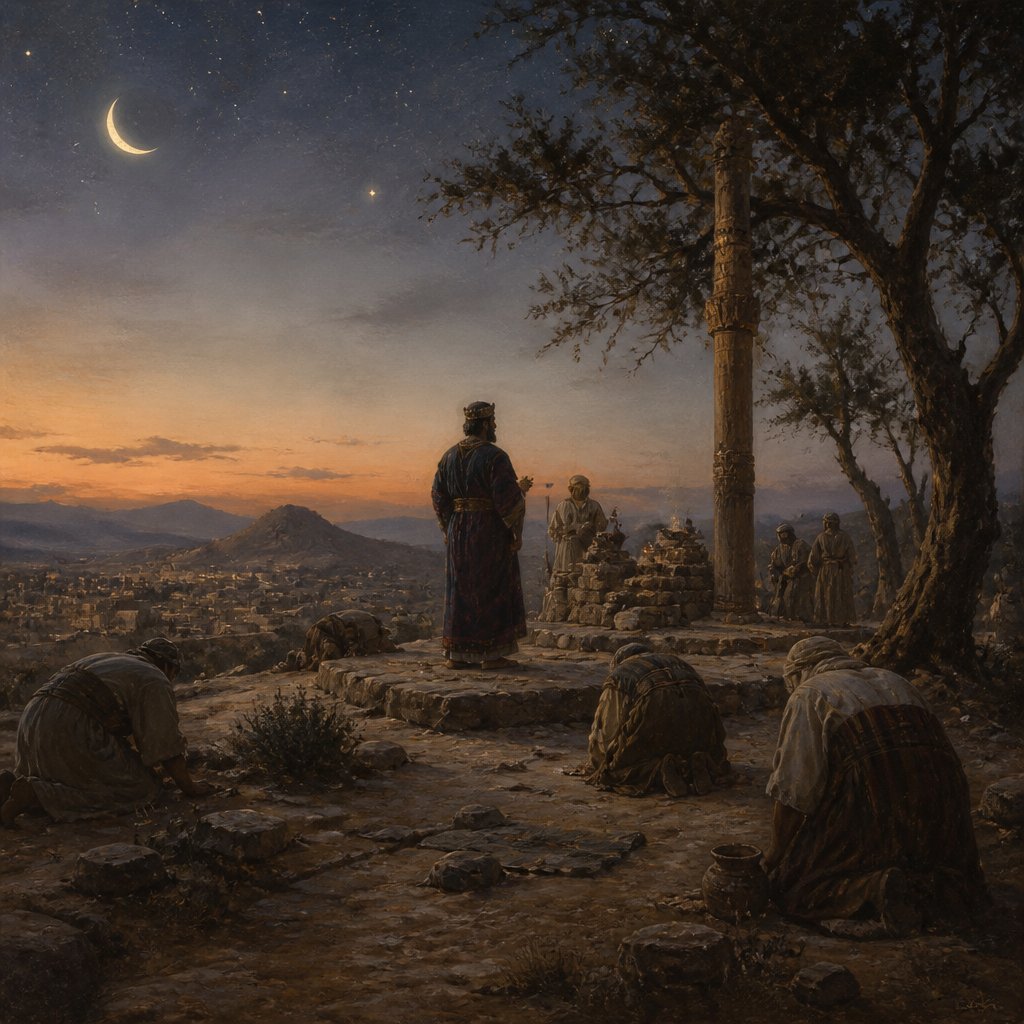
2 Kings 21:3 (KJV) reads: "For he built up again the high places which Hezekiah his father had destroyed; and he reared up altars for Baal, and made a grove, as did Ahab king of Israel; and worshipped all the host of heaven, and served them."
This verse is part of a larger narrative about the reign of King Manasseh, who became king of Judah at the young age of 12 and ruled for 55 years. This is the longest reign of any king in the history of Judah. The verse describes how Manasseh, in his efforts to consolidate and maintain his power, engaged in a significant departure from the religious reforms of his father, Hezekiah. He rebuilt the high places which Hezekiah had destroyed, erected altars for the pagan god Baal, constructed an Asherah pole (a wooden image used in the worship of the Canaanite goddess Asherah), and worshipped the host of heaven - a practice associated with astrology and the worship of celestial bodies.
The context of this verse is critical for understanding its meaning and implications. Hezekiah, who was Manasseh's father, was a righteous king who instituted significant religious reforms in Judah. He removed all forms of idolatry and restored the worship of Yahweh in the temple in Jerusalem. However, his son Manasseh reversed these reforms, reintroducing the worship of foreign deities and engaging in syncretistic practices that combined elements of the worship of Yahweh with the worship of other gods.
This verse carries several important themes and messages. Firstly, it demonstrates the cyclical nature of faith and misbelief within the Israelite monarchy. Just as one king might institute reforms and turn the nation towards Yahweh, his successor might lead the people astray once again. This message serves as a cautionary tale, warning against the dangers of spiritual backsliding and apostasy.
Additionally, the verse underscores the persistent struggle between the worship of Yahweh and the allure of other gods. Throughout the Old Testament, the Israelites are repeatedly tempted to abandon their exclusive devotion to Yahweh and to embrace the religious practices of neighboring nations. The story of Manasseh serves as a potent illustration of this struggle, showing how even a king raised in the worship of Yahweh can succumb to the influences of foreign religions.
There is also a theme of the consequences of disobedience and idolatry woven throughout this verse. The Mosaic covenant emphasized the exclusive worship of Yahweh and prohibited the worship of other gods or idols. Manasseh's actions in erecting altars for foreign deities and engaging in the worship of celestial bodies constituted a direct violation of this covenant. The subsequent events of Manasseh's reign, including the prophecy of the nation's eventual destruction and the judgment that fell upon him, serve as a sobering reminder of the swift and severe consequences of turning away from Yahweh.
Symbolism plays a significant role in interpreting this verse. The rebuilding of the high places and the construction of altars for Baal and the Asherah pole represent a departure from the centralization of worship in Jerusalem and a return to the syncretistic and polytheistic practices of the Canaanites. These actions symbolize a rejection of exclusive devotion to Yahweh and a capitulation to the religious practices of foreign nations. The worship of the host of heaven likewise symbolizes a rejection of the transcendent sovereignty of Yahweh in favor of the worship of created elements.
In conclusion, 2 Kings 21:3 powerfully captures the tragic reversal of religious reforms and the consequences of idolatry during the reign of King Manasseh. It serves as a somber reflection on the cyclical nature of faith and misbelief, the persistent struggle between the worship of Yahweh and the allure of other gods, and the severe consequences of disobedience and idolatry. This verse is a poignant reminder of the importance of remaining steadfast in exclusive devotion to Yahweh and the dangers that arise from syncretism and the worship of other deities.
Get our apps


Artwork for 2 Kings 21:3

2 Kings 21:3 - "For he built up again the high places which Hezekiah his father had destroyed; and he reared up altars for Baal, and made a grove, as did Ahab king of Israel; and worshipped all the host of heaven, and served them."
"For he built up again the high places which Hezekiah his father had destroyed; and he reared up altars for Baal, and made a grove, as did Ahab king of Israel; and worshipped all the host of heaven, and served them." - 2 Kings 21:3

2 Kings 3:21 - "¶ And when all the Moabites heard that the kings were come up to fight against them, they gathered all that were able to put on armour, and upward, and stood in the border."

2 Kings 2:21

2 Kings 15:21 - "¶ And the rest of the acts of Menahem, and all that he did, are they not written in the book of the chronicles of the kings of Israel?"

2 Kings 21:25 - "Now the rest of the acts of Amon which he did, are they not written in the book of the chronicles of the kings of Judah?"

2 Kings 21:10 - "¶ And the LORD spake by his servants the prophets, saying,"

2 Kings 21:21 - "And he walked in all the way that his father walked in, and served the idols that his father served, and worshipped them:"

1 Kings 21:3 - "And Naboth said to Ahab, The LORD forbid it me, that I should give the inheritance of my fathers unto thee."

2 Kings 11:21 - "Seven years old was Jehoash when he began to reign."

2 Kings 21:17 - "¶ Now the rest of the acts of Manasseh, and all that he did, and his sin that he sinned, are they not written in the book of the chronicles of the kings of Judah?"

2 Kings 21:23 - "¶ And the servants of Amon conspired against him, and slew the king in his own house."
2 Kings 3:15

2 Kings 3:15

2 Kings 3:15

2 Kings 21:22 - "And he forsook the LORD God of his fathers, and walked not in the way of the LORD."

"¶ And when all the Moabites heard that the kings were come up to fight against them, they gathered all that were able to put on armour, and upward, and stood in the border." - 2 Kings 3:21

2 Kings 21:5 - "And he built altars for all the host of heaven in the two courts of the house of the LORD."

2 Kings 20:21 - "And Hezekiah slept with his fathers: and Manasseh his son reigned in his stead."

2 Kings 21:20 - "And he did that which was evil in the sight of the LORD, as his father Manasseh did."

1 Kings 2:21 - "And she said, Let Abishag the Shunammite be given to Adonijah thy brother to wife."

2 Kings 3:16-19

2 Kings 21:2 - "And he did that which was evil in the sight of the LORD, after the abominations of the heathen, whom the LORD cast out before the children of Israel."

2 Kings 3:10 - "And the king of Israel said, Alas! that the LORD hath called these three kings together, to deliver them into the hand of Moab!"

2 Kings 3:23 - "And they said, This is blood: the kings are surely slain, and they have smitten one another: now therefore, Moab, to the spoil."

2 Kings 21:26 - "And he was buried in his sepulchre in the garden of Uzza: and Josiah his son reigned in his stead."

2 Kings 23:21 - "¶ And the king commanded all the people, saying, Keep the passover unto the LORD your God, as it is written in the book of this covenant."

2 Kings 21:4 - "And he built altars in the house of the LORD, of which the LORD said, In Jerusalem will I put my name."

2 Kings 25:21 - "And the king of Babylon smote them, and slew them at Riblah in the land of Hamath. So Judah was carried away out of their land."

Daniel 2:21 - "And he changeth the times and the seasons: he removeth kings, and setteth up kings: he giveth wisdom unto the wise, and knowledge to them that know understanding:" respectful, symbolic bible verse art