What does 2 Kings 3:19 mean?
“And ye shall smite every fenced city, and every choice city, and shall fell every good tree, and stop all wells of water, and mar every good piece of land with stones.” — 2 Kings 3:19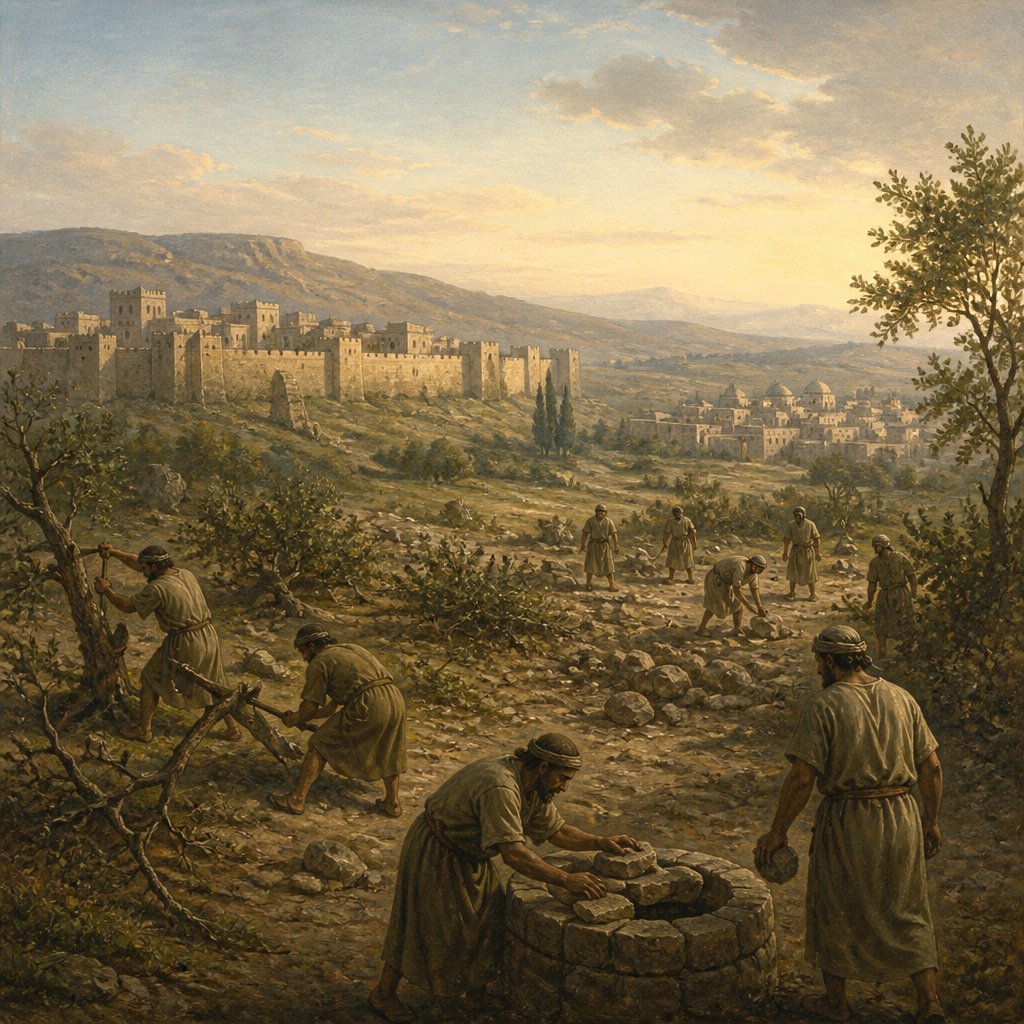
The Bible verse 2 Kings 3:19 from the King James Version (KJV) states, "And ye shall smite every fenced city, and every choice city, and shall fell every good tree, and stop all wells of water, and mar every good piece of land with stones."
This verse is part of the narrative of the confrontation between the kings of Israel, Judah, and Edom against the king of Moab. The Moabites had rebelled against the king of Israel, and the Israelites, along with their allies, sought to subdue them. The verse is an instruction from the prophet Elisha to the kings before they engage in battle against the Moabites.
The verse contains a series of instructions that involve the destruction of fortified cities, the cutting down of trees, the stopping up of wells, and the defacing of the land with stones. These instructions are given as a means to devastate the land of Moab and make it uninhabitable, thus crippling the Moabites and their ability to sustain themselves.
In a broader context, this verse raises questions about the ethics of warfare and the treatment of enemies during times of conflict. It presents a stark portrayal of the brutality and destruction that often accompany battles between nations. The deliberate destruction of infrastructure and resources, such as cities, trees, water sources, and land, is a tactic aimed at crippling the enemy and asserting dominance.
From a thematic perspective, this verse highlights the themes of power, domination, and conquest. It speaks to the harsh realities of war and the lengths to which nations and leaders will go in order to assert their authority and secure their interests. It also raises questions about the morality of such actions and the human cost of warfare.
Symbolically, the actions outlined in this verse can be seen as a representation of the devastating impact of conflict on both the land and its inhabitants. The destruction of cities, trees, and water sources symbolizes the disruption of the natural order and the devastation of communities. It serves as a cautionary reminder of the far-reaching consequences of war and the responsibility of leaders to consider the wellbeing of all those affected by their actions.
In a spiritual sense, this verse can also be interpreted as a metaphor for the inner battles that individuals face in their lives. The fortified cities and choice cities may represent the strongholds and defenses that people build around themselves, while the trees, water, and land symbolize the resources and vitality that sustain and nourish them. The instructions to destroy and disrupt these elements could be understood as a call to confront and overcome the personal obstacles and barriers that hinder spiritual growth and well-being.
Overall, 2 Kings 3:19 conveys a powerful message about the destructive nature of conflict and the ethical considerations that arise in times of war. It serves as a reminder of the need for wisdom, compassion, and accountability in the face of power struggles and the importance of seeking peaceful resolutions to disputes. It also invites reflection on the ways in which individuals and societies can cultivate resilience and healing in the aftermath of devastation.
Get our apps


Artwork for 2 Kings 3:19

2 Kings 3:19 - "And ye shall smite every fenced city, and every choice city, and shall fell every good tree, and stop all wells of water, and mar every good piece of land with stones."
"And ye shall smite every fenced city, and every choice city, and shall fell every good tree, and stop all wells of water, and mar every good piece of land with stones." - 2 Kings 3:19

2 Kings 3:16-19

2 Kings 19:3 - "And they said unto him, Thus saith Hezekiah, This day is a day of trouble, and of rebuke, and blasphemy: for the children are come to the birth, and there is not strength to bring forth."

1 Kings 3:19 - "And this woman's child died in the night; because she overlaid it."

2 Kings 19:2

2 Kings 19:2

2 Kings 19:2

2 Kings 3:15

2 Kings 3:15

2 Kings 3:15

2 Kings 19:17 - "Of a truth, LORD, the kings of Assyria have destroyed the nations and their lands,"

"And this woman's child died in the night; because she overlaid it." - 1 Kings 3:19

2 Kings 12:19 - "¶ And the rest of the acts of Joash, and all that he did, are they not written in the book of the chronicles of the kings of Judah?"

2 Kings 16:19 - "¶ Now the rest of the acts of Ahaz which he did, are they not written in the book of the chronicles of the kings of Judah?"

2 Kings 19:5 - "So the servants of king Hezekiah came to Isaiah."

2 Kings 19:36 - "So Sennacherib king of Assyria departed, and went and returned, and dwelt at Nineveh."

2 Kings 19:13 - "Where is the king of Hamath, and the king of Arpad, and the king of the city of Sepharvaim, of Hena, and Ivah?"

2 Kings 19:11 - "Behold, thou hast heard what the kings of Assyria have done to all lands, by destroying them utterly: and shalt thou be delivered?"

2 Kings 3:10 - "And the king of Israel said, Alas! that the LORD hath called these three kings together, to deliver them into the hand of Moab!"

2 Kings 19:2 - "And he sent Eliakim, which was over the household, and Shebna the scribe, and the elders of the priests, covered with sackcloth, to Isaiah the prophet the son of Amoz."

2 Kings 19:34 - "For I will defend this city, to save it, for mine own sake, and for my servant David's sake."

"Of a truth, LORD, the kings of Assyria have destroyed the nations and their lands," - 2 Kings 19:17

2 Kings 3:23 - "And they said, This is blood: the kings are surely slain, and they have smitten one another: now therefore, Moab, to the spoil."

1 Kings 19:3 - "And when he saw that, he arose, and went for his life, and came to Beer-sheba, which belongeth to Judah, and left his servant there."

2 Kings 24:19 - "And he did that which was evil in the sight of the LORD, according to all that Jehoiakim had done."

2 Kings 17:19 - "Also Judah kept not the commandments of the LORD their God, but walked in the statutes of Israel which they made."

2 Kings 3:6 - "¶ And king Jehoram went out of Samaria the same time, and numbered all Israel."

2 Kings 19:33 - "By the way that he came, by the same shall he return, and shall not come into this city, saith the LORD."

2 Kings 3:16 - "And he said, Thus saith the LORD, Make this valley full of ditches."