What does 2 Kings 3:4 mean?
“And Mesha king of Moab was a sheepmaster, and rendered unto the king of Israel an hundred thousand lambs, and an hundred thousand rams, with the wool.” — 2 Kings 3:4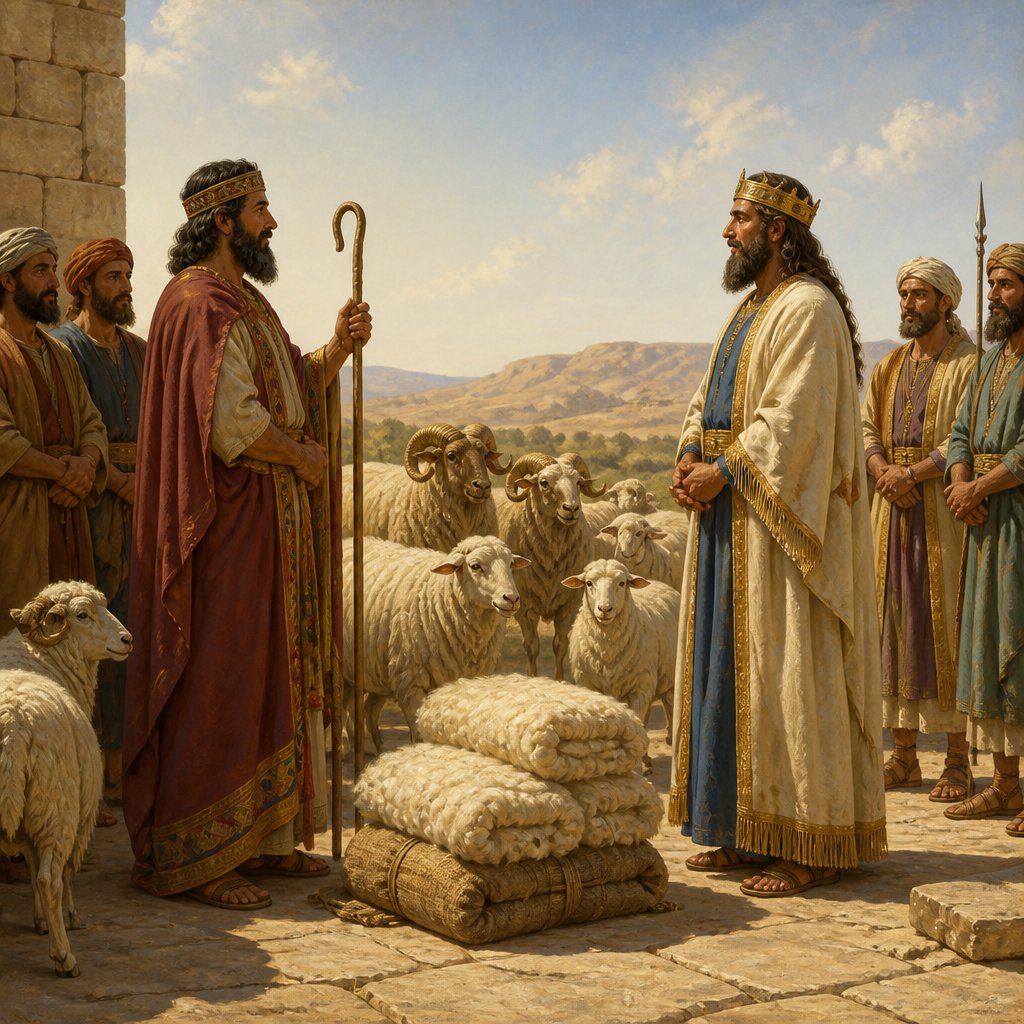
The Bible verse 2 Kings 3:4 in the King James Version reads, "And Mesha king of Moab was a sheepmaster, and rendered unto the king of Israel an hundred thousand lambs, and an hundred thousand rams with the wool." This verse is a part of the historical narrative in the Old Testament that describes the events during the reign of the kings of Israel and Judah.
To understand the full meaning and context of this verse, we must first look at the historical and cultural background. During this time, the nation of Israel was divided into two kingdoms, the northern kingdom of Israel and the southern kingdom of Judah. The Moabites, who were descendants of Lot and inhabited the region east of the Dead Sea, were often in conflict with the Israelites. This conflict stemmed from territorial disputes and historical animosities.
In 2 Kings 3, we find that the king of Moab, Mesha, had been paying tribute to the king of Israel, Jehoram. Tribute in ancient times was a form of payment or gift given to a ruling power as a sign of submission or allegiance. Mesha, as a shepherd, would give a large number of lambs and rams to the king of Israel as a part of this tribute. This exchange of tribute between Mesha and Jehoram is significant because it reflects the power dynamics and political relationships between neighboring kingdoms at that time.
The fact that Mesha was a sheepmaster is also important in understanding this verse. Mesha's occupation as a sheepmaster signifies his wealth and resources. He was able to offer a considerable amount of livestock as tribute to the king of Israel, demonstrating his prosperity and influence as a ruler. This also implies that the Moabite economy was largely dependent on animal husbandry and agricultural pursuits, particularly sheep farming.
Symbolically, the large number of lambs and rams offered as tribute by Mesha holds spiritual significance. In the Bible, lambs and rams are often associated with sacrifice and atonement. The act of giving these animals as tribute may serve as a metaphor for the need for reconciliation and peace between the Moabites and Israelites. It could be interpreted as a call for restoration and healing in the strained relationship between these neighboring nations.
From a thematic perspective, this verse ties into broader themes of power, diplomacy, and conflict resolution. It illustrates the complex political landscape of the ancient Near East and the interplay of power dynamics between rival nations. It also raises questions about the nature of tribute and allegiance, as well as the challenges of maintaining peace and stability in a region fraught with historical animosities and territorial disputes.
In summary, 2 Kings 3:4 offers a window into the historical and political realities of the ancient world. It provides insight into the dynamics of tribute and diplomacy between neighboring kingdoms, as well as the symbolic significance of the livestock offered by Mesha. It serves as a reminder of the complexities of international relations and the ongoing quest for reconciliation and peace.
Get our apps


Artwork for 2 Kings 3:4

2 Kings 3:4 - "¶ And Mesha king of Moab was a sheepmaster, and rendered unto the king of Israel an hundred thousand lambs, and an hundred thousand rams, with the wool."
"¶ And Mesha king of Moab was a sheepmaster, and rendered unto the king of Israel an hundred thousand lambs, and an hundred thousand rams, with the wool." - 2 Kings 3:4

2 Kings 4:3 - "Then he said, Go, borrow thee vessels abroad of all thy neighbours, even empty vessels; borrow not a few."

2 Kings 3:15

2 Kings 3:15

2 Kings 3:15

2 Kings 3:16-19

2 Kings 4:4-5

1 Kings 4:3 - "Elihoreph and Ahiah, the sons of Shisha, scribes; Jehoshaphat the son of Ahilud, the recorder."

1 Kings 3:4 - "And the king went to Gibeon to sacrifice there; for that was the great high place: a thousand burnt offerings did Solomon offer upon that altar."

2 Kings 3:10 - "And the king of Israel said, Alas! that the LORD hath called these three kings together, to deliver them into the hand of Moab!"

2 Kings 3:23 - "And they said, This is blood: the kings are surely slain, and they have smitten one another: now therefore, Moab, to the spoil."

2 Kings 3:6 - "¶ And king Jehoram went out of Samaria the same time, and numbered all Israel."

2 Kings 10:4 - "But they were exceedingly afraid, and said, Behold, two kings stood not before him: how then shall we stand?"

2 Kings 3:16 - "And he said, Thus saith the LORD, Make this valley full of ditches."

Matthew 2:3-4

Matthew 2:3-4

Matthew 2:3-4

Matthew 2:3-4

2 Kings 3:3 - "Nevertheless he cleaved unto the sins of Jeroboam the son of Nebat, which made Israel to sin; he departed not therefrom."

"Then he said, Go, borrow thee vessels abroad of all thy neighbours, even empty vessels; borrow not a few." - 2 Kings 4:3

2 Kings 3:5 - "But it came to pass, when Ahab was dead, that the king of Moab rebelled against the king of Israel."

2 Kings 4:11 - "And it fell on a day, that he came thither, and he turned into the chamber, and lay there."

1 Kings 4:2 - "And these were the princes which he had; Azariah the son of Zadok the priest,"

2 Kings 9:4 - "¶ So the young man, even the young man the prophet, went to Ramoth-gilead."

2 Kings 6:4 - "So he went with them. And when they came to Jordan, they cut down wood."

2 Corinthians 1:3-4

2 Kings 3:18 - "And this is but a light thing in the sight of the LORD: he will deliver the Moabites also into your hand."

2 Kings 25:3 - "And on the ninth day of the fourth month the famine prevailed in the city, and there was no bread for the people of the land."

2 Kings 3:21 - "¶ And when all the Moabites heard that the kings were come up to fight against them, they gathered all that were able to put on armour, and upward, and stood in the border."