What does 2 Samuel 1:25 mean?
“How are the mighty fallen in the midst of the battle! O Jonathan, thou wast slain in thine high places.” — 2 Samuel 1:25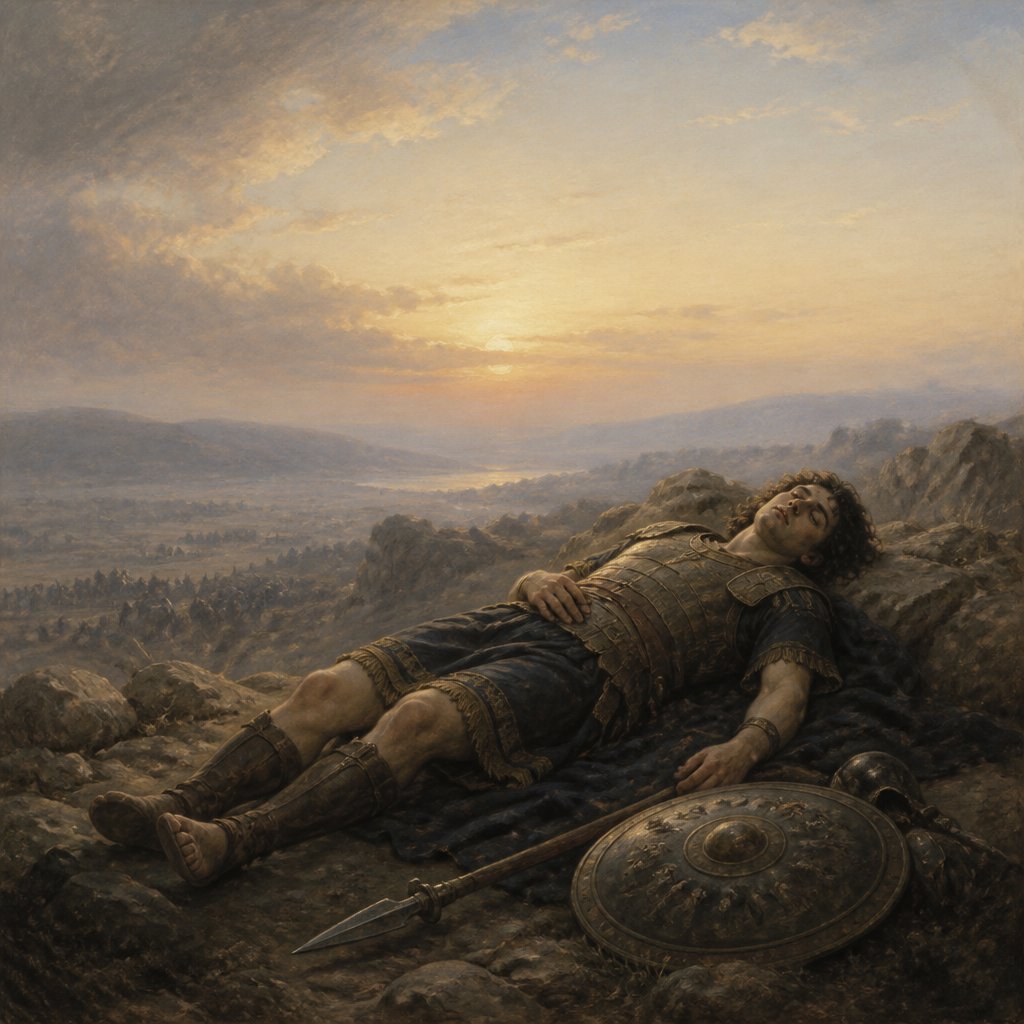
2 Samuel 1:25 (KJV) says, "How are the mighty fallen in the midst of the battle! O Jonathan, thou wast slain in thine high places."
This verse is part of a lament that David sings upon hearing of the deaths of King Saul and his son Jonathan. The context of this verse is important for understanding its meaning. David and Jonathan were close friends, despite the fact that Jonathan's father Saul was David's sworn enemy. The deaths of Saul and Jonathan were deeply tragic for David, and this lament expresses his grief, as well as his admiration for the fallen warriors.
The phrase "How are the mighty fallen in the midst of the battle!" serves as a way for David to mourn the loss of Saul and Jonathan, who were once powerful and influential leaders. The word "mighty" captures the strength and authority they once held, but now they have been brought low by their deaths on the battlefield. The use of the word "fallen" emphasizes their sudden and tragic demise, as well as the loss of their leadership and protection for the people of Israel.
The second part of the verse, "O Jonathan, thou wast slain in thine high places," further emphasizes the tragedy of Jonathan's death. Jonathan was not only a mighty warrior, but also a son of royalty. His "high places" refer to his elevated status and position within society. The fact that he was slain in such a lofty position adds to the irony and sorrow of his death. It highlights the unpredictability and cruelty of war, as even those in positions of privilege and power are not exempt from its devastation.
One of the key themes of this verse is the fleeting nature of human strength and power. It serves as a reminder that even the mightiest individuals are subject to mortality and can be cut down in an instant. This sentiment is echoed throughout the Bible, such as in the book of Psalms, which describes the brevity of human life and the inevitability of death.
Another important theme in this verse is the human experience of grief and mourning. David's lament is a powerful expression of his emotional response to the loss of his dear friend and the tragic deaths of Saul and Jonathan. This verse captures the universal experience of mourning for loved ones, and serves as a poignant reminder of the pain and sorrow that accompanies death.
The symbolism in this verse is also worth noting. The image of fallen warriors in the midst of battle conjures up powerful and evocative imagery. It represents the chaos and carnage of war, as well as the untimely deaths of those who were once strong and brave. The use of the word "fallen" also carries a sense of downfall or defeat, adding to the tragic tone of the verse.
Overall, 2 Samuel 1:25 is a poignant and moving expression of grief and lamentation. It captures the universal experience of mourning for the loss of loved ones, as well as the transient nature of human strength and power. Through this verse, we are reminded of the fragility of life, the inevitability of death, and the enduring emotions of sorrow and loss that accompany it.
Get our apps


Artwork for 2 Samuel 1:25

2 Samuel 1:25 - "How are the mighty fallen in the midst of the battle! O Jonathan, thou wast slain in thine high places."
"How are the mighty fallen in the midst of the battle! O Jonathan, thou wast slain in thine high places." - 2 Samuel 1:25

1 Samuel 1:25 - "And they slew a bullock, and brought the child to Eli."

2 Samuel 23:25 - "Shammah the Harodite, Elika the Harodite,"

2 Samuel 20:25 - "And Sheva was scribe: and Zadok and Abiathar were the priests:"

1 Samuel 25:2 - "And there was a man in Maon, whose possessions were in Carmel; and the man was very great, and he had three thousand sheep, and a thousand goats: and he was shearing his sheep in Carmel."

2 Samuel 1. 17-27

1 Samuel 9:25 - "¶ And when they were come down from the high place into the city, Samuel communed with Saul upon the top of the house."

"And they slew a bullock, and brought the child to Eli." - 1 Samuel 1:25

1 Samuel 25:1 - "And Samuel died; and all the Israelites were gathered together, and lamented him, and buried him in his house at Ramah. And David arose, and went down to the wilderness of Paran."

2 Samuel 2:25 - "¶ And the children of Benjamin gathered themselves together after Abner, and became one troop, and stood on the top of an hill."

1 Samuel 10:25 - "Then Samuel told the people the manner of the kingdom, and wrote it in a book, and laid it up before the LORD. And Samuel sent all the people away, every man to his house."

1 Samuel 14:25 - "And all they of the land came to a wood; and there was honey upon the ground."

1 Samuel 25:4 - "¶ And David heard in the wilderness that Nabal did shear his sheep."

"Shammah the Harodite, Elika the Harodite," - 2 Samuel 23:25
1 Samuel 2:25 - "If one man sin against another, the judge shall judge him: but if a man sin against the LORD, who shall intreat for him? Notwithstanding they hearkened not unto the voice of their father, because the LORD would slay them."

2 Samuel 12:25 - "And he sent by the hand of Nathan the prophet; and he called his name Jedidiah, because of the LORD."

Nabal becomes like stone in 1 Samuel 25:37

Nabal becomes like stone in 1 Samuel 25:37

1 Samuel 25:43 - "David also took Ahinoam of Jezreel; and they were also both of them his wives."

1 Samuel 25:38 - "And it came to pass about ten days after, that the LORD smote Nabal, that he died."

1 Samuel 30:25 - "And it was so from that day forward, that he made it a statute and an ordinance for Israel unto this day."

1 Samuel 25:44 - "¶ But Saul had given Michal his daughter, David's wife, to Phalti the son of Laish, which was of Gallim."

2 Samuel 22:25 - "Therefore the LORD hath recompensed me according to my righteousness; according to my cleanness in his eye sight."

1 Samuel 12:25 - "But if ye shall still do wickedly, ye shall be consumed, both ye and your king."

1 Samuel 28:25 - "And she brought it before Saul, and before his servants; and they did eat. Then they rose up, and went away that night."

1 Samuel 25:32 - "¶ And David said to Abigail, Blessed be the LORD God of Israel, which sent thee this day to meet me:"

2 Samuel 5:25 - "And David did so, as the LORD had commanded him; and smote the Philistines from Geba until thou come to Gazer."

2 Samuel 1:27 - "How are the mighty fallen, and the weapons of war perished!"

"And Sheva was scribe: and Zadok and Abiathar were the priests:" - 2 Samuel 20:25