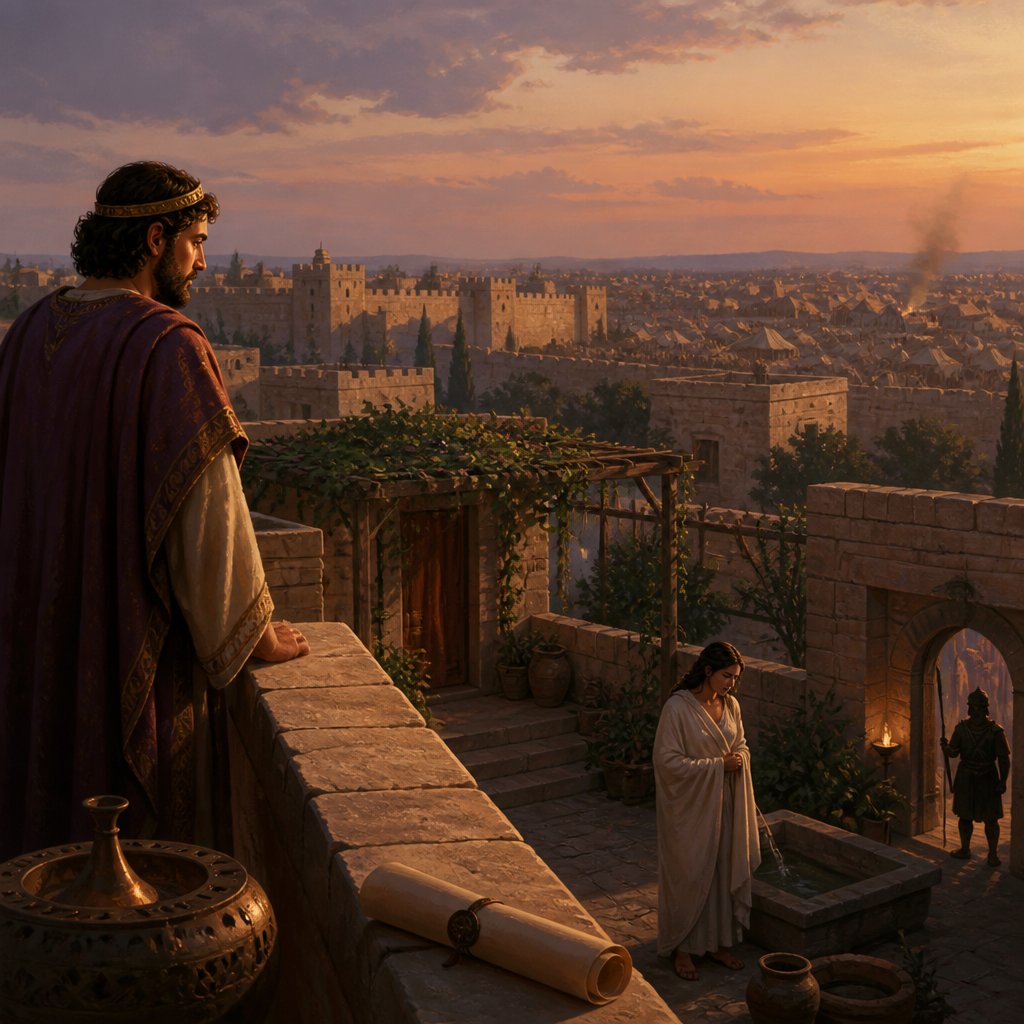
The Bible verse 2 Samuel 11:1-15 from the King James Version reads:
1 And it came to pass, after the year was expired, at the time when kings go forth to battle, that David sent Joab, and his servants with him, and all Israel; and they destroyed the children of Ammon, and besieged Rabbah. But David tarried still at Jerusalem.
2 And it came to pass in an eveningtide, that David arose from off his bed, and walked upon the roof of the king's house: and from the roof he saw a woman washing herself; and the woman was very beautiful to look upon.
3 And David sent and inquired after the woman. And one said, Is not this Bathsheba, the daughter of Eliam, the wife of Uriah the Hittite?
4 And David sent messengers, and took her; and she came in unto him, and he lay with her; for she was purified from her uncleanness: and she returned unto her house.
5 And the woman conceived, and sent and told David, and said, I am with child.
6 And David sent to Joab, saying, Send me Uriah the Hittite. And Joab sent Uriah to David.
7 And when Uriah was come unto him, David demanded of him how Joab did, and how the people did, and how the war prospered.
8 And David said to Uriah, Go down to thy house, and wash thy feet. And Uriah departed out of the king's house, and there followed him a mess of meat from the king.
9 But Uriah slept at the door of the king's house with all the servants of his lord, and went not down to his house.
10 And when they had told David, saying, Uriah went not down unto his house, David said unto Uriah, Camest thou not from thy journey? why then didst thou not go down unto thine house?
11 And Uriah said unto David, The ark, and Israel, and Judah, abide in tents; and my lord Joab, and the servants of my lord, are encamped in the open fields; shall I then go into mine house, to eat and to drink, and to lie with my wife? as thou livest, and as thy soul liveth, I will not do this thing.
12 And David said to Uriah, Tarry here to day also, and to morrow I will let thee depart. So Uriah abode in Jerusalem that day, and the morrow.
13 And when David had called him, he did eat and drink before him; and he made him drunk: and at even he went out to lie on his bed with the servants of his lord, but went not down to his house.
14 And it came to pass in the morning, that David wrote a letter to Joab, and sent it by the hand of Uriah.
15 And he wrote in the letter, saying, Set ye Uriah in the forefront of the hottest battle, and retire ye from him, that he may be smitten, and die.
This passage from the book of 2 Samuel is a significant and poignant account of the fall of King David, a man who was known as a man after God's own heart (1 Samuel 13:14). The story of David and Bathsheba is a narrative that displays the depth of human sinfulness and the profound consequences of disobedience to God.
The passage begins with the statement that it was the season when kings go to war, but David, instead of leading his army, "tarried still at Jerusalem." This decision to stay behind set the stage for the events that would unfold. As David walked on the roof of his palace, he saw Bathsheba, the wife of Uriah, bathing. The text emphasizes her beauty, and David's lust led him to inquire about her and eventually commit adultery with her.
David's actions led to Bathsheba becoming pregnant. In an attempt to cover up his sin, David called for Uriah, Bathsheba's husband, to come back from the battlefield, hoping that he would sleep with his wife and the pregnancy would be attributed to him. However, Uriah's loyalty to his fellow soldiers and commitment to the war effort led him to refuse the comforts of home while his companions were still fighting on the battlefield. This refusal highlights the integrity and honor of Uriah, which stands in stark contrast to David's deceitful and selfish behavior.
In a desperate attempt to hide his sin, David plotted to have Uriah killed in battle. He wrote a letter to Joab instructing him to place Uriah in the most dangerous part of the battle and then withdraw the troops, leaving Uriah vulnerable to attack. This devious act resulted in the death of Uriah, and David took Bathsheba as his wife.
The consequences of David's actions were severe. The prophet Nathan confronted David with his sin, and David experienced deep conviction and repentance. The child conceived through his relationship with Bathsheba died, and David faced ongoing turmoil in his family and kingdom as a result of his actions.
This passage addresses several important themes that are applicable to human nature and the consequences of sin. First, it highlights the destructive power of unchecked desire and lust. David's unbridled passion for Bathsheba led him to commit adultery and ultimately murder, demonstrating the devastating effects of sin when it is allowed to take root in the heart.
Additionally, this passage underscores the principle of accountability and the reality that sin will ultimately be exposed. Despite David's attempts to conceal his actions, he was ultimately held accountable, and his sin had far-reaching impacts on his life and those around him. This serves as a sobering reminder that no one can escape the consequences of sin.
Furthermore, the story of David and Bathsheba serves as a poignant example of the need for genuine repentance. When confronted by Nathan, David confessed his sin and humbled himself before God. His heartfelt repentance and willingness to acknowledge his wrongdoing demonstrate the redemptive power of seeking forgiveness and turning from sin.
Symbolically, the narrative of David and Bathsheba can be seen as a cautionary tale about the dangers of pride and the importance of maintaining a humble and obedient heart before God. David's decision to remain in Jerusalem instead of leading his army may have been influenced by a sense of entitlement and complacency, leading to his vulnerability to temptation and moral failure.
Ultimately, the story of David and Bathsheba serves as a vivid portrait of the human struggle with sin and the far-reaching consequences of disobedience. It highlights the need for humility, accountability, and genuine repentance, while also pointing to the redemptive power of God's forgiveness and grace. This passage challenges readers to consider the condition of their own hearts and the potential ramifications of unchecked desires and sinful actions. It serves as a timeless reminder of the universal need for reliance on God's strength and guidance in the face of temptation and moral struggle.
Get our apps


Artwork for 2 Samuel 11:1-15

2 Samuel 11:1-15 - "In the spring, at the time when kings go off to war, David sent Joab out with the king’s men and the whole Israelite army. They destroyed the Ammonites and besieged Rabbah. But David remained in Jerusalem. One evening David got up from his bed and walked around on the roof of the palace. From the roof he saw a woman bathing. The woman was very beautiful, and David sent someone to find out about her. The man said, “She is Bathsheba, the daughter of Eliam and the wife of Uriah the Hittite.” Then David sent messengers to get her. She came to him, and he slept with her. (Now she was purifying herself from her monthly uncleanness.) Then she went back home. The woman conceived and sent word to David, saying, “I am pregnant.” So David sent this word to Joab: “Send me Uriah the Hittite.” And Joab sent him to David. When Uriah came to him, David asked him how Joab was, how the soldiers were and how the war was going. Then David said to Uriah, “Go down to your house and wash your feet.” So Uriah left the palace, and a gift from the king was sent after him. But Uriah slept at the entrance to the palace with all his master’s servants and did not go down to his house. David was told, “Uriah did not go home.” So he asked Uriah, “Haven’t you just come from a military campaign? Why didn’t you go home?” Uriah said to David, “The ark and Israel and Judah are staying in tents, and my commander Joab and my lord’s men are camped in the open country. How could I go to my house to eat and drink and make love to my wife? As surely as you live, I will not do such a thing!” Then David said to him, “Stay here one more day, and tomorrow I will send you back.” So Uriah remained in Jerusalem that day and the next. At David’s invitation, he ate and drank with him, and David made him drunk. But in the evening Uriah went out to sleep on his mat among his master’s servants; he did not go home. In the morning David wrote a letter to Joab and sent it with Uriah. In it he wrote, “Put Uriah out in front where the fighting is fiercest. Then withdraw from him so he will be struck down and die.”"
"In the spring, at the time when kings go off to war, David sent Joab out with the king’s men and the whole Israelite army. They destroyed the Ammonites and besieged Rabbah. But David remained in Jerusalem. One evening David got up from his bed and walked around on the roof of the palace. From the roof he saw a woman bathing. The woman was very beautiful, and David sent someone to find out about her. The man said, “She is Bathsheba, the daughter of Eliam and the wife of Uriah the Hittite.” Then David sent messengers to get her. She came to him, and he slept with her. (Now she was purifying herself from her monthly uncleanness.) Then she went back home. The woman conceived and sent word to David, saying, “I am pregnant.” So David sent this word to Joab: “Send me Uriah the Hittite.” And Joab sent him to David. When Uriah came to him, David asked him how Joab was, how the soldiers were and how the war was going. Then David said to Uriah, “Go down to your house and wash your feet.” So Uriah left the palace, and a gift from the king was sent after him. But Uriah slept at the entrance to the palace with all his master’s servants and did not go down to his house. David was told, “Uriah did not go home.” So he asked Uriah, “Haven’t you just come from a military campaign? Why didn’t you go home?” Uriah said to David, “The ark and Israel and Judah are staying in tents, and my commander Joab and my lord’s men are camped in the open country. How could I go to my house to eat and drink and make love to my wife? As surely as you live, I will not do such a thing!” Then David said to him, “Stay here one more day, and tomorrow I will send you back.” So Uriah remained in Jerusalem that day and the next. At David’s invitation, he ate and drank with him, and David made him drunk. But in the evening Uriah went out to sleep on his mat among his master’s servants; he did not go home. In the morning David wrote a letter to Joab and sent it with Uriah. In it he wrote, “Put Uriah out in front where the fighting is fiercest. Then withdraw from him so he will be struck down and die.”" - 2 Samuel 11:1-15

2 Samuel 11:5 - "And the woman conceived, and sent and told David, and said, I am with child."

2 Samuel 15:11 - "And with Absalom went two hundred men out of Jerusalem, that were called; and they went in their simplicity, and they knew not any thing."
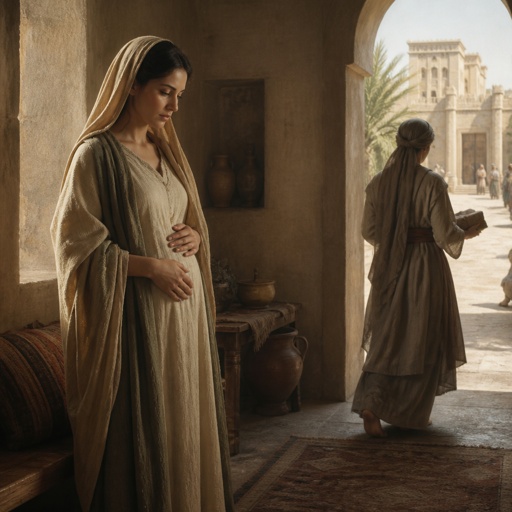
"And the woman conceived, and sent and told David, and said, I am with child." - 2 Samuel 11:5

1 Samuel 15:11 - "It repenteth me that I have set up Saul to be king: for he is turned back from following me, and hath not performed my commandments. And it grieved Samuel; and he cried unto the LORD all night."

2 Samuel 11:15 - "And he wrote in the letter, saying, Set ye Uriah in the forefront of the hottest battle, and retire ye from him, that he may be smitten, and die."

2 Samuel 11:9

2 Samuel 11

2 samuel 11

2 Samuel 15:1 - "And it came to pass after this, that Absalom prepared him chariots and horses, and fifty men to run before him."

2 Samuel 1:11 - "Then David took hold on his clothes, and rent them; and likewise all the men that were with him:"

2 Samuel 11:11

1 Samuel 11:15 - "And all the people went to Gilgal; and there they made Saul king before the LORD in Gilgal; and there they sacrificed sacrifices of peace offerings before the LORD; and there Saul and all the men of Israel rejoiced greatly."

1 Samuel 2:11 - "And Elkanah went to Ramah to his house. And the child did minister unto the LORD before Eli the priest."

2 Samuel 1:15 - "And David called one of the young men, and said, Go near, and fall upon him. And he smote him that he died."

1Samuel 15:11

1 Samuel 15:10 - "¶ Then came the word of the LORD unto Samuel, saying,"

1 Samuel 7:15 - "And Samuel judged Israel all the days of his life."
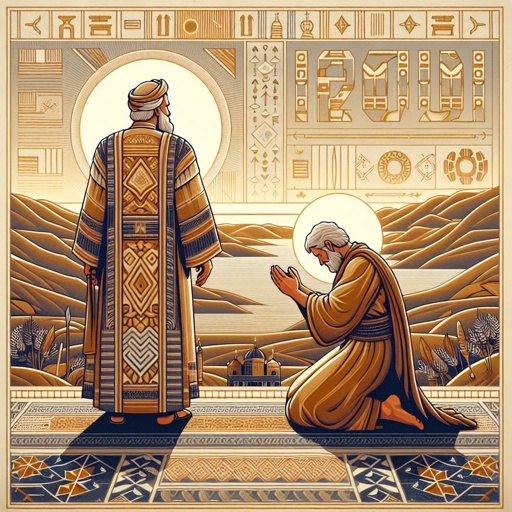
1 Samuel 15:31 - "So Samuel turned again after Saul; and Saul worshipped the LORD."

1 Samuel 15:34 - "¶ Then Samuel went to Ramah; and Saul went up to his house to Gibeah of Saul."

1 Samuel 1:15-17

1 Samuel 3:15 - "¶ And Samuel lay until the morning, and opened the doors of the house of the LORD. And Samuel feared to shew Eli the vision."
1 samuel15:11:11

1.samuel 15:30

1.samuel 15:30

1 Samuel 28:15

1 Samuel 15:22

1 Samuel 15:22

1 Samuel 2:15 - "Also before they burnt the fat, the priest's servant came, and said to the man that sacrificed, Give flesh to roast for the priest; for he will not have sodden flesh of thee, but raw."