What does 2 Samuel 14:2 mean?
“And Joab sent to Tekoah, and fetched thence a wise woman, and said unto her, I pray thee, feign thyself to be a mourner, and put on now mourning apparel, and anoint not thyself with oil, but be as a woman that had a long time mourned for the dead:” — 2 Samuel 14:2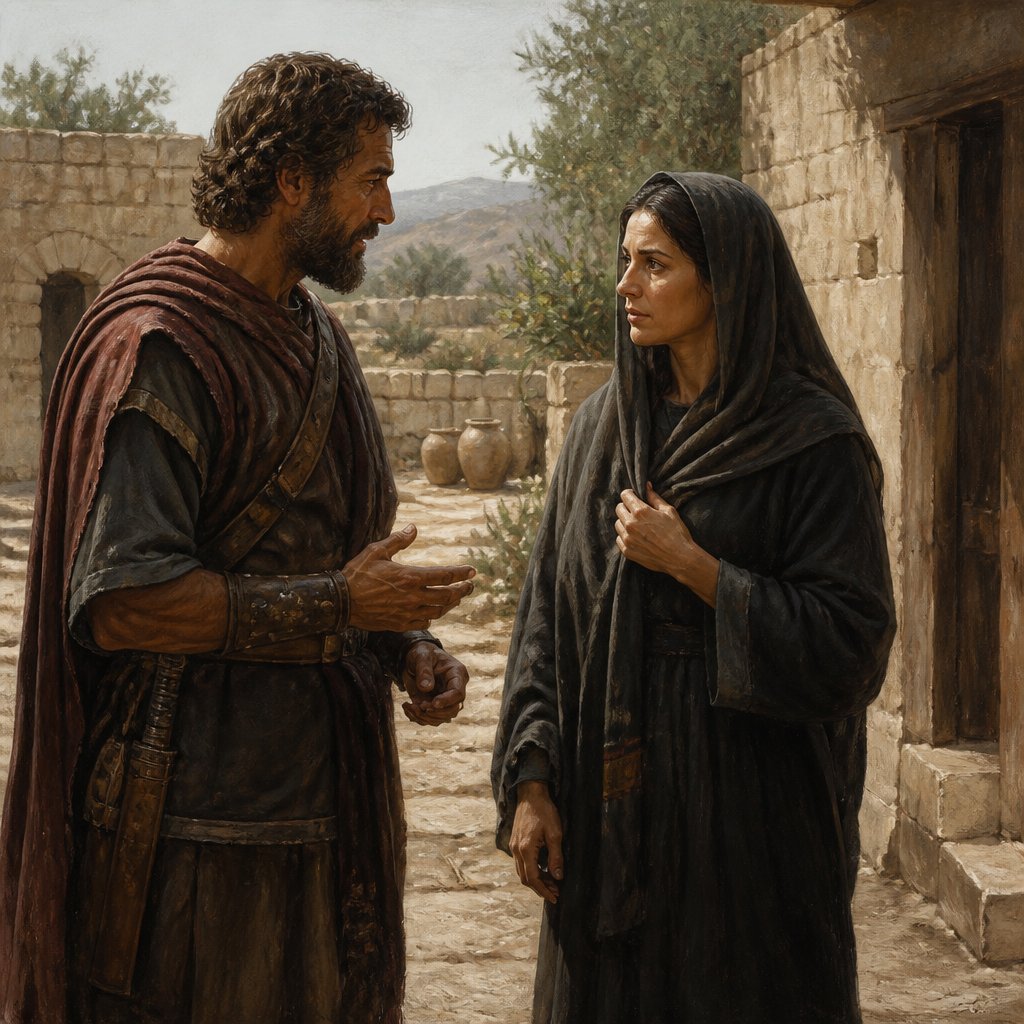
The Bible verse 2 Samuel 14:2 in the King James Version (KJV) reads, "And Joab sent to Tekoah, and fetched thence a wise woman, and said unto her, I pray thee, feign thyself to be a mourner, and put on now mourning apparel, and anoint not thyself with oil, but be as a woman that had a long time mourned for the dead."
This verse is part of the story of David and his son Absalom. To understand the meaning and implications of this verse, it is essential to look at the context in which it is situated.
At this point in the narrative, Absalom, who had killed his brother Amnon for raping his sister Tamar, had been exiled from Jerusalem for three years. Joab, the commander of David's army, saw that David longed for Absalom, and he devised a plan to bring Absalom back to Jerusalem. Joab sent to Tekoah, a town in Judah, and brought a wise woman from there, asking her to act as a mourner and make a plea to King David on behalf of Absalom.
The symbolism and themes in this verse are rich and multifaceted. The passage highlights the complexity of human relationships, particularly those within families, and the power of manipulation and persuasion. The use of a wise woman from Tekoah to act as a mourner is significant because it suggests the importance of wisdom and strategic thinking in achieving one's goals. Additionally, the emphasis on mourning and the instructions for the woman to appear as one who had been grieving for a long time underscore the emotional weight of the situation and the need for empathy and understanding in dealing with David's feelings for his son.
The verse also addresses the themes of forgiveness and reconciliation. Despite Absalom's grave offenses, there is a sense of longing for him within David, and Joab's plan to bring him back reflects the hope for restoration and healing within the family. The use of the mourning apparel and the instruction not to anoint oneself with oil further underscores the seriousness of the plea being made and the urgency of the situation.
Furthermore, the verse speaks to the idea of role-playing and disguise in order to achieve a desired outcome. The wise woman from Tekoah is asked to "feign" herself to be a mourner, highlighting the ways in which people may resort to acting in order to sway the opinions or decisions of others. This raises questions about authenticity and sincerity, as well as the ethical implications of using such tactics to achieve one's goals.
In a broader sense, this verse can also be seen as a reflection of the human condition and the complexities of love, loss, and longing. It portrays the depth of David's emotions as a father, as well as the intricate dynamics of family relationships and the lengths to which people may go in order to mend broken ties.
In conclusion, 2 Samuel 14:2 carries a wealth of meaning and commentary within its seemingly simple instructions. It delves into the depths of human emotions, the complexities of relationships, and the moral and ethical implications of manipulating others to achieve one's desires. It ultimately serves as a reminder of the power of empathy, forgiveness, and the resilience of the human spirit in the face of adversity.
Get our apps


Artwork for 2 Samuel 14:2

2 Samuel 14:2 - "And Joab sent to Tekoah, and fetched thence a wise woman, and said unto her, I pray thee, feign thyself to be a mourner, and put on now mourning apparel, and anoint not thyself with oil, but be as a woman that had a long time mourned for the dead:"
"And Joab sent to Tekoah, and fetched thence a wise woman, and said unto her, I pray thee, feign thyself to be a mourner, and put on now mourning apparel, and anoint not thyself with oil, but be as a woman that had a long time mourned for the dead:" - 2 Samuel 14:2

2 Samuel 6:14

2 Samuel 6:14–22

2 Samuel 23:14 - "And David was then in an hold, and the garrison of the Philistines was then in Beth-lehem."

2 Samuel 2:14 - "And Abner said to Joab, Let the young men now arise, and play before us. And Joab said, Let them arise."

2 Samuel 14:23 - "So Joab arose and went to Geshur, and brought Absalom to Jerusalem."

2 Samuel 22:14 - "The LORD thundered from heaven, and the most High uttered his voice."

2 Samuel 16:14 - "And the king, and all the people that were with him, came weary, and refreshed themselves there."

2 Samuel 14:1 - "Now Joab the son of Zeruiah perceived that the king's heart was toward Absalom."

2 Samuel 14:28 - "¶ So Absalom dwelt two full years in Jerusalem, and saw not the king's face."

2 Samuel 11:14 - "¶ And it came to pass in the morning, that David wrote a letter to Joab, and sent it by the hand of Uriah."

2 Samuel 5:14 - "And these be the names of those that were born unto him in Jerusalem; Shammua, and Shobab, and Nathan, and Solomon,"

2 Samuel 6:14 - "And David danced before the LORD with all his might; and David was girded with a linen ephod."

2 Samuel 14:3 - "And come to the king, and speak on this manner unto him. So Joab put the words in her mouth."

2 Samuel 14:8 - "And the king said unto the woman, Go to thine house, and I will give charge concerning thee."

2 Samuel 1:14 - "And David said unto him, How wast thou not afraid to stretch forth thine hand to destroy the LORD'S anointed?"

2 Samuel 14:27 - "And unto Absalom there were born three sons, and one daughter, whose name was Tamar: she was a woman of a fair countenance."

"And David was then in an hold, and the garrison of the Philistines was then in Beth-lehem." - 2 Samuel 23:14

2 Samuel 14:10 - "And the king said, Whosoever saith ought unto thee, bring him to me, and he shall not touch thee any more."

2 Samuel 14:4 - "¶ And when the woman of Tekoah spake to the king, she fell on her face to the ground, and did obeisance, and said, Help, O king."

1 Samuel 14:2 - "And Saul tarried in the uttermost part of Gibeah under a pomegranate tree which is in Migron: and the people that were with him were about six hundred men;"

2 Samuel 14:5 - "And the king said unto her, What aileth thee? And she answered, I am indeed a widow woman, and mine husband is dead."

2 Samuel 14:16 - "For the king will hear, to deliver his handmaid out of the hand of the man that would destroy me and my son together out of the inheritance of God."

2 Samuel 14:21 - "¶ And the king said unto Joab, Behold now, I have done this thing: go therefore, bring the young man Absalom again."

2 Samuel 14:6 - "And thy handmaid had two sons, and they two strove together in the field, and there was none to part them, but the one smote the other, and slew him."

2 Samuel 14:12 - "Then the woman said, Let thine handmaid, I pray thee, speak one word unto my lord the king. And he said, Say on."

2 Samuel 7:14 - "I will be his father, and he shall be my son. If he commit iniquity, I will chasten him with the rod of men, and with the stripes of the children of men:"

2 Samuel 14:31 - "Then Joab arose, and came to Absalom unto his house, and said unto him, Wherefore have thy servants set my field on fire?"

2 Samuel 14:9 - "And the woman of Tekoah said unto the king, My lord, O king, the iniquity be on me, and on my father's house: and the king and his throne be guiltless."