What does 2 Samuel 3:34 mean?
“Thy hands were not bound, nor thy feet put into fetters: as a man falleth before wicked men, so fellest thou. And all the people wept again over him.” — 2 Samuel 3:34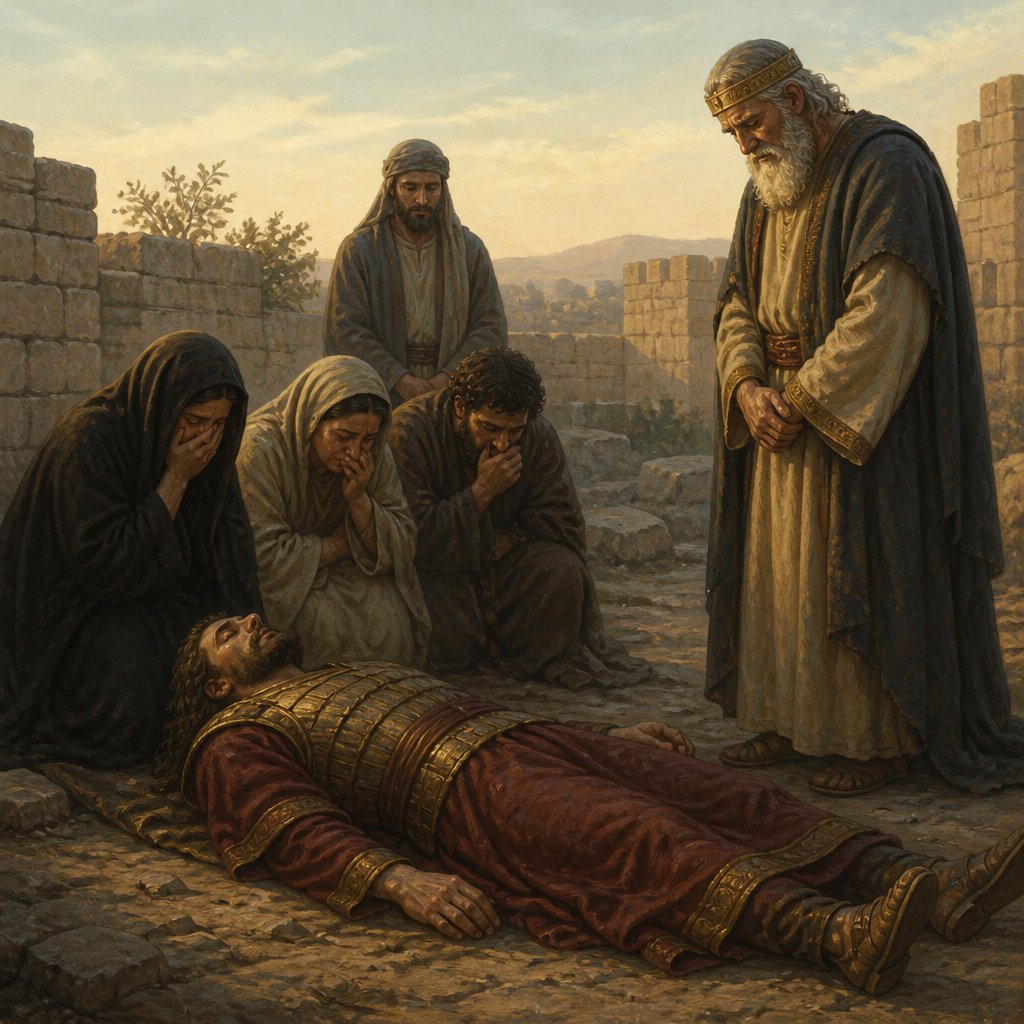
The verse 2 Samuel 3:34 from the King James Version of the Bible reads: "Thy hands were not bound, nor thy feet put into fetters: as a man falleth before wicked men, so fellest thou. And all the people wept again over him."
This verse is part of a lament that David speaks upon hearing of the death of Abner, the commander of Saul's army who had defected to David's side. In this verse, David is expressing his grief over the death of Abner and lamenting the way in which he died.
The first part of the verse, "Thy hands were not bound, nor thy feet put into fetters," speaks to the fact that Abner was not killed in battle or as a prisoner of war. Instead, he was betrayed and murdered by a man named Joab, the commander of David's army. This brutal and dishonorable act is emphasized by the imagery of binding and fetters, which symbolize captivity and imprisonment. The use of this imagery highlights the injustice of Abner's death and adds to the tragedy of the situation.
The second part of the verse, "as a man falleth before wicked men, so fellest thou," speaks to the manner in which Abner died. He was slain dishonorably, as though he had fallen before wicked men. This further emphasizes the injustice of Abner's death and adds to David's sorrow and lament.
The verse concludes with the statement, "And all the people wept again over him," which underscores the widespread grief and mourning that Abner's death evoked. Abner was a prominent and respected figure, and his untimely and unjust death deeply affected those around him. This communal expression of sorrow reflects the impact of Abner's life and death on the community as a whole.
In the broader context of the Book of 2 Samuel, this verse is situated within the larger narrative of the struggle for power and the aftermath of King Saul's death. Abner's death plays a significant role in the ongoing power dynamics and political intrigue that characterizes this period in Israel's history. It also serves as a reminder of the moral complexities and personal costs of leadership and conflict.
The themes present in this verse include justice, betrayal, and the complexities of human relationships. It highlights the tension between honor and dishonor, the consequences of betrayal, and the weight of grief and loss. It also emphasizes the communal nature of mourning and the impact of an individual's actions on the larger community.
The symbolism in this verse is rich and nuanced. The imagery of binding and fetters symbolizes the injustice and dishonor of Abner's death, while the metaphor of falling before wicked men highlights the moral and ethical dimensions of the situation. The communal weeping underscores the profound impact of Abner's death on the community and the shared experience of grief and mourning.
Overall, 2 Samuel 3:34 is a powerful and poignant verse that captures the depth of emotion and the moral complexity of the situation surrounding Abner's death. It speaks to the universal experiences of grief, loss, and the search for justice, while also highlighting the unique historical and cultural context in which this narrative unfolds.
Get our apps


Artwork for 2 Samuel 3:34

2 Samuel 3:34 - "Thy hands were not bound, nor thy feet put into fetters: as a man falleth before wicked men, so fellest thou. And all the people wept again over him."
"Thy hands were not bound, nor thy feet put into fetters: as a man falleth before wicked men, so fellest thou. And all the people wept again over him." - 2 Samuel 3:34

2 Samuel 3:4 - "And the fourth, Adonijah the son of Haggith; and the fifth, Shephatiah the son of Abital;"

"And the fourth, Adonijah the son of Haggith; and the fifth, Shephatiah the son of Abital;" - 2 Samuel 3:4

2 Samuel 23:34 - "Eliphelet the son of Ahasbai, the son of the Maachathite, Eliam the son of Ahithophel the Gilonite,"

2 Samuel 22:34 - "He maketh my feet like hinds' feet: and setteth me upon my high places."

1 Samuel 3:4 - "That the LORD called Samuel: and he answered, Here am I."

2 Samuel 19:34 - "And Barzillai said unto the king, How long have I to live, that I should go up with the king unto Jerusalem?"

1 Samuel 15:34 - "¶ Then Samuel went to Ramah; and Saul went up to his house to Gibeah of Saul."

1 Samuel 2:34 - "And this shall be a sign unto thee, that shall come upon thy two sons, on Hophni and Phinehas; in one day they shall die both of them."

2 Samuel 13:34 - "But Absalom fled. And the young man that kept the watch lifted up his eyes, and looked, and, behold, there came much people by the way of the hill side behind him."

"That the LORD called Samuel: and he answered, Here am I." - 1 Samuel 3:4

"Eliphelet the son of Ahasbai, the son of the Maachathite, Eliam the son of Ahithophel the Gilonite," - 2 Samuel 23:34

2 Samuel 3:2 - "¶ And unto David were sons born in Hebron: and his firstborn was Amnon, of Ahinoam the Jezreelitess;"

1 Samuel 17:34-35

2 Samuel 4:3 - "And the Beerothites fled to Gittaim, and were sojourners there until this day.)"

2 Samuel 3:3 - "And his second, Chileab, of Abigail the wife of Nabal the Carmelite; and the third, Absalom the son of Maacah the daughter of Talmai king of Geshur;"

2 Samuel 3:11 - "And he could not answer Abner a word again, because he feared him."

2 Samuel 3:33 - "And the king lamented over Abner, and said, Died Abner as a fool dieth?"

2 Samuel 3:5 - "And the sixth, Ithream, by Eglah David's wife. These were born to David in Hebron."

2 Samuel 2:3 - "And his men that were with him did David bring up, every man with his household: and they dwelt in the cities of Hebron."

2 Samuel 7:3 - "And Nathan said to the king, Go, do all that is in thine heart; for the LORD is with thee."

2 Samuel 3:37 - "For all the people and all Israel understood that day that it was not of the king to slay Abner the son of Ner."

2 Samuel 3:15 - "And Ish-bosheth sent, and took her from her husband, even from Phaltiel the son of Laish."

2 Samuel 3:36 - "And all the people took notice of it, and it pleased them: as whatsoever the king did pleased all the people."

2 Samuel 14:3 - "And come to the king, and speak on this manner unto him. So Joab put the words in her mouth."

Mark 3:31-34

2 Samuel 3:6 - "¶ And it came to pass, while there was war between the house of Saul and the house of David, that Abner made himself strong for the house of Saul."

2 Samuel 3:38 - "And the king said unto his servants, Know ye not that there is a prince and a great man fallen this day in Israel?"

2 Samuel 15:34 - "But if thou return to the city, and say unto Absalom, I will be thy servant, O king; as I have been thy father's servant hitherto, so will I now also be thy servant: then mayest thou for me defeat the counsel of Ahithophel."