What does 2 Samuel 5:14 mean?
“And these be the names of those that were born unto him in Jerusalem; Shammua, and Shobab, and Nathan, and Solomon,” — 2 Samuel 5:14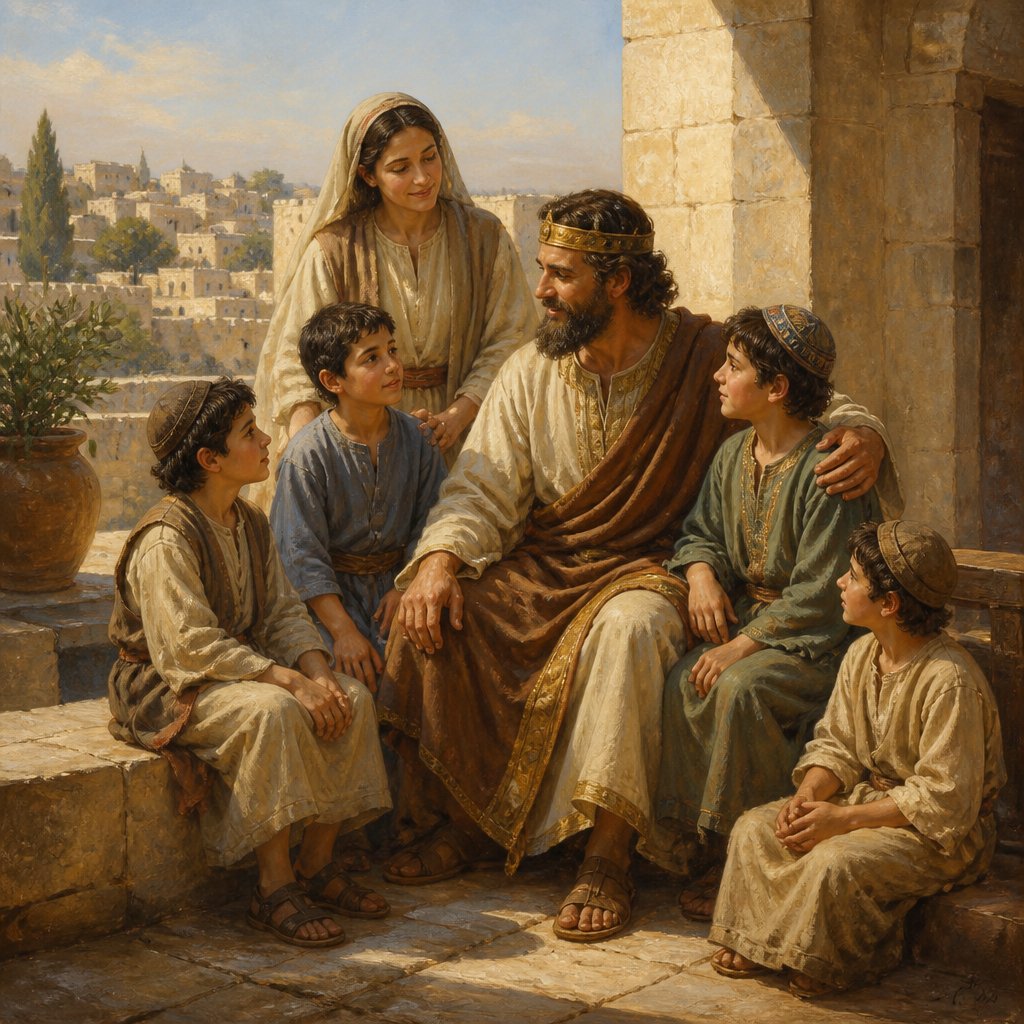
2 Samuel 5:14 (KJV) - "And these be the names of those that were born unto him in Jerusalem; Shammua, and Shobab, and Nathan, and Solomon,"
The verse 2 Samuel 5:14 serves as a brief genealogy of the sons of King David who were born in Jerusalem. This verse is part of the narrative in the Old Testament that depicts David's reign as the second king of Israel, after he had been anointed by Samuel and had ascended to the throne. This scripture carries several themes and holds important contextual and symbolic meanings in the broader Old Testament narrative.
One prominent theme in this verse is the fulfillment of God's promises. Throughout the Old Testament, God makes numerous promises to David, including the promise that his descendants will inherit the throne and that his kingdom will be established forever. The birth of David's sons, particularly Solomon, in Jerusalem represents the fulfillment of God's promise to establish David's dynasty. This theme is crucial in understanding the profound significance of the genealogy of David's sons as recorded in 2 Samuel 5:14.
Another theme that is present in this verse is the importance of Jerusalem. David's decision to make Jerusalem the capital of his kingdom was significant, as it represented a unification of the northern and southern tribes of Israel and the establishment of a centralized and powerful nation. The birth of David's sons in Jerusalem holds symbolic importance as it solidifies Jerusalem as the center of David's kingdom and the future dynasty. This symbolism is crucial in understanding the significance of Jerusalem in the history of Israel and its importance in the fulfillment of God's promises to David.
Contextually, this verse is situated within the larger narrative of David's reign as king. After years of turmoil and division among the tribes of Israel, David's ascension to the throne marked a new era of unity and prosperity for the nation. The birth of David's sons in Jerusalem symbolizes the beginning of a new royal lineage that will continue to rule over the united kingdom of Israel. This contextual significance underscores the importance of David's sons in the continuation of his dynasty and the fulfillment of God's promises.
Symbolically, the genealogy of David's sons in 2 Samuel 5:14 represents the continuity and legacy of David's reign. Each son mentioned in this verse represents a future link in the chain of David's royal lineage. The name "Solomon" is particularly significant, as he would eventually succeed David as king and build the first temple in Jerusalem. The birth of Solomon holds profound symbolic importance as the future ruler who will continue David's legacy and fulfill God's promises of an eternal kingdom.
In conclusion, 2 Samuel 5:14 holds rich thematic, contextual, and symbolic meanings that are deeply intertwined with the broader narrative of David's reign and the establishment of the kingdom of Israel. This verse serves as a testament to the fulfillment of God's promises, the significance of Jerusalem, and the continuity of David's royal lineage. It also foreshadows the future reign of Solomon and the continuation of God's plan for the nation of Israel. Overall, this verse is a crucial piece of the Old Testament narrative that showcases the divine fulfillment of prophecies and the establishment of a powerful and enduring royal dynasty.
Get our apps


Artwork for 2 Samuel 5:14

2 Samuel 5:14 - "And these be the names of those that were born unto him in Jerusalem; Shammua, and Shobab, and Nathan, and Solomon,"
"And these be the names of those that were born unto him in Jerusalem; Shammua, and Shobab, and Nathan, and Solomon," - 2 Samuel 5:14

2 Samuel 14:5 - "And the king said unto her, What aileth thee? And she answered, I am indeed a widow woman, and mine husband is dead."

2 Samuel 5:12

2 Samuel 6:14

2 Samuel 5:15 - "Ibhar also, and Elishua, and Nepheg, and Japhia,"

2 Samuel 5:16 - "And Elishama, and Eliada, and Eliphalet."

2 Samuel 6:14–22

"And Elishama, and Eliada, and Eliphalet." - 2 Samuel 5:16

1 Samuel 14:5 - "The forefront of the one was situate northward over against Michmash, and the other southward over against Gibeah."

2 Samuel 23:14 - "And David was then in an hold, and the garrison of the Philistines was then in Beth-lehem."

2 Samuel 14:23 - "So Joab arose and went to Geshur, and brought Absalom to Jerusalem."

2 Samuel 5:18 - "The Philistines also came and spread themselves in the valley of Rephaim."

2 Samuel 5:7 - "Nevertheless David took the strong hold of Zion: the same is the city of David."

2 Samuel 5:22 - "¶ And the Philistines came up yet again, and spread themselves in the valley of Rephaim."

2 Samuel 5:21 - "And there they left their images, and David and his men burned them."

2 Samuel 22:14 - "The LORD thundered from heaven, and the most High uttered his voice."

2 Samuel 16:14 - "And the king, and all the people that were with him, came weary, and refreshed themselves there."

2 Samuel 14:1 - "Now Joab the son of Zeruiah perceived that the king's heart was toward Absalom."

2 Samuel 14:28 - "¶ So Absalom dwelt two full years in Jerusalem, and saw not the king's face."

2 Samuel 11:14 - "¶ And it came to pass in the morning, that David wrote a letter to Joab, and sent it by the hand of Uriah."

"Ibhar also, and Elishua, and Nepheg, and Japhia," - 2 Samuel 5:15

2 Samuel 5:10 - "And David went on, and grew great, and the LORD God of hosts was with him."

2 Samuel 2:14 - "And Abner said to Joab, Let the young men now arise, and play before us. And Joab said, Let them arise."

2 Samuel 5:4 - "¶ David was thirty years old when he began to reign, and he reigned forty years."

2 Samuel 11:5 - "And the woman conceived, and sent and told David, and said, I am with child."

2 Samuel 6:14 - "And David danced before the LORD with all his might; and David was girded with a linen ephod."

2 Samuel 3:5 - "And the sixth, Ithream, by Eglah David's wife. These were born to David in Hebron."

1 Samuel 5:2 - "When the Philistines took the ark of God, they brought it into the house of Dagon, and set it by Dagon."

2 Samuel 14:3 - "And come to the king, and speak on this manner unto him. So Joab put the words in her mouth."