What does Acts 8:39 mean?
“And when they were come up out of the water, the Spirit of the Lord caught away Philip, that the eunuch saw him no more: and he went on his way rejoicing.” — Acts 8:39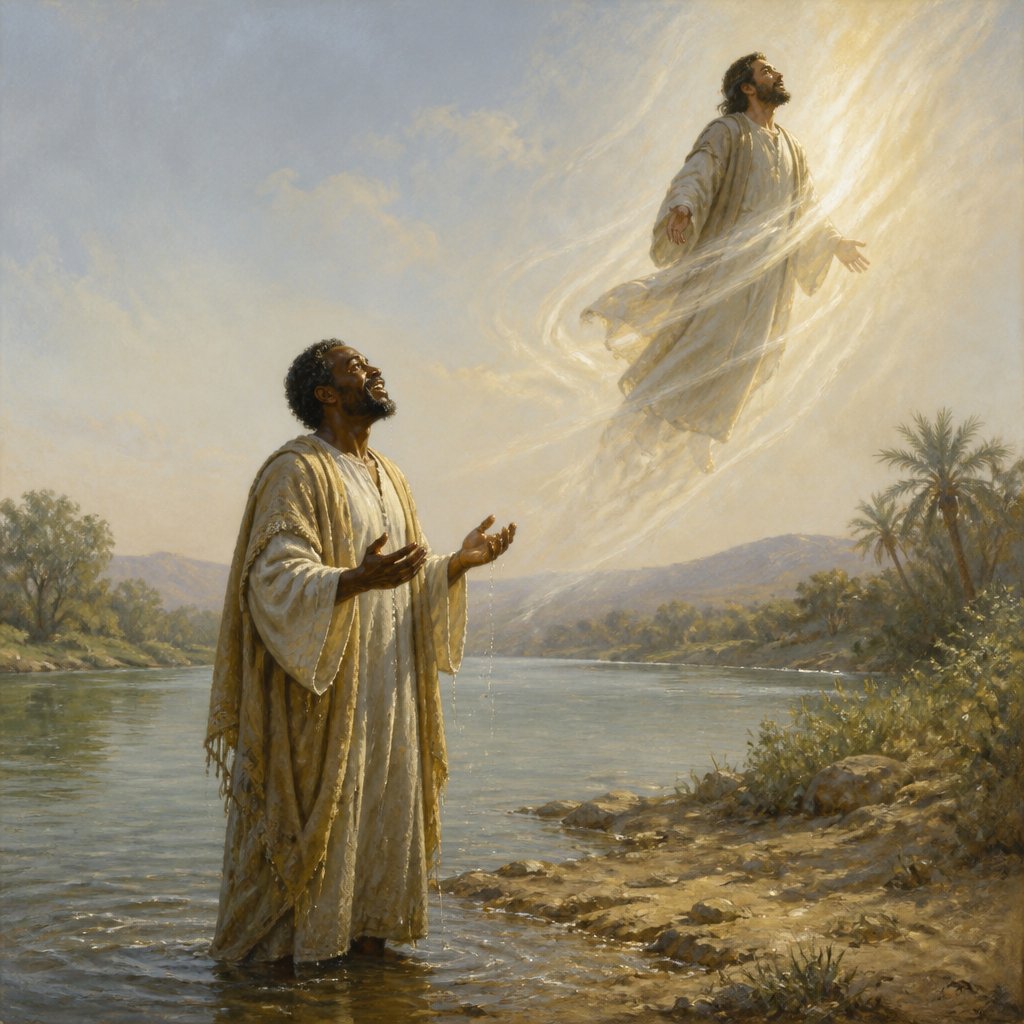
Acts 8:39 in the King James Version reads, “And when they were come up out of the water, the Spirit of the Lord caught away Philip, that the eunuch saw him no more: and he went on his way rejoicing.”
In its immediate context, this verse concludes the encounter between Philip the evangelist and the Ethiopian eunuch on the road from Jerusalem to Gaza. The eunuch, a man of high station under Candace queen of the Ethiopians, had been returning from worship at Jerusalem and was reading the prophet Esaias. Philip is sent by an angel of the Lord to join himself to the chariot, and the eunuch is providentially found reading Isaiah 53, the passage that speaks of the suffering servant led “as a sheep to the slaughter.” The eunuch’s question, “Of whom speaketh the prophet this? of himself, or of some other man?” becomes the opening by which “Philip opened his mouth, and began at the same scripture, and preached unto him Jesus.” When the eunuch sees water and asks, “What doth hinder me to be baptized?” Philip’s answer places the matter squarely in the realm of faith: “If thou believest with all thine heart, thou mayest.” The eunuch confesses, “I believe that Jesus Christ is the Son of God,” and then they go down into the water and he is baptized. Acts 8:39 therefore stands at the point where the ordinance is finished and God himself sets his seal upon the moment by the sudden removal of the preacher and the settled joy of the convert.
The first phrase, “when they were come up out of the water,” gathers up the action just completed and emphasizes that baptism is not merely inward sentiment but an outward act in time and place, performed in response to the preached gospel. Luke’s narration keeps the event concrete: there is Scripture read, Scripture explained, faith confessed, water found, and baptism administered. The act is framed as a divinely arranged meeting, and the “coming up out of the water” marks the transition from instruction and decision to a life now set in motion by grace. Because the chapter has already shown Samaritans believing and being baptized, and Simon himself being baptized yet showing an unchanged heart, the narrative places weight not on the water as a charm, but on faith in Christ and the Spirit’s sovereign work. The water is significant as obedience and identification, but the true power displayed in Acts 8:39 is God’s power to direct, save, and continue his mission beyond one moment.
“The Spirit of the Lord caught away Philip” introduces a striking theme: the gospel advances by the initiative of God, not the strength of man. Earlier in the chapter Philip went down to Samaria because persecution scattered the church; later he goes to a desert road because an angel directs him; now, after baptizing the eunuch, he is suddenly removed because the Spirit wills it. The phrase “caught away” presents Philip’s departure as God’s decisive act, not Philip’s choice, and it underscores that Philip is a servant sent and moved at the Lord’s pleasure. The same Spirit who arranged the meeting also concludes it, showing that the Spirit governs both the beginning and the end of gospel encounters. There is symbolism here as well: the messenger is not to become the object of the eunuch’s attachment. Philip is not left as a permanent guide, so that the eunuch’s faith rests not in Philip, but in Christ revealed by Scripture and sealed in obedience. The preacher disappears; the word remains.
“that the eunuch saw him no more” highlights the completeness and finality of the Spirit’s act. It also sharpens the test and the triumph of genuine conversion. The eunuch is left without the human teacher who had just opened the Scriptures to him. Yet the verse does not portray confusion or fear; instead it moves immediately to the outcome: “and he went on his way rejoicing.” The narrative logic is theological: the joy does not depend on Philip’s continued presence, because salvation has been received. The eunuch has heard of Jesus, believed with all his heart, confessed Christ, obeyed in baptism, and now continues his journey with joy. The missing teacher becomes, in effect, a sign that the believer is now sustained by the Lord himself and by the word of God he has received. This is not joy rooted in novelty or in companionship, but joy rooted in the gospel.
The “way” imagery is also significant. The eunuch had been “returning” from Jerusalem when the Lord met him; now he continues on his “way” as a changed man. Acts frequently describes the Christian faith in terms of a path or way of life, and here the eunuch’s literal journey becomes a living parable of spiritual pilgrimage. He is not called to remain at the water’s edge, nor to cling to the moment; he is sent forward. His rejoicing suggests that the encounter has not merely informed him but transformed him. In the wider book of Acts, joy regularly accompanies the reception of the word and the work of the Spirit, even amid hardship and uncertainty, and Acts 8:39 compresses that pattern into one line: the Spirit acts, the messenger departs, the believer proceeds with joy.
The verse also bears significance within the larger movement of Acts from Jerusalem outward. The eunuch is an Ethiopian, a Gentile proselyte or God-fearer connected to the worship at Jerusalem yet still, by his very status, somewhat on the margins of Israel’s religious life. As a eunuch, he embodies a kind of social and ceremonial distance that makes God’s reaching him all the more meaningful. Without adding words beyond the KJV text, the story’s shape shows the widening reach of the gospel: from Jews to Samaritans and now toward the ends of the earth, carried not only by apostles in public cities but also by Spirit-led evangelism on an empty road. Philip’s sudden removal and subsequent reappearance elsewhere in the chapter further serves the book’s purpose: the good news does not stall; it is carried swiftly to new places according to the Lord’s design.
In summary, Acts 8:39 is significant because it portrays baptism as the obedient response of faith, the Spirit as the sovereign director of mission, the preacher as a temporary instrument rather than the object of trust, and the believer as one who can go forward in true joy even when human supports are removed. The water marks the moment of public identification, the Spirit’s “catching away” marks divine authority over the work, and the eunuch’s rejoicing marks the inward reality of salvation. The verse closes the scene with a quiet but powerful testimony: God gives the word, God gives the Spirit, and the one who believes in Jesus Christ can continue his way with joy.
Get our apps


Artwork for Acts 8:39

"And when they were come up out of the water, the Spirit of the Lord caught away Philip, that the eunuch saw him no more: and he went on his way rejoicing." - Acts 8:39

Acts 8:39 - "And when they were come up out of the water, the Spirit of the Lord caught away Philip, that the eunuch saw him no more: and he went on his way rejoicing."
"And when they were come up out of the water, the Spirit of the Lord caught away Philip, that the eunuch saw him no more: and he went on his way rejoicing." - Acts 8:39

Romans 8:38-39

Acts 16:39 - "And they came and besought them, and brought them out, and desired them to depart out of the city."

Acts 19:39 - "But if ye enquire any thing concerning other matters, it shall be determined in a lawful assembly."

Acts 5:39 - "But if it be of God, ye cannot overthrow it; lest haply ye be found even to fight against God."

Acts 7:39 - "To whom our fathers would not obey, but thrust him from them, and in their hearts turned back again into Egypt,"

Acts 13:39 - "And by him all that believe are justified from all things, from which ye could not be justified by the law of Moses."

Acts 27:39 - "And when it was day, they knew not the land: but they discovered a certain creek with a shore, into the which they were minded, if it were possible, to thrust in the ship."

Acts 2:39 - "For the promise is unto you, and to your children, and to all that are afar off, even as many as the Lord our God shall call."

Acts 10:39 - "And we are witnesses of all things which he did both in the land of the Jews, and in Jerusalem; whom they slew and hanged on a tree:"

Acts 8:8 - "And there was great joy in that city."

Acts 15:39 - "And the contention was so sharp between them, that they departed asunder one from the other: and so Barnabas took Mark, and sailed unto Cyprus;"

Job 39:8 - "The range of the mountains is his pasture, and he searcheth after every green thing."

Psalms 39:8 - "Deliver me from all my transgressions: make me not the reproach of the foolish."

Jeremiah 39:8 - "¶ And the Chaldeans burned the king's house, and the houses of the people, with fire, and brake down the walls of Jerusalem."

Ezekiel 39:8 - "¶ Behold, it is come, and it is done, saith the Lord GOD; this is the day whereof I have spoken."

1 Chronicles 8:39 - "And the sons of Eshek his brother were, Ulam his firstborn, Jehush the second, and Eliphelet the third."

1 Kings 22:39 - "Now the rest of the acts of Ahab, and all that he did, and the ivory house which he made, and all the cities that he built, are they not written in the book of the chronicles of the kings of Israel?"

"And there was great joy in that city." - Acts 8:8

Acts 21:39 - "But Paul said, I am a man which am a Jew of Tarsus, a city in Cilicia, a citizen of no mean city: and, I beseech thee, suffer me to speak unto the people."

Acts 1:8

Acts 8:33

Exodus 39:8 - "¶ And he made the breastplate of cunning work, like the work of the ephod; of gold, blue, and purple, and scarlet, and fine twined linen."

"But if ye enquire any thing concerning other matters, it shall be determined in a lawful assembly." - Acts 19:39
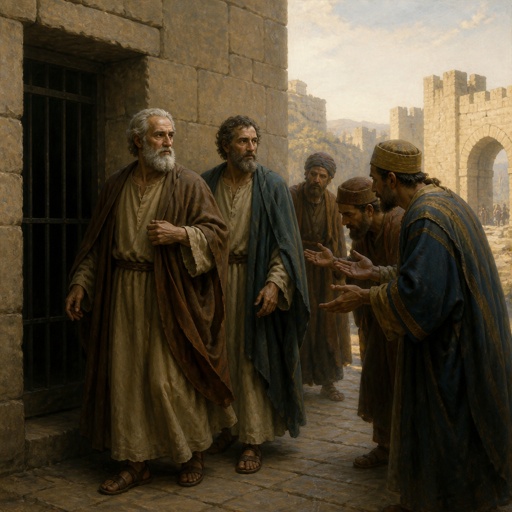
"And they came and besought them, and brought them out, and desired them to depart out of the city." - Acts 16:39

Acts 9:39 - "Then Peter arose and went with them. When he was come, they brought him into the upper chamber: and all the widows stood by him weeping, and shewing the coats and garments which Dorcas made, while she was with them."

Acts 4:8-12

Acts 10:39-40 - "And we are witnesses of all things which he did both in the land of the Jews, and in Jerusalem; whom they slew and hanged on a tree: Him God raised up the third day, and shewed him openly."