What does Esther 5:14 mean?
“Then said Zeresh his wife and all his friends unto him, Let a gallows be made of fifty cubits high, and to morrow speak thou unto the king that Mordecai may be hanged thereon: then go thou in merrily with the king unto the banquet. And the thing pleased Haman; and he caused the gallows to be made.” — Esther 5:14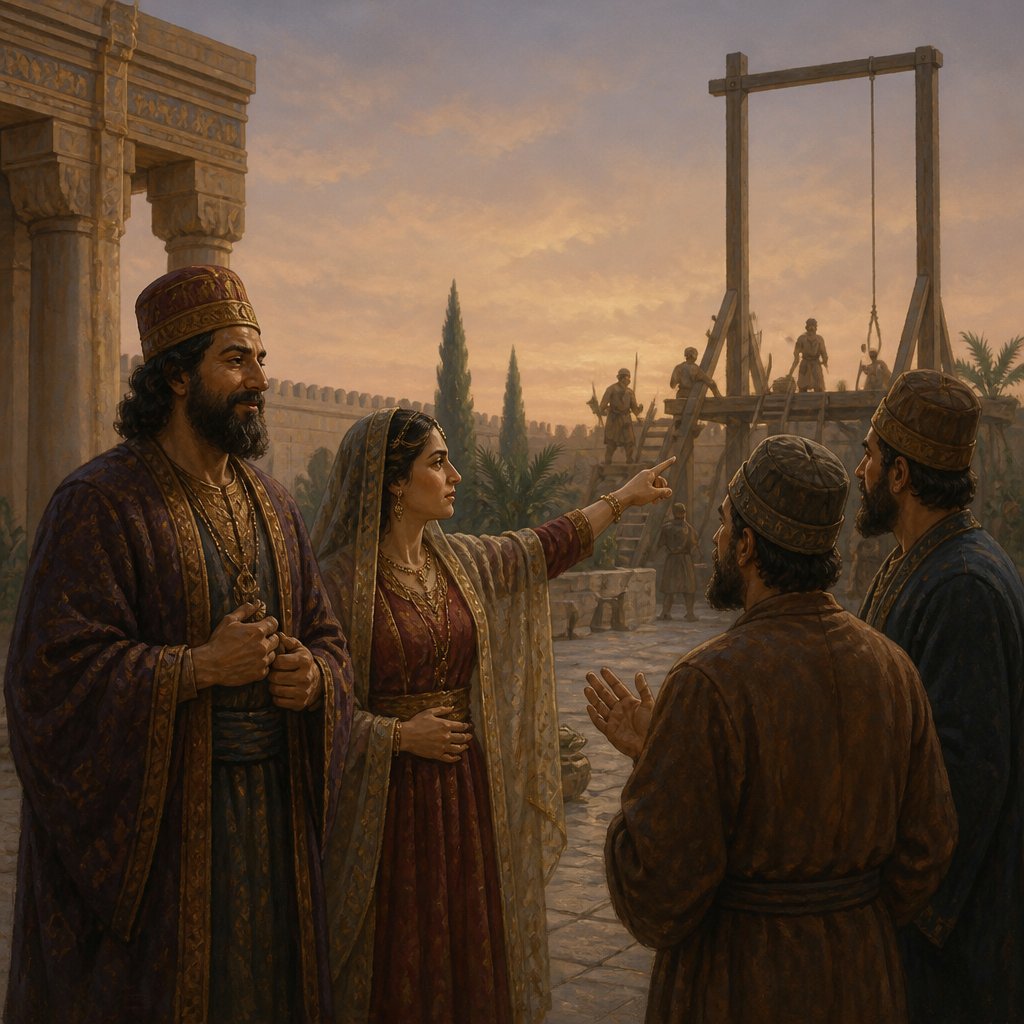
The book of Esther is one of the most fascinating and compelling stories in the Old Testament. It tells the story of a Jewish girl named Esther who becomes the queen of Persia and uses her position to save her people from being exterminated. The verse Esther 5:14 from the King James Version (KJV) reads:
"Then said Zeresh his wife and all his friends unto him, Let a gallows be made of fifty cubits high, and to morrow speak thou unto the king that Mordecai may be hanged thereon: then go thou in merrily with the king unto the banquet. And the thing pleased Haman; and he caused the gallows to be made."
This verse occurs in the context of the story of Esther where the wicked Haman makes plans to execute Mordecai, who had refused to bow down to him. Haman's wife and friends suggest that he builds a gallows to hang Mordecai and convinces the king to allow it. The height of the gallows, 50 cubits, is particularly significant as it demonstrates the extreme hatred and desire for revenge that Haman harbored against Mordecai.
One of the main themes of the book of Esther is the ultimate triumph of good over evil. In this verse, we see the evil intentions and actions of Haman, who is willing to go to extreme lengths to see his enemy destroyed. However, through the bravery and intelligence of Esther and Mordecai, as well as the providence of God, the plans of Haman are ultimately thwarted, and the Jewish people are saved.
The verse also speaks to the themes of pride and arrogance. Haman's desire to hang Mordecai on a gallows demonstrates his overconfidence and belief that he can exert his power over anyone who defies him. This pride ultimately leads to his downfall as he is eventually exposed and executed on the very same gallows he had built for Mordecai.
Additionally, the verse reflects the theme of divine providence and how God works behind the scenes to bring about justice and deliverance. In the book of Esther, even though the name of God is not explicitly mentioned, His hand is clearly seen in the events that unfold. It is through a series of unlikely and seemingly coincidental circumstances that Esther becomes queen and is able to intervene on behalf of her people.
Symbolically, the gallows in this verse represents the evil intentions of Haman and the height of his pride and hatred. It serves as a reminder of the consequences of harboring such malicious intentions and the ultimate justice that is meted out to those who seek to harm others.
In conclusion, Esther 5:14 serves as a pivotal moment in the book of Esther, where the evil plans of Haman are set in motion. It sets the stage for the dramatic climax of the story where the tables are turned, and the Jewish people are delivered from their enemies. The verse is rich in themes of good versus evil, pride, divine providence, and the ultimate triumph of righteousness. It serves as a powerful reminder of the importance of standing up against injustice and the belief that ultimately, truth and justice will prevail.
Get our apps


Artwork for Esther 5:14

Esther 5:14 - "¶ Then said Zeresh his wife and all his friends unto him, Let a gallows be made of fifty cubits high, and to morrow speak thou unto the king that Mordecai may be hanged thereon: then go thou in merrily with the king unto the banquet. And the thing pleased Haman; and he caused the gallows to be made."
"¶ Then said Zeresh his wife and all his friends unto him, Let a gallows be made of fifty cubits high, and to morrow speak thou unto the king that Mordecai may be hanged thereon: then go thou in merrily with the king unto the banquet. And the thing pleased Haman; and he caused the gallows to be made." - Esther 5:14

Esther 5:5 - "Then the king said, Cause Haman to make haste, that he may do as Esther hath said. So the king and Haman came to the banquet that Esther had prepared."

Esther 5:7 - "Then answered Esther, and said, My petition and my request is;"

Esther 5:2

Esther 5:2 - "And it was so, when the king saw Esther the queen standing in the court, that she obtained favour in his sight: and the king held out to Esther the golden sceptre that was in his hand. So Esther drew near, and touched the top of the sceptre."

Esther 6:14 - "And while they were yet talking with him, came the king's chamberlains, and hasted to bring Haman unto the banquet that Esther had prepared."

Esther 5:2

Esther 5:2

Esther 5:4 - "And Esther answered, If it seem good unto the king, let the king and Haman come this day unto the banquet that I have prepared for him."
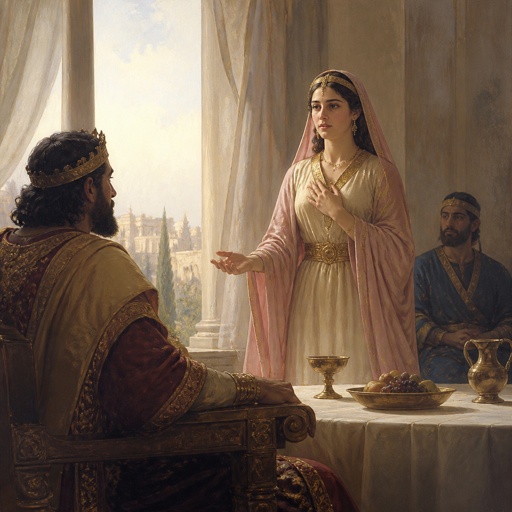
"Then answered Esther, and said, My petition and my request is;" - Esther 5:7

Esther 5:3 - "Then said the king unto her, What wilt thou, queen Esther? and what is thy request? it shall be even given thee to the half of the kingdom."

Esther 7:5 - "¶ Then the king Ahasuerus answered and said unto Esther the queen, Who is he, and where is he, that durst presume in his heart to do so?"

Esther 5:2 - "And it was so, when the king saw Esther the queen standing in the court, that she obtained favour in his sight: and the king held out to Esther the golden sceptre that was in his hand. So Esther drew near, and touched the top of the sceptre."
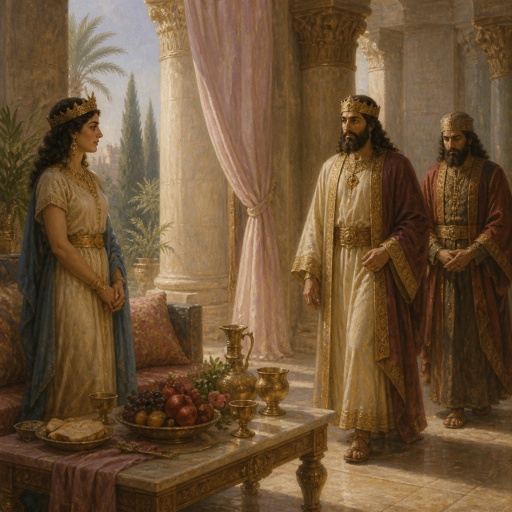
"Then the king said, Cause Haman to make haste, that he may do as Esther hath said. So the king and Haman came to the banquet that Esther had prepared." - Esther 5:5

Esther 4:5 - "Then called Esther for Hatach, one of the king's chamberlains, whom he had appointed to attend upon her, and gave him a commandment to Mordecai, to know what it was, and why it was."

Esther 5:6 - "¶ And the king said unto Esther at the banquet of wine, What is thy petition? and it shall be granted thee: and what is thy request? even to the half of the kingdom it shall be performed."

Esther 5:12 - "Haman said moreover, Yea, Esther the queen did let no man come in with the king unto the banquet that she had prepared but myself; and to morrow am I invited unto her also with the king."

Esther 9:14 - "And the king commanded it so to be done: and the decree was given at Shushan; and they hanged Haman's ten sons."

Esther 3:5 - "And when Haman saw that Mordecai bowed not, nor did him reverence, then was Haman full of wrath."

Esther 5:1 - "Now it came to pass on the third day, that Esther put on her royal apparel, and stood in the inner court of the king's house, over against the king's house: and the king sat upon his royal throne in the royal house, over against the gate of the house."

Esther 3:14 - "The copy of the writing for a commandment to be given in every province was published unto all people, that they should be ready against that day."

"And while they were yet talking with him, came the king's chamberlains, and hasted to bring Haman unto the banquet that Esther had prepared." - Esther 6:14
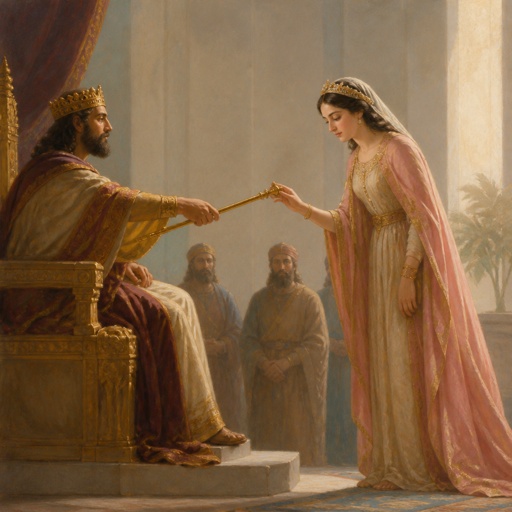
"And it was so, when the king saw Esther the queen standing in the court, that she obtained favour in his sight: and the king held out to Esther the golden sceptre that was in his hand. So Esther drew near, and touched the top of the sceptre." - Esther 5:2

Esther 6:5 - "And the king's servants said unto him, Behold, Haman standeth in the court. And the king said, Let him come in."

Esther 5:13 - "Yet all this availeth me nothing, so long as I see Mordecai the Jew sitting at the king's gate."

Esther 8:14 - "So the posts that rode upon mules and camels went out, being hastened and pressed on by the king's commandment. And the decree was given at Shushan the palace."

Esther 2:5 - "¶ Now in Shushan the palace there was a certain Jew, whose name was Mordecai, the son of Jair, the son of Shimei, the son of Kish, a Benjamite;"

Esther 5:10 - "Nevertheless Haman refrained himself: and when he came home, he sent and called for his friends, and Zeresh his wife."
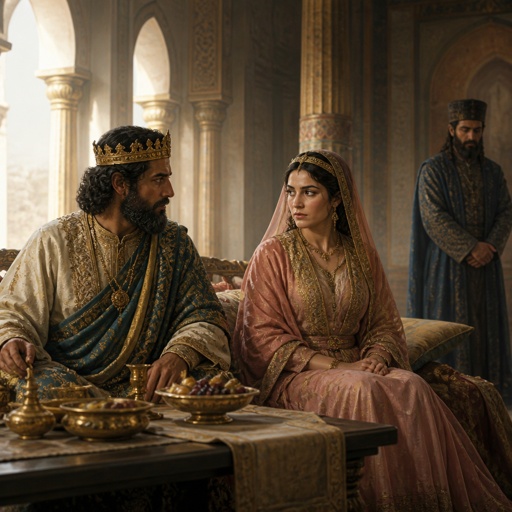
"¶ Then the king Ahasuerus answered and said unto Esther the queen, Who is he, and where is he, that durst presume in his heart to do so?" - Esther 7:5