What does Exodus 24:18 mean?
“And Moses went into the midst of the cloud, and gat him up into the mount: and Moses was in the mount forty days and forty nights.” — Exodus 24:18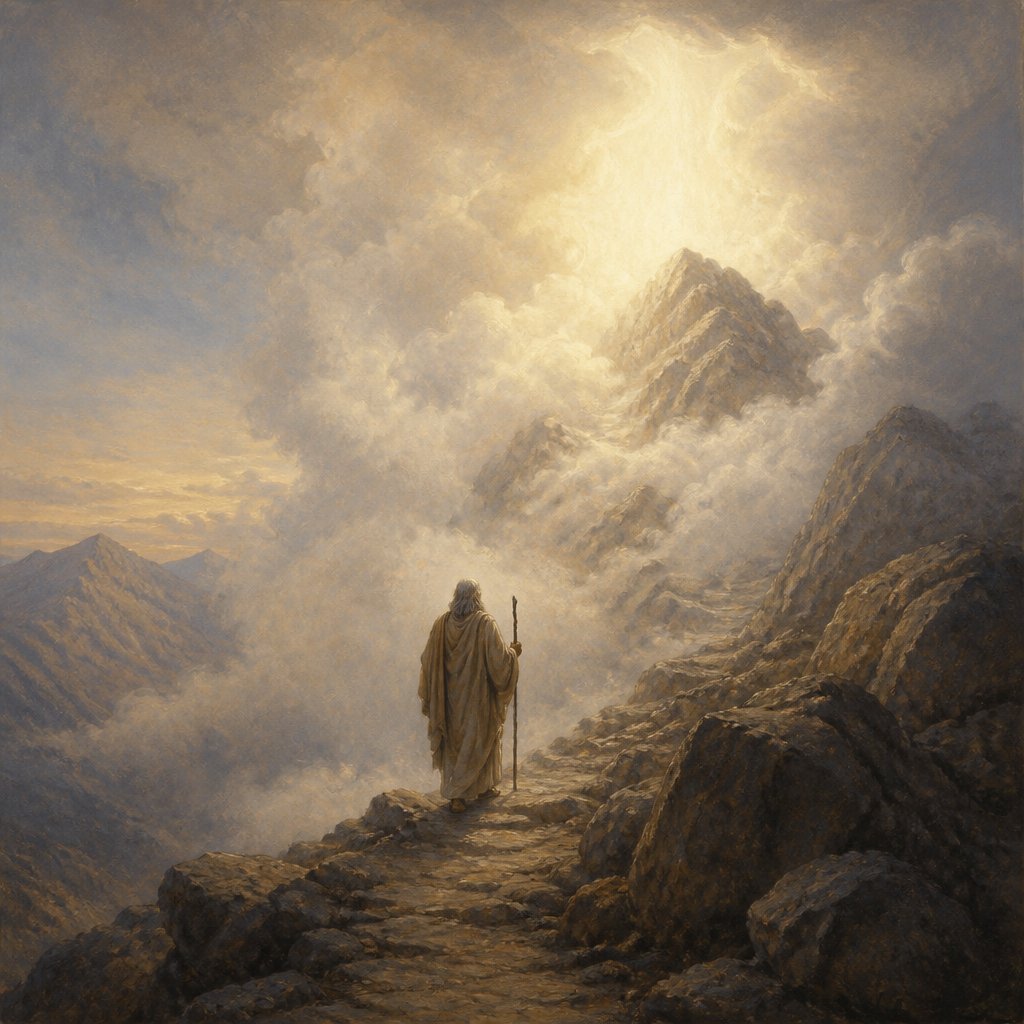
Exodus 24:18 in the King James Version of the Bible reads, "And Moses went into the midst of the cloud, and gat him up into the mount: and Moses was in the mount forty days and forty nights." This verse marks the conclusion of a pivotal moment in the Book of Exodus, during which Moses ascends Mount Sinai to receive the Ten Commandments from God. It is a profound and meaningful passage that holds significant theological, historical, and symbolic value within the overall narrative of the Exodus.
The Book of Exodus is a central text in the Hebrew Bible, and it recounts the liberation of the Israelites from slavery in Egypt and their subsequent journey to the Promised Land. Throughout the narrative, Moses is portrayed as the leader chosen by God to guide his people out of bondage and into a new covenant with Yahweh. The verse in question occurs after the Israelites have made a solemn commitment to uphold the covenant with God, and Moses has been summoned to receive the instructions and laws that will govern their society.
The image of Moses ascending the mountain is one of profound significance. In the biblical tradition, mountains are often depicted as places of encounter with the divine. This is particularly true in the case of Mount Sinai, where God is said to have manifested his presence in a powerful and awe-inspiring manner. For Moses to enter "the midst of the cloud" and ascend into the mount is to symbolize his direct communion with the divine. The cloud, in particular, is a powerful symbol of God's presence in the Hebrew Bible, signifying both his proximity and his mystery.
The fact that Moses was in the mount for "forty days and forty nights" is also laden with symbolism. The number forty is frequently used in the Bible to signify a period of testing, trial, or preparation. It is most prominently associated with the forty years that the Israelites spent wandering in the wilderness before reaching the Promised Land. In this context, it represents a period of intense and transformative encounter with God. The duration of his stay on the mountain underscores the importance and gravity of the revelation he is about to receive.
The broader theological themes at play in this verse revolve around the concept of the divine revelation of law. The Ten Commandments, which Moses is about to receive, are foundational to the entire moral and ethical framework of the biblical tradition. They form the basis of the covenant between God and the Israelites, outlining the principles that will govern their relationship with God and with one another. As such, Moses' ascent into the cloud and his extended stay on the mountain signify the momentous nature of this revelation, which will shape the identity and behavior of the Israelite community for generations to come.
From a contextual standpoint, this verse occurs within a pivotal moment in the Book of Exodus. The revelation of the Ten Commandments marks a turning point in the relationship between God and the Israelites, as well as in the formation of the nation of Israel. It establishes the moral and spiritual foundation upon which the Israelites will build their society and culture. Moreover, it sets the stage for the construction of the Tabernacle, the establishment of the priesthood, and the delineation of the sacrificial system, all of which are crucial aspects of Israelite religious practice.
In conclusion, Exodus 24:18 captures a profound and transformative moment in the biblical narrative, portraying the awe-inspiring encounter between Moses and God on Mount Sinai. The verse is rich in symbolism, conveying the profound significance of the revelation of the Ten Commandments and the establishment of the covenant between God and the Israelites. It serves as a powerful reminder of the foundational role of divine instruction and law in shaping the religious and moral identity of the Hebrew Bible's central figures. As such, it remains a crucial and evocative passage within the broader theological and narrative framework of the Book of Exodus.
Get our apps


Artwork for Exodus 24:18

Exodus 24:18 - "And Moses went into the midst of the cloud, and gat him up into the mount: and Moses was in the mount forty days and forty nights."
"And Moses went into the midst of the cloud, and gat him up into the mount: and Moses was in the mount forty days and forty nights." - Exodus 24:18
Exodus 18:24 - "So Moses hearkened to the voice of his father in law, and did all that he had said."
"So Moses hearkened to the voice of his father in law, and did all that he had said." - Exodus 18:24

Exodus 24:16

Exodus 24:17

Exodus 24:4

Exodus 18

Exodus 7:14-24

Exodus 24:9-11

Exodus 31: 18

exodus 18:11

Genesis 24-18

Genesis 18-24

Exodus 6:24 - "And the sons of Korah; Assir, and Elkanah, and Abiasaph: these are the families of the Korhites."

Exodus 24:15 - "And Moses went up into the mount, and a cloud covered the mount."

The Plague of Blood - Exodus 7:14-24

The Plague of Blood - Exodus 7:14-24

The Plague of Blood - Exodus 7:14-24

The Plague of Blood - Exodus 7:14-24

Exodus 21:24 - "Eye for eye, tooth for tooth, hand for hand, foot for foot,"

Exodus 37:24 - "Of a talent of pure gold made he it, and all the vessels thereof."

Exodus 22:18 - "¶ Thou shalt not suffer a witch to live."

Exodus 15:18 - "The LORD shall reign for ever and ever."

Exodus 35:18 - "The pins of the tabernacle, and the pins of the court, and their cords,"

Exodus 28:18 - "And the second row shall be an emerald, a sapphire, and a diamond."

Exodus 12:24 - "And ye shall observe this thing for an ordinance to thee and to thy sons for ever."

Exodus 15:24 - "And the people murmured against Moses, saying, What shall we drink?"

Exodus 24:9 - "¶ Then went up Moses, and Aaron, Nadab, and Abihu, and seventy of the elders of Israel:"

Exodus 2:24 - "And God heard their groaning, and God remembered his covenant with Abraham, with Isaac, and with Jacob."