
Ezra 10:42 in the King James Version reads, "Shallum, Amariah, and Joseph." At first glance, this verse may seem simple and straightforward, but when placed in its larger context within the Book of Ezra, it takes on deeper significance.
The Book of Ezra is set in the post-exilic period, during the time when the Israelites were returning to Jerusalem from Babylon. The focus of the book is on the restoration of the community and the rebuilding of the temple. The people had strayed from the ways of the Lord and had intermarried with the surrounding pagan nations, leading to a dilution of their faith and identity. Ezra, a scribe and priest, played a crucial role in leading the people towards repentance and renewal of their commitment to God's law.
In Chapter 10, Ezra confronts the issue of intermarriage directly. He calls for a national assembly and urges the people to confess their sins and separate from their pagan spouses. This was a difficult and controversial decision, as it meant breaking up families and causing great personal pain. However, it was necessary for the spiritual purity and survival of the community. The verse Ezra 10:42 is part of a list of those who had taken foreign wives and were compelled to put them away.
The mention of Shallum, Amariah, and Joseph in this verse can be seen as a reminder of the individual responsibility within the community. Each of these names represents a real person who had made the mistake of marrying outside of their faith. By including their names in the list, the verse emphasizes that no one is exempt from accountability. The act of confessing and separating from foreign spouses was a public and communal one, but it also required personal conviction and action from each individual.
It is also worth noting that these names are not accompanied by any further details or commentary. This could suggest that the focus is not on the specific individuals themselves, but rather on the collective responsibility and the broader message of repentance and obedience. The insertion of their names in the list serves as a tangible representation of the larger issue at hand – the need for the entire community to turn away from their disobedience and recommit themselves to God's covenant.
Furthermore, the verse can serve as a symbolic representation of the process of spiritual purification and renewal. The act of separation from foreign wives can be seen as a metaphor for the need to rid oneself of any influences or commitments that draw a person away from God. It requires a willingness to confront and let go of the things that hinder a person's relationship with the divine. This theme of separation and cleansing is echoed throughout the Bible, particularly in the Old Testament, as a necessary step towards holiness and obedience.
In a broader context, this verse highlights the tension between individual choice and communal responsibility. It underscores the idea that the actions of each person have an impact on the entire community. Through the inclusion of these names, the verse prompts readers to reflect on their own personal choices and their implications for their faith community. It also speaks to the need for communal accountability and support in the pursuit of righteousness.
In conclusion, Ezra 10:42, although seemingly brief, is a significant verse that encapsulates the themes of repentance, communal responsibility, and spiritual renewal. It represents a pivotal moment in the history of the Israelites, as they grappled with the challenges of maintaining their faith and identity in the midst of cultural mingling. The verse serves as a powerful reminder of the importance of personal conviction and collective accountability in the pursuit of righteousness.
Get our apps


Artwork for Ezra 10:42

Ezra 10:42 - "Shallum, Amariah, and Joseph."

"Shallum, Amariah, and Joseph." - Ezra 10:42

Ezra 10:10-12

Ezra 10:10 - "And Ezra the priest stood up, and said unto them, Ye have transgressed, and have taken strange wives, to increase the trespass of Israel."
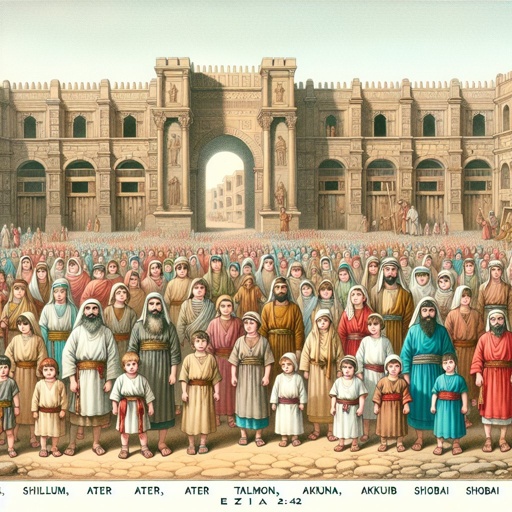
Ezra 2:42 - "¶ The children of the porters: the children of Shallum, the children of Ater, the children of Talmon, the children of Akkub, the children of Hatita, the children of Shobai, in all an hundred thirty and nine."

Ezra 10:3

Ezra 3:10

Ezra 10:3

Ezra 10:5 - "Then arose Ezra, and made the chief priests, the Levites, and all Israel, to swear that they should do according to this word. And they sware."

Ezra 7:10 - "For Ezra had prepared his heart to seek the law of the LORD, and to do it, and to teach in Israel statutes and judgments."

Ezra 10:38 - "And Bani, and Binnui, Shimei,"

Ezra 10:37 - "Mattaniah, Mattenai, and Jaasau,"

Ezra 10:40 - "Machnadebai, Shashai, Sharai,"

Ezra 10:32 - "Benjamin, Malluch, and Shemariah."

John 10:42 - "And many believed on him there."

Ezra 10:36 - "Vaniah, Meremoth, Eliashib,"

Ezra 10:35 - "Benaiah, Bedeiah, Chelluh,"

Ezra 10:41 - "Azareel, and Shelemiah, Shemariah,"

Ezra 10:39 - "And Shelemiah, and Nathan, and Adaiah,"

Ezra 10:20 - "And of the sons of Immer; Hanani, and Zebadiah."

Ezra 10:34 - "Of the sons of Bani; Maadai, Amram, and Uel,"

Ezra 2:10 - "The children of Bani, six hundred forty and two."

Ezra 10:21 - "And of the sons of Harim; Maaseiah, and Elijah, and Shemaiah, and Jehiel, and Uzziah."

Ezra 10:24 - "Of the singers also; Eliashib: and of the porters; Shallum, and Telem, and Uri."

Ezra 10:28 - "Of the sons also of Bebai; Jehohanan, Hananiah, Zabbai, and Athlai."

Ezra 10:31 - "And of the sons of Harim; Eliezer, Ishijah, Malchiah, Shemaiah, Shimeon,"

"Azareel, and Shelemiah, Shemariah," - Ezra 10:41

"And Bani, and Binnui, Shimei," - Ezra 10:38

"And Shelemiah, and Nathan, and Adaiah," - Ezra 10:39

"Vaniah, Meremoth, Eliashib," - Ezra 10:36