What does Ezra 2:70 mean?
“So the priests, and the Levites, and some of the people, and the singers, and the porters, and the Nethinims, dwelt in their cities, and all Israel in their cities.” — Ezra 2:70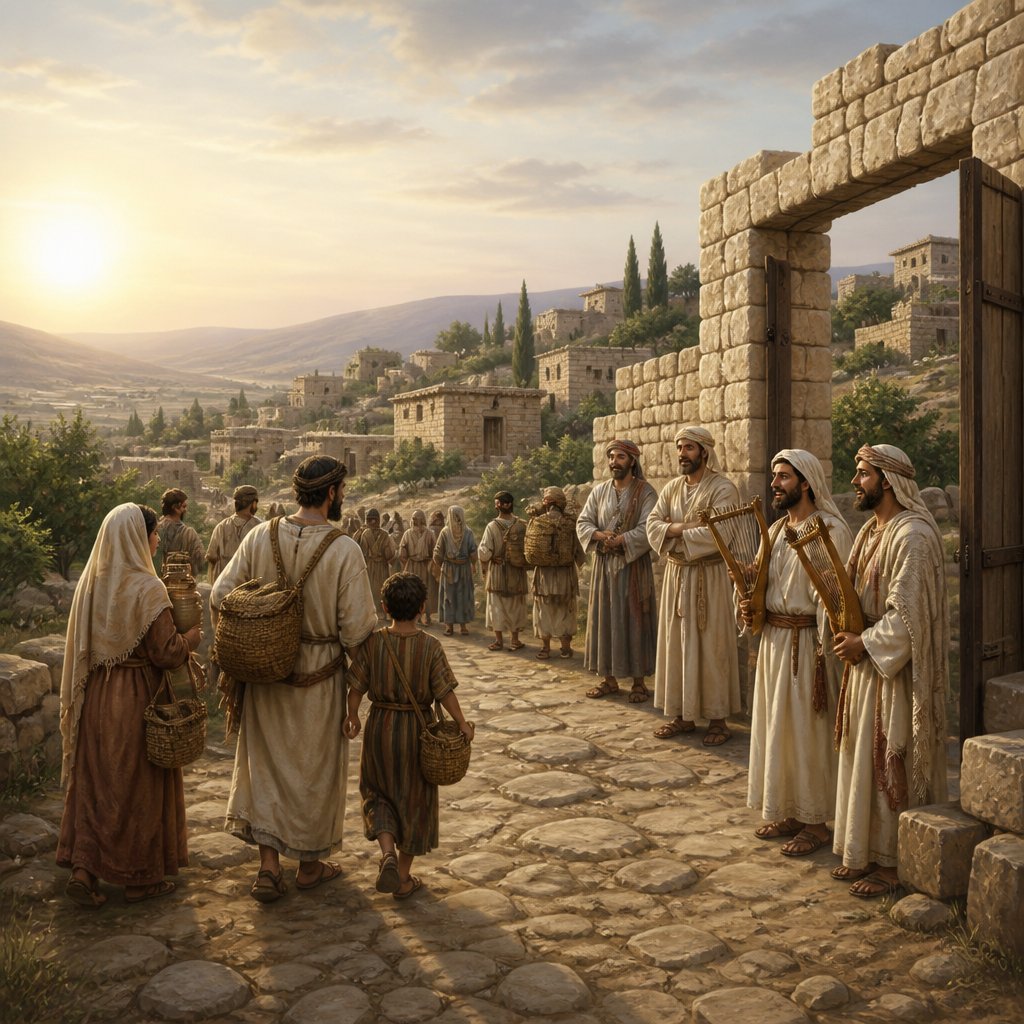
The King James Version of Ezra 2:70 reads, "So the priests, and the Levites, and some of the people, and the singers, and the porters, and the Nethinims, dwelt in their cities, and all Israel in their cities." At first glance, this verse may seem straightforward and unremarkable, but upon closer examination, it becomes clear that there is a deeper meaning and significance to be found within its words.
The book of Ezra is a part of the Hebrew Bible and the Old Testament of the Christian Bible. It takes place during the period of the Jewish exile in Babylon, and it tells the story of the Israelites' return to Jerusalem and the rebuilding of the temple. This verse comes near the end of a long list of names and numbers, detailing the people who returned to Jerusalem from exile. These details may seem tedious and unimportant to modern readers, but they serve to emphasize the significance of the return to Jerusalem and the reestablishment of the Jewish community in their homeland.
In the context of the book of Ezra, this verse reflects the reconstitution of the religious community in Jerusalem. The priests and Levites were responsible for maintaining the religious rituals and practices, the singers played a key role in the worship services, and the porters were gatekeepers of the temple. The Nethinims were a class of temple servants, who were dedicated to the service of God. By stating that all these groups "dwelt in their cities," the verse emphasizes the reestablishment of the religious life in Jerusalem.
The inclusion of "all Israel" in this verse is significant as well. The return to Jerusalem was not just a physical relocation, but a spiritual and cultural reclamation of their identity as the people of God. This verse emphasizes the unification of the Jewish people in their ancestral homeland, and the recommitment to their religious practices and traditions.
The themes present in this verse are themes of restoration, community, and devotion. The return to Jerusalem was a restoration of the Jewish people's identity and a reclamation of their religious heritage. It was also a time of building and strengthening the community, as the various groups listed in the verse came together to support and uphold one another in their new lives in Jerusalem. The devotion of the people to their religious practices and to each other is evident in their willingness to leave behind the familiarity of exile and return to the city of their ancestors.
The symbolism in this verse is powerful as well. The rebuilding of the temple and the reestablishment of the religious community can be seen as a symbol of spiritual renewal and hope. It represents the faith of the people in God's promises and their willingness to follow His guidance. The coming together of the different groups within the community symbolizes unity and a shared purpose among the people of Israel.
In conclusion, Ezra 2:70 may seem like a simple list of names and groups, but it holds within it a deep and profound meaning. It speaks to the restoration of the Jewish community in Jerusalem, the unification of the people of Israel, and the recommitment to their religious heritage. It is a testament to the faith and devotion of the Jewish people, and a symbol of hope and renewal for all who read its words.
Get our apps


Artwork for Ezra 2:70
Ezra 2:70 - "So the priests, and the Levites, and some of the people, and the singers, and the porters, and the Nethinims, dwelt in their cities, and all Israel in their cities."
"So the priests, and the Levites, and some of the people, and the singers, and the porters, and the Nethinims, dwelt in their cities, and all Israel in their cities." - Ezra 2:70

Psalms 70:2 - "Let them be ashamed and confounded that seek after my soul: let them be turned backward, and put to confusion, that desire my hurt."

Ezra 3:2

Ezra 3:2

Ezra 3:2

Ezra 3:2

Ezra 3:2

Ezra 9:1-2

Zerubbabel in Ezra chapter 2

Ezra 2:22 - "The men of Netophah, fifty and six."
Ezra 2:18 - "The children of Jorah, an hundred and twelve."

Ezra 2:54 - "The children of Neziah, the children of Hatipha."

Ezra 2:20 - "The children of Gibbar, ninety and five."

Ezra 2:24 - "The children of Azmaveth, forty and two."

Ezra 2:39 - "The children of Harim, a thousand and seventeen."

Ezra 9:1-2

Ezra 2:9 - "The children of Zaccai, seven hundred and threescore."

Ezra 2:27 - "The men of Michmas, an hundred twenty and two."

Ezra 2:29 - "The children of Nebo, fifty and two."

Ezra 2:56 - "The children of Jaalah, the children of Darkon, the children of Giddel,"

Ezra 2:11 - "The children of Bebai, six hundred twenty and three."

Ezra 2:53 - "The children of Barkos, the children of Sisera, the children of Thamah,"

Ezra 2:45 - "The children of Lebanah, the children of Hagabah, the children of Akkub,"

Ezra 2:48 - "The children of Rezin, the children of Nekoda, the children of Gazzam,"

Ezra 2:15 - "The children of Adin, four hundred fifty and four."

Ezra 2:21 - "The children of Beth-lehem, an hundred twenty and three."

Ezra 2:51 - "The children of Bakbuk, the children of Hakupha, the children of Harhur,"

Ezra 2:49 - "The children of Uzza, the children of Paseah, the children of Besai,"

Ezra 7:2 - "The son of Shallum, the son of Zadok, the son of Ahitub,"