What does Ezra 7:2 mean?
“The son of Shallum, the son of Zadok, the son of Ahitub,” — Ezra 7:2
Ezra 7:2 in the King James Version (KJV) of the Bible reads, “The son of Shallum, the son of Zadok, the son of Ahitub.” This verse may seem simple and unimpressive at first glance, but when we delve deeper into its context and significance, we find that it holds a rich tapestry of meaning and symbolism.
The book of Ezra, which contains this verse, is part of the Hebrew Bible and the Old Testament. It is a historical book that recounts the events surrounding the Jewish people's return to Jerusalem from exile in Babylon. Ezra, the central figure of the book, was a scribe and a priest who played a key role in the restoration of the Jewish community and the reestablishment of their religious practices. The verse in question is part of a genealogy, tracing Ezra's lineage back to Shallum, Zadok, and Ahitub.
Genealogies are a common feature in the Old Testament, and they serve several important purposes. First and foremost, they establish the legitimacy and authenticity of the individuals and groups mentioned in the narrative. In the case of Ezra, his lineage is important because it establishes his credentials as a member of the priestly line, giving him the authority to lead the religious community in Jerusalem. Additionally, genealogies are a way of connecting the present to the past, linking individuals to their ancestors and their collective history. In this sense, they provide a sense of continuity and identity for the Jewish people, reminding them of their roots and heritage.
The specific names mentioned in this verse – Shallum, Zadok, and Ahitub – also carry meaning and symbolism. Shallum, which means “retribution” or “repayment,” may suggest a sense of justice and accountability. Zadok, whose name means "righteous," is a figure associated with the priesthood in the Old Testament and is often seen as a symbol of faithfulness and integrity. Ahitub, meaning “brother of goodness,” hints at the idea of benevolence and kindness. Together, these names form a narrative of moral and spiritual qualities that are of central importance in the religious and ethical teachings of the Hebrew Bible.
In a broader sense, this verse is part of a larger narrative that emphasizes continuity and tradition. The genealogy of Ezra connects him to the history of his people and the religious heritage that defines their identity. It serves as a reminder that the community's faith and values are not disconnected from their past but are rooted in the deep and ancient traditions of their ancestors. This sense of continuity and tradition is a recurring theme throughout the Old Testament and is central to the Jewish understanding of their faith.
Furthermore, the genealogy in Ezra 7:2 also reflects the broader themes of restoration and renewal that are present throughout the book. The return from exile in Babylon was a pivotal moment in Jewish history, marking a new beginning and a chance to rebuild their community and religious life. Ezra's role in this process is significant, as he is seen as a key figure in the restoration of the temple and the reestablishment of the Mosaic law. The genealogy that connects him to his forefathers underscores the sense of renewal and continuity that characterized this period in Jewish history.
In conclusion, Ezra 7:2, though a simple verse at first glance, carries layers of meaning and symbolism that speak to important themes within the broader narrative of the Hebrew Bible. It highlights the significance of genealogy as a way of establishing legitimacy and connecting individuals to their collective history. It also emphasizes the themes of continuity and tradition, as well as the broader context of restoration and renewal. Ultimately, this verse serves as a reminder of the deep roots and enduring values of the Jewish faith, and the importance of understanding and honoring their ancestral heritage.
Get our apps


Artwork for Ezra 7:2

Ezra 7:2 - "The son of Shallum, the son of Zadok, the son of Ahitub,"

"The son of Shallum, the son of Zadok, the son of Ahitub," - Ezra 7:2

Ezra 2:7 - "The children of Elam, a thousand two hundred fifty and four."

"The children of Elam, a thousand two hundred fifty and four." - Ezra 2:7

Ezra 7:12 - "Artaxerxes, king of kings, unto Ezra the priest, a scribe of the law of the God of heaven, perfect peace, and at such a time."

Ezra 7:10 - "For Ezra had prepared his heart to seek the law of the LORD, and to do it, and to teach in Israel statutes and judgments."

Ezra 7:1 - "Now after these things, in the reign of Artaxerxes king of Persia, Ezra the son of Seraiah, the son of Azariah, the son of Hilkiah,"

Ezra 7:11 - "¶ Now this is the copy of the letter that the king Artaxerxes gave unto Ezra the priest, the scribe, even a scribe of the words of the commandments of the LORD, and of his statutes to Israel."

Ezra 7:4 - "The son of Zerahiah, the son of Uzzi, the son of Bukki,"

Ezra 7:3 - "The son of Amariah, the son of Azariah, the son of Meraioth,"
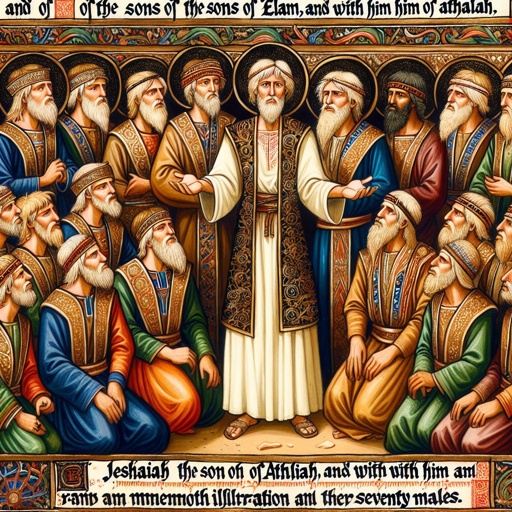
Ezra 8:7 - "And of the sons of Elam; Jeshaiah the son of Athaliah, and with him seventy males."

Ezra 3:2

Ezra 3:2

Ezra 3:2

Ezra 7:8 - "And he came to Jerusalem in the fifth month, which was in the seventh year of the king."

Ezra 7:21 - "And I, even I Artaxerxes the king, do make a decree to all the treasurers which are beyond the river, that whatsoever Ezra the priest, the scribe of the law of the God of heaven, shall require of you, it be done speedily,"

Ezra 7:7 - "And there went up some of the children of Israel, and of the priests, and the Levites, and the singers, and the porters, and the Nethinims, unto Jerusalem, in the seventh year of Artaxerxes the king."

Ezra 3:2

Ezra 3:2

Ezra 7:5 - "The son of Abishua, the son of Phinehas, the son of Eleazar, the son of Aaron the chief priest:"

Ezra 9:1-2

Zerubbabel in Ezra chapter 2

Ezra 2:22 - "The men of Netophah, fifty and six."
Ezra 2:18 - "The children of Jorah, an hundred and twelve."

Ezra 2:54 - "The children of Neziah, the children of Hatipha."

Ezra 2:20 - "The children of Gibbar, ninety and five."

Ezra 2:24 - "The children of Azmaveth, forty and two."

Ezra 2:39 - "The children of Harim, a thousand and seventeen."

Ezra 7:6 - "This Ezra went up from Babylon; and he was a ready scribe in the law of Moses, which the LORD God of Israel had given: and the king granted him all his request, according to the hand of the LORD his God upon him."

Ezra 7:25 - "And thou, Ezra, after the wisdom of thy God, that is in thine hand, set magistrates and judges, which may judge all the people that are beyond the river, all such as know the laws of thy God; and teach ye them that know them not."