What does Genesis 16:13 mean?
"And she called the name of the LORD that spake unto her, Thou God seest me: for she said, Have I also here looked after him that seeth me?" - Genesis 16:13
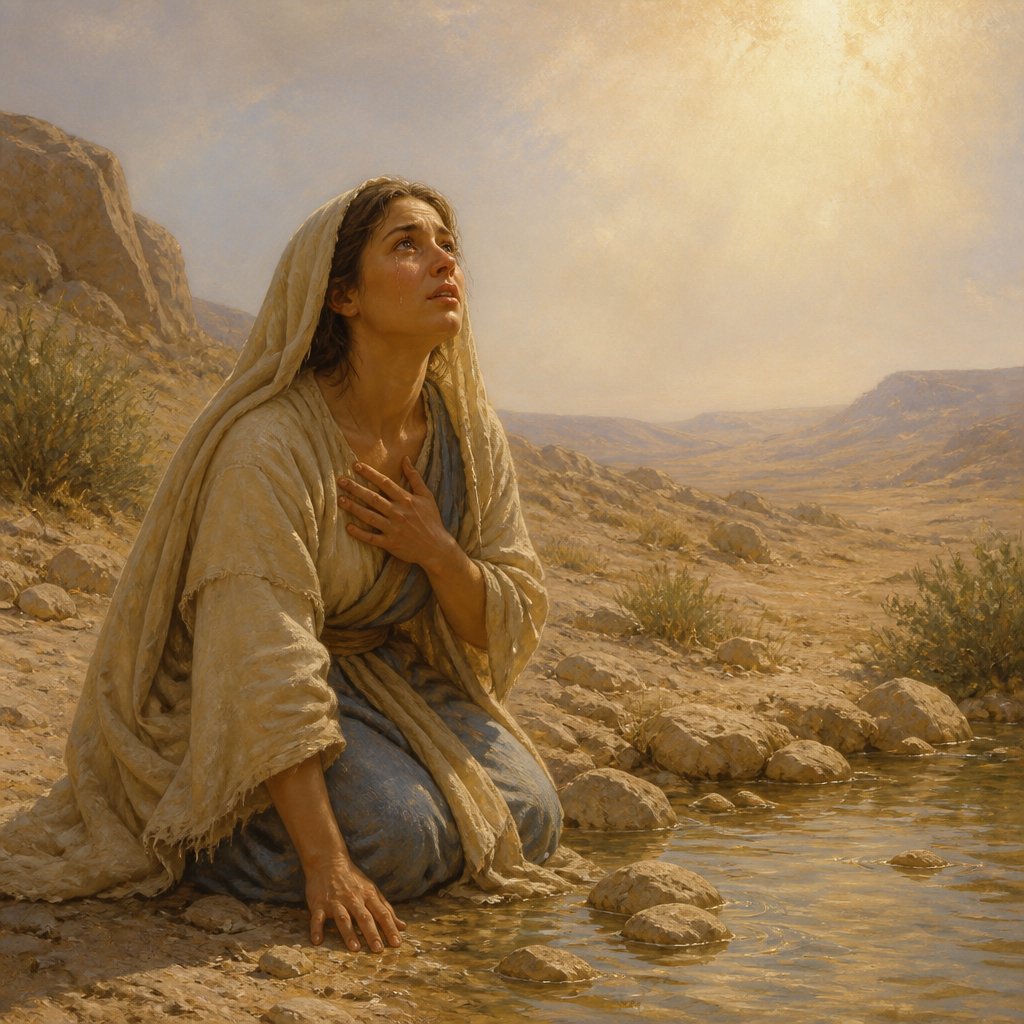
Genesis 16:13 in the KJV reads, “And she called the name of the LORD that spake unto her, Thou God seest me: for she said, Have I also here looked after him that seeth me?” The verse stands at the emotional and theological center of Hagar’s flight into the wilderness, and its meaning comes into focus when it is read as the response of an afflicted, displaced woman who discovers that the God of Abram is not confined to tents, households, or the privileges of those in power, but is present, speaking, and seeing even in desolation.
The immediate context is the household conflict created by Sarai’s barrenness and her plan to obtain children by Hagar. When Hagar conceives, tensions rise; Sarai deals hardly with her, and Hagar flees. In the wilderness the angel of the LORD finds her by a fountain of water and addresses her personally, calling her by name and asking where she has come from and where she is going. He then gives her a hard command and a hopeful promise: she must return and submit herself, yet she is also assured that her seed will be multiplied exceedingly, and she is told the name of her son, “Ishmael,” with its explanation that “the LORD hath heard thy affliction.” Genesis 16:13 is Hagar’s answering confession after this encounter. It is not merely relief at being noticed; it is worship, recognition, and a re-naming of God as she has now come to know Him in her own suffering.
The first theme is divine sight as intimate knowledge and compassionate attention. Hagar “called the name of the LORD that spake unto her, Thou God seest me.” In Scripture, God’s seeing is never passive observation. It is active regard, the kind of seeing that includes hearing, visiting, and intervening. The angel of the LORD had already interpreted her experience by saying that the LORD “hath heard thy affliction.” Now Hagar adds the corresponding truth: the LORD sees. In the wilderness, where she might have felt unprotected, unnoticed, and erased, she discovers that her life is fully within God’s awareness. This is significant because Hagar is a servant, a foreigner, and a woman driven out by those with authority over her. Yet the LORD speaks to her directly, and she responds by naming Him according to what she has just learned: the God who sees.
A second theme is revelation that comes through God’s speech. The verse begins, “And she called the name of the LORD that spake unto her.” The seeing of God is connected to the speaking of God. The LORD does not merely watch Hagar; He addresses her, questions her, commands her, and promises her. In the KJV, the title “LORD” marks the covenant name, showing that the One who has bound Himself to Abram is the same One who turns toward Hagar. What she learns about God is not derived from her status in Abram’s household, but from the fact that God Himself “spake unto her.” The significance here is that God’s knowledge of the afflicted is not abstract; it becomes personal and verbal. God’s word meets Hagar in the place she least expected to receive it.
A third theme is the astonishment of survival in the presence of God. Hagar says, “Have I also here looked after him that seeth me?” The phrase carries the sense of wonder that she has had an encounter with the One who sees her, and that she remains alive to speak of it. In the world of Genesis, the presence of God is holy and overwhelming; the idea that a human might “look after” or behold God and live is extraordinary. Hagar’s question expresses reverent amazement: she has been seen by God, and she has in some sense perceived Him, encountered Him, and come away preserved. This is why the verse matters: it is not only about God’s gaze upon a suffering person, but about the miracle that the suffering person is granted a real meeting with God, and that this meeting becomes the turning point in her story.
Symbolically, the wilderness and the fountain of water intensify the meaning of the verse. The wilderness is a place of exposure, scarcity, and danger; it represents the condition of being cast out and having no visible provision. The fountain is a sign of life and mercy in a deathlike landscape. That the LORD finds her there shows that divine sight penetrates the most barren places, and divine provision appears where human provision has failed. Hagar’s naming of God grows out of that geography: the God who sees is the God who finds, the God who meets, the God who sustains in the desert. Her confession is therefore tied to the setting; it is a testimony born from extremity.
The verse also carries a theme of identity and dignity. Hagar has been treated as an instrument for another person’s plan and then as a problem to be dealt with. Yet in Genesis 16 the LORD addresses her as a person with a future, names her child, and ties her suffering to His own awareness. When Hagar calls the LORD “Thou God seest me,” she is implicitly declaring that her life is not negligible. Divine sight confers dignity. Her affliction is not invisible, and her story is not outside God’s care. This is part of the significance of Genesis 16 within the larger narrative: even as God’s covenant line moves forward through Abram, God’s compassion and attention are shown to extend beyond the central household to the one who has been pushed to the margins.
Finally, Genesis 16:13 functions as a theological testimony within Genesis: God is the One who sees and hears, and His seeing is bound up with His faithfulness and His governance of human history. The verse does not deny the complexities to come in the lives of Hagar and Ishmael; it does, however, establish that God’s dealings with them are not incidental. Hagar’s words preserve the memory of an encounter in which the LORD’s character is disclosed in the wilderness as the God who sees the afflicted and speaks hope into their flight. In that way, the verse stands as a quiet but profound witness that no place is too remote, and no person too overlooked, for the LORD who sees.
Have questions about Genesis 16:13?
Dive deeper into this scripture with Bible Chat — an AI-powered tool for exploring God's Word through conversation. Ask questions, get context, and grow in your understanding of the Bible.
Get Our Apps


Genesis 16:13 Artwork

Genesis 16:13

Genesis 16:13 - "And she called the name of the LORD that spake unto her, Thou God seest me: for she said, Have I also here looked after him that seeth me?"
"And she called the name of the LORD that spake unto her, Thou God seest me: for she said, Have I also here looked after him that seeth me?" - Genesis 16:13
"And she called the name of the LORD that spake unto her, Thou God seest me: for she said, Have I also here looked after him that seeth me?" - Genesis 16:13

Genesis 13:16 - "And I will make thy seed as the dust of the earth: so that if a man can number the dust of the earth, then shall thy seed also be numbered."

Genesis 16:16

Genesis 13:16 And I will make thy seed as the dust of the earth: so that if a man can number the dust of the earth, then shall thy seed also be numbered.

Genesis 16:3

Genesis 16:14

Genesis 16:2

Genesis 16:6

Genesis 1:16

Genesis 15:16

Genesis 16:8

Genesis 16:12

Genesis 25-16

Genesis 16:1

Genesis 18-16

Genesis 16:11

Genesis 3:16

Genesis 17-16

Genesis 16:4

Genesis 16:7

Genesis 23-16

Genesis 16:9

Genesis 16:5

Genesis 20-16

Genesis 28-16

Genesis 22-16

Genesis 16:15