What does Genesis 43:5 mean?
“But if thou wilt not send him, we will not go down: for the man said unto us, Ye shall not see my face, except your brother be with you.” — Genesis 43:5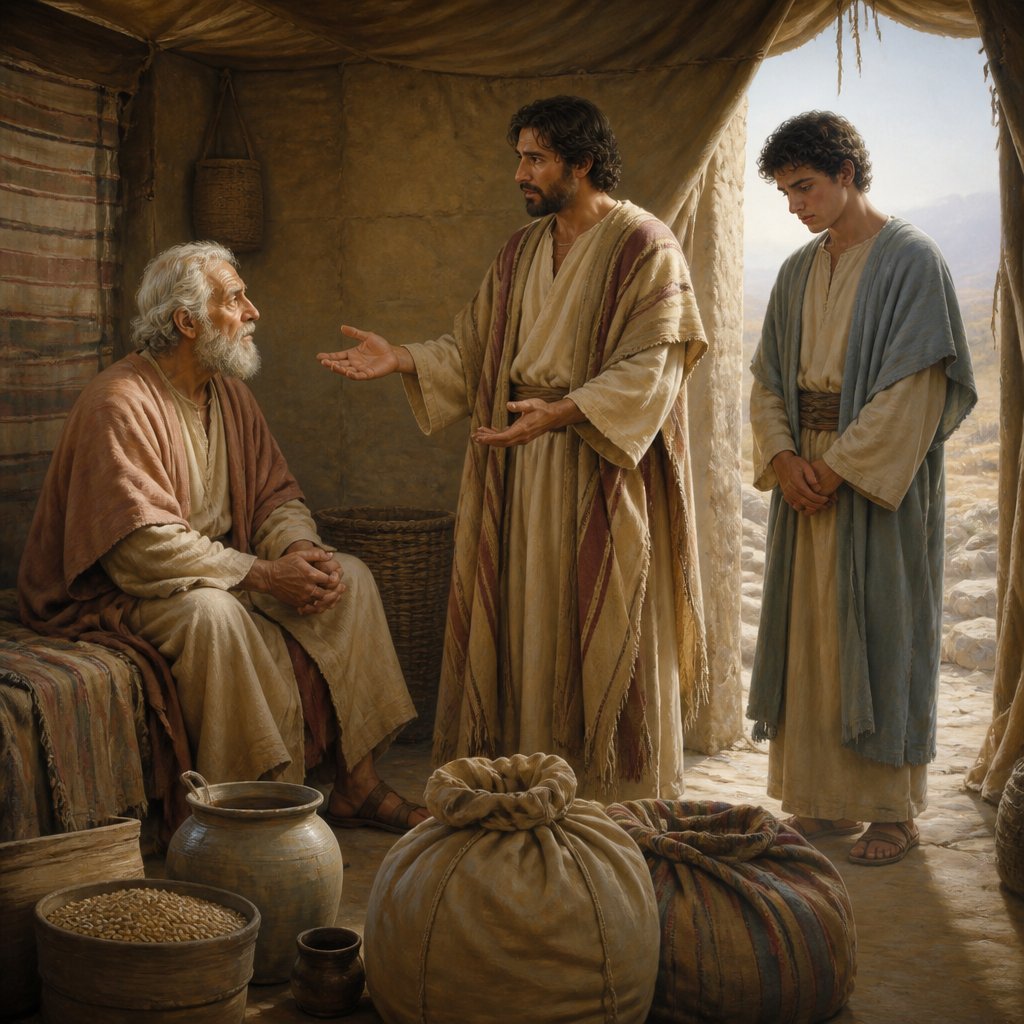
In Genesis 43:5 (KJV), we read the following words spoken by the patriarch Jacob to his sons, "But if thou wilt not send him, we will not go down: for the man said unto us, Ye shall not see my face, except your brother be with you." This verse is an essential part of the narrative in the Book of Genesis, where Joseph's brothers- who had sold him into slavery- are compelled to return to Egypt to purchase food during a time of famine. Joseph, who had become a powerful figure in Egypt, demanded that the brothers return with their youngest brother, Benjamin, as a condition for their survival.
This verse reflects the themes of family loyalty, reconciliation, and the fulfillment of divine prophecy. It also showcases the complexities of human relationships and the consequences of past actions. To fully understand the significance of this verse, we must consider its broader context within the biblical narrative and the symbolism that it carries.
First and foremost, the verse highlights the importance of family loyalty. Jacob, as the patriarch, expresses his concern for his youngest son's well-being and the necessity of fulfilling the demands of the powerful Egyptian ruler (Joseph, unbeknownst to him). This underscores the deep familial bonds and the lengths to which one is willing to go for the sake of family unity and survival. The verse serves as a reminder of the timeless value placed on family relationships in the biblical tradition.
Furthermore, the verse also speaks to the theme of reconciliation. The brothers' journey to Egypt provides an opportunity for them to confront their past actions and seek reconciliation with Joseph. Their initial betrayal and sale of Joseph into slavery had caused deep rifts within the family, leading to years of separation and suffering. Now, they are faced with the chance to right their wrongs and restore harmony within their family. This theme of reconciliation is a powerful and enduring message found throughout the Bible and holds great significance for believers today.
Moreover, the verse demonstrates the fulfillment of divine prophecy. The demand for Benjamin's presence in Egypt was a part of God's plan to reunite Joseph with his family and preserve the line of the Israelites. This narrative serves as a reminder of the overarching providence and sovereignty of God, who works through human actions and circumstances to bring about his ultimate purposes. It also emphasizes the importance of trust and obedience in following God's will, even when it may seem difficult or perplexing.
Symbolically, the verse can be seen as representing the idea of facing and overcoming past mistakes and hardships. The brothers' journey to Egypt can be understood as a metaphor for the process of repentance and reconciliation. Their willingness to confront their past and make amends reflects the transformative power of forgiveness and redemption. The demand for Benjamin's presence serves as a catalyst for the brothers' transformation, leading to a profound reunion with Joseph and the restoration of their fractured family.
In conclusion, Genesis 43:5 (KJV) holds profound meaning within the broader biblical narrative. It conveys important themes of family loyalty, reconciliation, and the fulfillment of divine prophecy. It calls upon believers to reflect on the complexities of human relationships and the importance of facing and overcoming past mistakes. The verse also serves as a powerful reminder of the enduring message of forgiveness, redemption, and the providence of God in the face of adversity. It continues to inspire and resonate with believers as a profound and timeless expression of biblical truth.
Get our apps


Artwork for Genesis 43:5

Genesis 43:5 - "But if thou wilt not send him, we will not go down: for the man said unto us, Ye shall not see my face, except your brother be with you."
"But if thou wilt not send him, we will not go down: for the man said unto us, Ye shall not see my face, except your brother be with you." - Genesis 43:5

Genesis 24-43

Genesis 43:1 - "And the famine was sore in the land."

"And the famine was sore in the land." - Genesis 43:1

Genesis 43:19 - "And they came near to the steward of Joseph's house, and they communed with him at the door of the house,"

Genesis 43:13 - "Take also your brother, and arise, go again unto the man:"

Genesis 43:17 - "And the man did as Joseph bade; and the man brought the men into Joseph's house."

Genesis 43:20 - "And said, O sir, we came indeed down at the first time to buy food:"

Genesis 43:25 - "And they made ready the present against Joseph came at noon: for they heard that they should eat bread there."

Genesis 30:43 - "And the man increased exceedingly, and had much cattle, and maidservants, and menservants, and camels, and asses."

Genesis 43:4 - "If thou wilt send our brother with us, we will go down and buy thee food:"

Genesis 43:10 - "For except we had lingered, surely now we had returned this second time."

Genesis 43:31 - "And he washed his face, and went out, and refrained himself, and said, Set on bread."

Genesis 43:24 - "And the man brought the men into Joseph's house, and gave them water, and they washed their feet; and he gave their asses provender."

Genesis 36:43 - "Duke Magdiel, duke Iram: these be the dukes of Edom, according to their habitations in the land of their possession: he is Esau the father of the Edomites."

Genesis 43:6 - "And Israel said, Wherefore dealt ye so ill with me, as to tell the man whether ye had yet a brother?"

Genesis 27:43 - "Now therefore, my son, obey my voice; and arise, flee thou to Laban my brother to Haran;"

Genesis 43:26 - "¶ And when Joseph came home, they brought him the present which was in their hand into the house, and bowed themselves to him to the earth."

Genesis 43:33 - "And they sat before him, the firstborn according to his birthright, and the youngest according to his youth: and the men marvelled one at another."

Genesis 43:28 - "And they answered, Thy servant our father is in good health, he is yet alive. And they bowed down their heads, and made obeisance."

Genesis 43:12 - "And take double money in your hand; and the money that was brought again in the mouth of your sacks, carry it again in your hand; peradventure it was an oversight:"

Genesis 43:15 - "And the men took that present, and they took double money in their hand, and Benjamin; and rose up, and went down to Egypt, and stood before Joseph."

Genesis 43:27 - "And he asked them of their welfare, and said, Is your father well, the old man of whom ye spake? Is he yet alive?"

Mark 5:43 - "And he charged them straitly that no man should know it; and commanded that something should be given her to eat."

Ezekiel 43:5 - "So the spirit took me up, and brought me into the inner court; and, behold, the glory of the LORD filled the house."

Genesis 43:22 - "And other money have we brought down in our hands to buy food: we cannot tell who put our money in our sacks."

Matthew 5:43 - "¶ Ye have heard that it hath been said, Thou shalt love thy neighbour, and hate thine enemy."

Isaiah 43:5 - "Fear not: for I am with thee: I will bring thy seed from the east, and gather thee from the west;"

"Take also your brother, and arise, go again unto the man:" - Genesis 43:13