What does Genesis 9:25 mean?
“And he said, Cursed be Canaan; a servant of servants shall he be unto his brethren.” — Genesis 9:25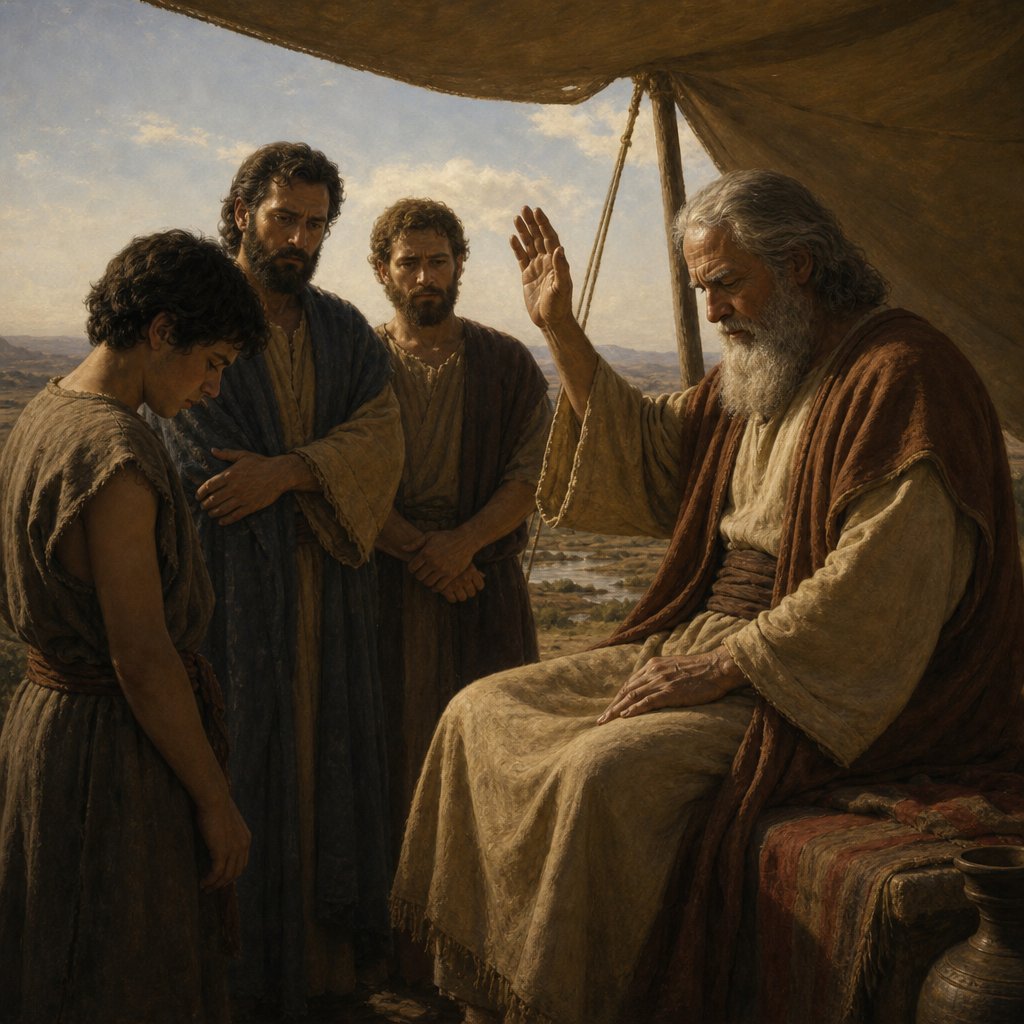
Genesis 9:25 from the King James Version (KJV) states, "And he said, Cursed be Canaan; a servant of servants shall he be unto his brethren." This verse comes from the story of Noah and his sons, Shem, Ham, and Japheth, after the incident where Noah became drunk and uncovered himself in his tent.
In this verse, Noah pronounces a curse on Canaan, the son of Ham. It is important to note that he is not cursing Ham directly, but rather his son Canaan. This distinction is significant because it sets the stage for the narrative of the Israelites' relationship with the Canaanites in the Promised Land later on in the Bible.
The context of this verse is important in understanding its meaning. After the flood, Noah's family is starting anew and God has promised never to flood the earth again. Despite this fresh start, Noah's actions and the subsequent curse reveal the continued existence of sin and the human condition. Noah's drunkenness and the behavior of his sons demonstrate the brokenness and imperfection that persist in the post-flood world.
The curse on Canaan has several implications and themes that run throughout the Bible. Firstly, it represents the idea of generational sin and the consequences that can be passed down from one generation to the next. Canaan is being punished for the actions of his father, Ham, and this illustrates the idea of familial responsibility and consequences. This theme is echoed in the Ten Commandments where God says that he "visits the iniquity of the fathers upon the children to the third and fourth generation" (Exodus 20:5).
Additionally, the curse on Canaan sets the stage for the Israelites' conquest of the Promised Land. The Canaanites were the occupants of this land and were seen as enemies of God's chosen people. The mention of Canaan being a servant of servants may also symbolize the eventual subjugation of the Canaanites to the Israelites. The curse thus serves to justify the Israelites' actions in taking over the land that was promised to them by God.
Furthermore, the curse on Canaan also points to the broader theme of the consequences of disobedience and sin. The Bible often presents the idea that disobeying God's laws will lead to negative repercussions, and the curse on Canaan is an example of this. It serves as a warning to readers about the seriousness of sin and the impact it can have not only on the individual but also on their descendants.
Symbolically, the curse on Canaan can be seen as a reflection of the broader theme of God's sovereignty and the establishment of His chosen people. The Israelites, who are descended from Shem, are portrayed as the favored and blessed lineage, while the descendants of Ham and Canaan are presented as being under a curse. This division between the descendants of these three brothers becomes a recurring theme throughout the Bible, emphasizing the idea that God has a chosen people and a plan for their redemption and salvation.
In conclusion, Genesis 9:25 is a verse that holds deep thematic and symbolic significance within the broader narrative of the Bible. It addresses themes of generational sin, the consequences of disobedience, and the establishment of God's chosen people. The curse on Canaan serves as a warning and a justification for the Israelites' conquest of the Promised Land, while also highlighting the broader theme of God's sovereignty and His plan for redemption. This verse, while seemingly straightforward, carries with it a multitude of layers and implications that contribute to the depth and complexity of the biblical narrative.
Get our apps


Artwork for Genesis 9:25

Genesis 9:25 - "And he said, Cursed be Canaan; a servant of servants shall he be unto his brethren."
"And he said, Cursed be Canaan; a servant of servants shall he be unto his brethren." - Genesis 9:25

Genesis 25-9

Genesis 9:24-25

Genesis 25:9 - "And his sons Isaac and Ishmael buried him in the cave of Machpelah, in the field of Ephron the son of Zohar the Hittite, which is before Mamre;"

Genesis 25:25

Genesis 1:1-25

Genesis 1:1-25

Genesis 1:1-25

Genesis 25-2

Genesis 25-18

Genesis 25-24

Genesis 25-7

Genesis 25-23

Genesis 25-14

Genesis 26:25

Genesis 50:25

Genesis 25:1

Genesis 21:25

Genesis 25-15

Genesis 25-26

Genesis 25-13

Genesis 50:25

Genesis 25-32

Genesis 25-6

Genesis 18-25

Genesis 25-16

Genesis 2:25

Genesis 18:25

Genesis 25-8