What does Hebrews 11:23 mean?
“By faith Moses, when he was born, was hid three months of his parents, because they saw he was a proper child; and they were not afraid of the king’s commandment.” — Hebrews 11:23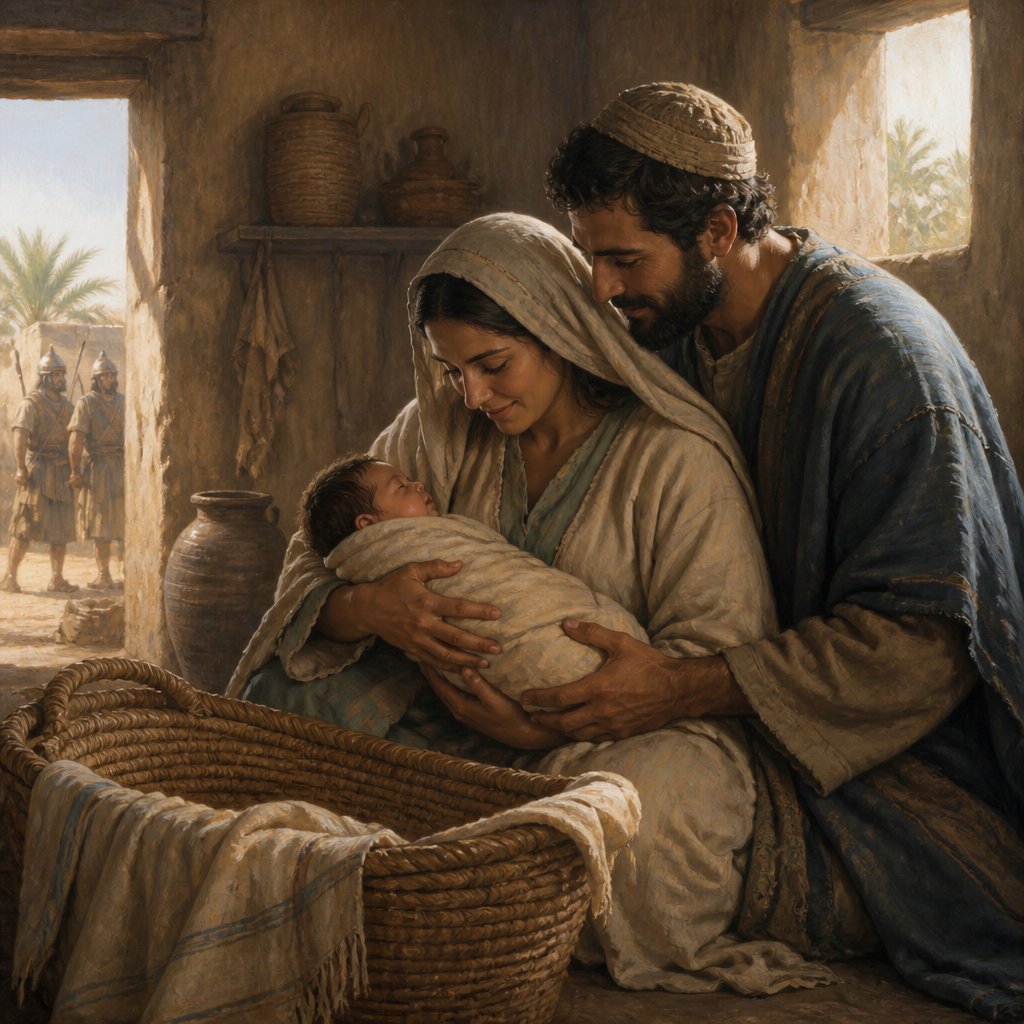
Hebrews 11:23 in the King James Version reads, “By faith Moses, when he was born, was hid three months of his parents, because they saw he was a proper child; and they were not afraid of the king's commandment.” In the flow of Hebrews 11—often called the chapter of faith—this verse is not mainly about Moses’ later miracles or leadership, but about the earliest, quietest act by which God’s purposes were preserved: the faithful courage of Moses’ parents at the moment his life was most vulnerable. The writer is showing that faith is not only displayed on public stages; it can be expressed in hidden rooms, in domestic obedience, and in the willingness to risk safety in order to honor God.
The immediate context is the long line of examples beginning with Abel, Enoch, Noah, Abraham, and the patriarchs, each introduced as acting “by faith.” The pattern is deliberate: faith is shown as trust that shapes choices before outcomes are visible. When Hebrews reaches Moses, it begins before Moses can choose anything at all, emphasizing that God’s covenant purposes do not depend on human strength. The deliverer of Israel is first saved through the faith of others. This underlines a theme running through Scripture: God advances redemption through ordinary means—parents, households, decisions made under pressure—so that the glory of preservation belongs to Him rather than to human power.
Historically, “the king's commandment” evokes the setting of Israel’s oppression in Egypt, where the authority of Pharaoh sought to control Israel’s future by destroying its male children. Against that political backdrop, the verse highlights a direct conflict between the decree of a ruler and the higher claims of God. Moses’ parents hide him “three months,” a small measure of time that nevertheless becomes a decisive turning point. Scripture often invests such limited spans with great spiritual meaning: the faith that endures for “three months” is still faith that endures, and it becomes the bridge between threatened infancy and divinely appointed calling. The verse therefore frames deliverance as something that begins long before the visible exodus, in the unseen contest between fear and faith.
The phrase “because they saw he was a proper child” carries a richness of meaning in the KJV’s wording. On its surface it indicates that the child was well-formed, healthy, and beautiful; yet in the moral logic of Hebrews, their seeing is not mere parental pride. It is perception joined to faith. They “saw” something that made them act contrary to fear. In Scripture, seeing is often linked to discernment—recognizing the hand of God, the worth of a life, the sign of divine intention. The child’s “proper” appearance becomes, in the narrative of faith, a providential marker: not that physical beauty earns protection, but that God was giving them reason to hope rather than to surrender. Their response interprets that sign as a call to protect life, even under threat. In that sense the “proper child” functions symbolically as the promise of future deliverance wrapped in weakness: the deliverer begins as a baby, and God’s strength is hidden in what the world considers expendable.
The climax of the verse is the moral description of their courage: “they were not afraid of the king's commandment.” Faith here is not defined as the absence of danger but the refusal to let danger become the ruling authority of the heart. Hebrews repeatedly contrasts enduring faith with shrinking back, and this line places Moses’ parents among those who choose reverence toward God over terror of man. The “king’s commandment” represents the most intimidating kind of pressure: official, public, enforceable power. Yet the verse testifies that faith can loosen the grip of that power. This is not portrayed as reckless defiance for its own sake; it is a purposeful protection of life aligned with God’s covenant intentions for His people. Their lack of fear is not mere temperament but conviction—an inward persuasion that obedience to God is safer than submission to unjust decrees, even when obedience appears outwardly more perilous.
There is also an important theme of hiddenness. “Was hid three months” suggests secrecy, concealment, and waiting. In biblical symbolism, what is hidden is not necessarily absent; it may be preserved for revelation at the right time. Moses’ early life begins under concealment, hinting that God’s work often develops invisibly before it becomes history-shaping. Hebrews 11 itself honors this pattern by commemorating acts that may have seemed small when performed. The verse invites readers to regard protective, patient faithfulness—especially in the home—as spiritually significant. The child is hidden, but God’s purpose is not. The parents’ faith becomes a kind of sanctuary erected against the violence of the age.
Theologically, Hebrews 11:23 contributes to the chapter’s larger claim that faith lays hold of God’s promises in advance. The salvation of Israel from Egypt is one of the great redemptive events of the Old Testament, but Hebrews chooses to begin that story with parents who trust God more than a king. This is a reminder that God’s great acts in history often turn on private decisions of trust. The verse also underscores the dignity and sacredness of life under threat; it presents the preservation of Moses not as political resistance alone but as faith-driven obedience. In doing so, it quietly condemns tyranny’s attempt to define which lives may be discarded, and it honors the faithful who protect life even when the culture and the state command otherwise.
Finally, Hebrews 11:23 sets up the later description of Moses himself in the following verses, where he chooses affliction with the people of God rather than the pleasures of sin for a season. The narrative arc is coherent: the one who will later refuse Egypt’s treasures is first guarded by parents who refuse Egypt’s fear. The deliverer’s life begins with faith, and his later faith is foreshadowed by theirs. In this way the verse teaches that faith can be inherited as an example, cultivated in a household, and passed on as moral courage. It invites the reader to see that what looks like a simple act—hiding a child—can be the seed of deliverance, because God honors faith that fears Him above any king.
Get our apps


Artwork for Hebrews 11:23
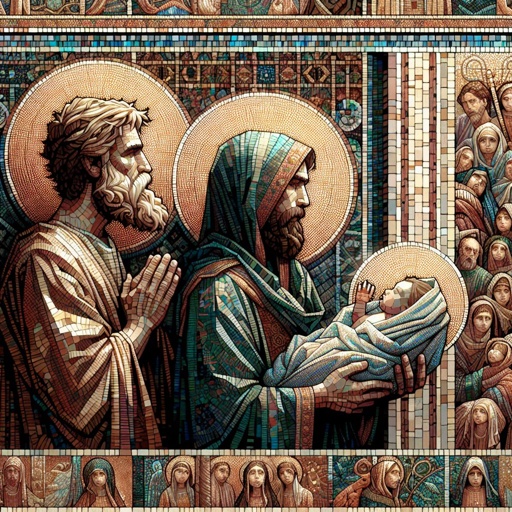
Hebrews 11:23 - "By faith Moses, when he was born, was hid three months of his parents, because they saw he was a proper child; and they were not afraid of the king's commandment."
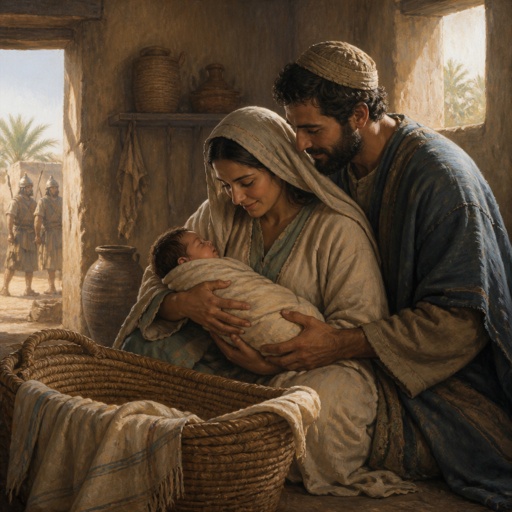
"By faith Moses, when he was born, was hid three months of his parents, because they saw he was a proper child; and they were not afraid of the king's commandment." - Hebrews 11:23
!["By faith Moses, when he was born, was hid three months of his parents, because they saw [he was] a proper child; and they were not afraid of the king’s commandment." - Hebrews 11:23](https://media.bible.art/fab670ae-298b-4fce-ab46-9347046364d5-thumbnail.jpg)
"By faith Moses, when he was born, was hid three months of his parents, because they saw [he was] a proper child; and they were not afraid of the king’s commandment." - Hebrews 11:23

Hebrews 11:16

Hebrews 11:16

Hebrews 11 the faith hall of fame

the jewish holidays mentioned in leviticus 23:1 until 23:40 combined in one picture, with hebrew names in hebrew charactes

Hebrews 11:2 - "For by it the elders obtained a good report."

Hebrews 11 the faith hall of fame

Hebrews 11 the faith hall of fame
Hebrews 7:23 - "And they truly were many priests, because they were not suffered to continue by reason of death:"

Hebrews 11:18 - "Of whom it was said, That in Isaac shall thy seed be called:"

Hebrews 11:14 - "For they that say such things declare plainly that they seek a country."
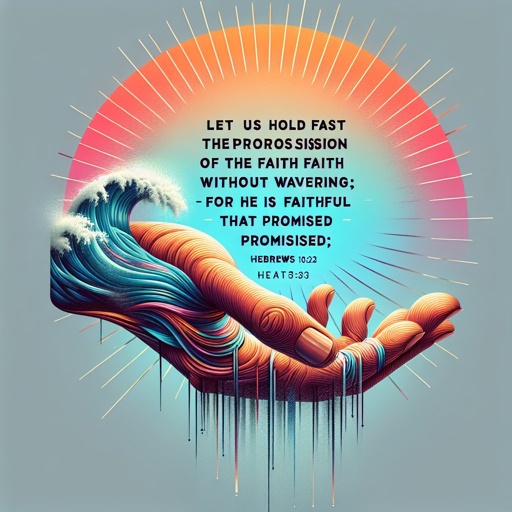
Hebrews 10:23 - "Let us hold fast the profession of our faith without wavering; (for he is faithful that promised;)"

Hebrews 11:1 - "Now faith is the substance of things hoped for, the evidence of things not seen."

Hebrews 3:11 - "So I sware in my wrath, They shall not enter into my rest.)"

Hebrews 9:23 - "It was therefore necessary that the patterns of things in the heavens should be purified with these; but the heavenly things themselves with better sacrifices than these."

"For by it the elders obtained a good report." - Hebrews 11:2

Hebrews 11:20 - "By faith Isaac blessed Jacob and Esau concerning things to come."
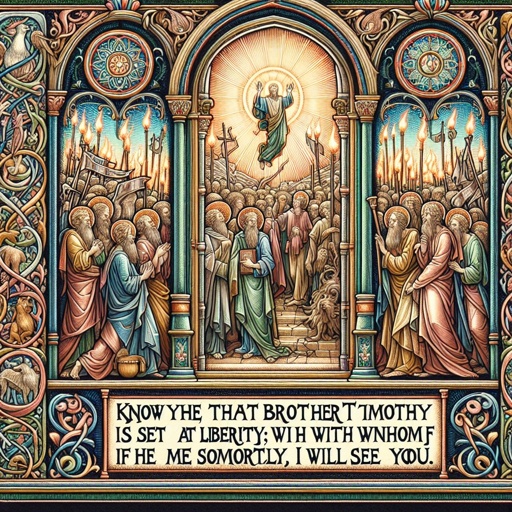
Hebrews 13:23 - "Know ye that our brother Timothy is set at liberty; with whom, if he come shortly, I will see you."

Hebrews 1:11 - "They shall perish; but thou remainest; and they all shall wax old as doth a garment;"

Hebrews 11:10 - "For he looked for a city which hath foundations, whose builder and maker is God."

Hebrews 11:38 - "(Of whom the world was not worthy:) they wandered in deserts, and in mountains, and in dens and caves of the earth."

Hebrews 11:39 - "And these all, having obtained a good report through faith, received not the promise:"

Hebrews 12:23 - "To the general assembly and church of the firstborn, which are written in heaven, and to God the Judge of all, and to the spirits of just men made perfect,"

Hebrews 11:30 - "By faith the walls of Jericho fell down, after they were compassed about seven days."

Hebrews 11:25 - "Choosing rather to suffer affliction with the people of God, than to enjoy the pleasures of sin for a season;"

Hebrews 11:36 - "And others had trial of cruel mockings and scourgings, yea, moreover of bonds and imprisonment:"

Hebrews 11:1 a picture of a person learning to walk by faith

Hebrews 11:1 a picture of a person learning to walk by faith