What does Hebrews 4:16 mean?
“Let us therefore come bold ly unto the throne of grace, that we may obtain mercy, and find grace to help in time of need.” — Hebrews 4:16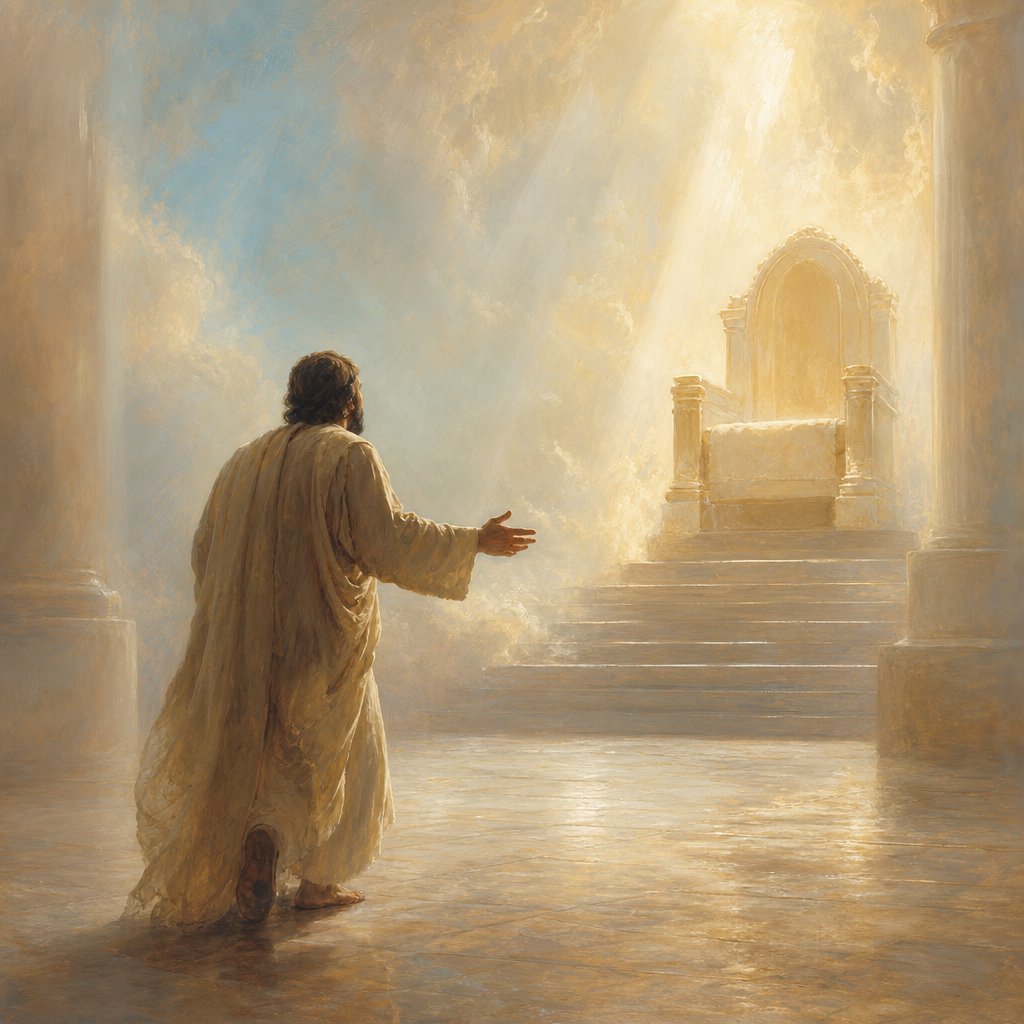
Hebrews 4:16 in the King James Version reads, “Let us therefore come boldly unto the throne of grace, that we may obtain mercy, and find grace to help in time of need.” The force of the verse is in its “therefore.” It is not an isolated encouragement to pray with confidence; it is a conclusion drawn from what has just been said about Jesus Christ as the believer’s great High Priest. The surrounding passage (Hebrews 4:14–15) has established two realities at once: first, that believers “have a great high priest, that is passed into the heavens, Jesus the Son of God,” and second, that this High Priest is not distant or indifferent, but One who “was in all points tempted like as we are, yet without sin.” Because He is both exalted and compassionate, the verse calls the believer to respond in a specific way: come.
The invitation, “Let us therefore come,” is corporate and pastoral. Hebrews regularly speaks to a congregation under pressure, calling them to perseverance, faith, and steadiness. The “us” assumes a shared need and a shared access. The epistle has warned against unbelief and hardening the heart, using Israel’s wilderness failure as a sobering example, and it has spoken of God’s “rest” as something to be entered by faith and obedience. In that setting, Hebrews 4:16 functions as a remedy and a direction: when weakness, temptation, fear, weariness, guilt, or external affliction presses in, the answer is not retreat from God but approach to God. The verse turns the reader from self-reliance and despair to worshipful nearness.
The phrase “come boldly” is striking because Scripture also teaches reverence and godly fear. The boldness here is not arrogance; it is liberty of access grounded in the priestly work and sympathetic understanding of Christ. This is the boldness of someone who has a right of entry, not because he is worthy in himself, but because he is welcomed through another. The immediate context emphasizes that Christ knows human weakness from within the reality of temptation, yet without the stain of sin. That sinlessness matters: He can sympathize without being compromised, and He can represent without needing to be represented. The verse’s boldness is therefore the confidence that the believer is not approaching a harsh judge without an advocate, but approaching God with a High Priest who has already gone “into the heavens” and who remains able to be “touched with the feeling of our infirmities.”
The central image, “the throne of grace,” gathers several biblical themes into one symbol. A throne speaks of kingship, authority, and sovereign rule. It is the seat of judgment and government. Yet Hebrews calls it not merely a throne, but a throne “of grace.” That title changes the atmosphere of the throne without denying its majesty. It does not say the throne is no longer righteous or that holiness is suspended; it says that for those who come through Christ, the reigning God meets them with favor they did not earn. The same sovereign who has the right to condemn is presented as the One who dispenses grace. The symbolism is powerful: the place that might be dreaded by the guilty becomes, for the believer, the place where grace reigns, where help is given, and where communion is granted. In the background lies the Old Testament pattern of priestly approach to God’s presence, where access was regulated, mediated, and costly. Hebrews, by presenting Jesus as the great High Priest, shows that the way to God’s presence is opened in Him, and thus the believer is urged to draw near rather than stand afar off.
The purpose of coming is stated with two parallel outcomes: “that we may obtain mercy, and find grace.” Mercy and grace are related but not identical in their emphasis. Mercy looks toward misery, guilt, and need; it is compassion shown to the afflicted and pardon extended to the undeserving. To “obtain mercy” suggests receiving what one cannot demand, especially when conscience accuses and when failure has left a person aware of his dependence. Grace, in this verse, is not only forgiving favor but also enabling power. To “find grace to help” indicates that God not only pardons but supplies strength; He not only clears the past but provides assistance for the present. The verse thus speaks to both the shame of sin and the weakness of suffering: mercy meets the sinner and the wounded; grace equips the struggler and the tempted.
The final phrase, “in time of need,” makes the promise concrete. Hebrews does not treat spiritual life as theoretical. The letter addresses real pressures: temptation to drift, weariness in the race, fear in the face of hardship, and the pull to turn back. “Time of need” includes moments when temptation is hot, when faith feels thin, when trials seem beyond strength, when sorrow weighs heavily, and when obedience seems costly. The verse teaches that God’s help is not vague or delayed beyond relevance; it is grace “to help” precisely when need arrives. The timing matters: it is not merely that grace exists in general, but that grace is found for the urgent hour.
Taken as a whole, Hebrews 4:16 is a call to a particular posture of the Christian life: confident approach to God based on Christ’s priesthood. It assumes God’s holiness and authority, yet it proclaims that the believer’s access is real and welcomed. It assumes human weakness, yet it proclaims that divine resources are available. It assumes ongoing need, yet it promises timely help. The verse is significant because it anchors prayer and perseverance in the character of God as He is revealed through Jesus Christ: a King upon a throne, and yet a Giver of grace; a Judge of all the earth, and yet, for those who come, the One from whom mercy is obtained and enabling grace is found.
Get our apps


Artwork for Hebrews 4:16

Hebrews 4:16 - "Let us therefore come boldly unto the throne of grace, that we may obtain mercy, and find grace to help in time of need."
"Let us therefore come boldly unto the throne of grace, that we may obtain mercy, and find grace to help in time of need." - Hebrews 4:16

Hebrews 11:16

Hebrews 11:16

Hebrews 9:16 - "For where a testament is, there must also of necessity be the death of the testator."

Hebrews 13:16 - "But to do good and to communicate forget not: for with such sacrifices God is well pleased."

Hebrews 4:9 - "There remaineth therefore a rest to the people of God."

Revelation 16:16 - "And he gathered them together into a place called in the Hebrew tongue Armageddon."

Hebrews 7:16 - "Who is made, not after the law of a carnal commandment, but after the power of an endless life."

Hebrews 6:16 - "For men verily swear by the greater: and an oath for confirmation is to them an end of all strife."

Hebrews 4:5 - "And in this place again, If they shall enter into my rest."

Hebrews 2:16 - "For verily he took not on him the nature of angels; but he took on him the seed of Abraham."

Hebrews 3:16 - "For some, when they had heard, did provoke: howbeit not all that came out of Egypt by Moses."

Judges 16:4 - "¶ And it came to pass afterward, that he loved a woman in the valley of Sorek, whose name was Delilah."

Hebrews 10:4 - "For it is not possible that the blood of bulls and of goats should take away sins."

Hebrews 12:16 - "Lest there be any fornicator, or profane person, as Esau, who for one morsel of meat sold his birthright."

Hebrews 4:4 - "For he spake in a certain place of the seventh day on this wise, And God did rest the seventh day from all his works."

Hebrews 12:4 - "Ye have not yet resisted unto blood, striving against sin."

Hebrews 4:12 – "For the word of God is alive and active. Sharper than any double-edged sword."

Hebrews 4:12 – "For the word of God is alive and active. Sharper than any double-edged sword."

Hebrews 13:4 - "Marriage is honourable in all, and the bed undefiled: but whoremongers and adulterers God will judge."

Hebrews 5:4 - "And no man taketh this honour unto himself, but he that is called of God, as was Aaron."

Hebrews 11:16 - "But now they desire a better country, that is, an heavenly: wherefore God is not ashamed to be called their God: for he hath prepared for them a city."
"For where a testament is, there must also of necessity be the death of the testator." - Hebrews 9:16

Hebrews 3:4 - "For every house is builded by some man; but he that built all things is God."
!["For the word of God [is] quick, and powerful, and sharper than any twoedged sword, piercing even to the dividing asunder of soul and spirit, and of the joints and marrow, and [is] a discerner of the thoughts and intents of the heart." - Hebrews 4:12](https://media.bible.art/0705b859-7ae8-4ac8-9dce-49043e2ec43b-thumbnail.jpg)
"For the word of God [is] quick, and powerful, and sharper than any twoedged sword, piercing even to the dividing asunder of soul and spirit, and of the joints and marrow, and [is] a discerner of the thoughts and intents of the heart." - Hebrews 4:12

Hebrews 4:15-16 - "For we do not have a high priest who is unable to empathize with our weaknesses, but we have one who has been tempted in every way, just as we are—yet he did not sin. Let us then approach God’s throne of grace with confidence, so that we may receive mercy and find grace to help us in our time of need."

Hebrews 8:4 - "For if he were on earth, he should not be a priest, seeing that there are priests that offer gifts according to the law:"
!["For the word of God [is] quick, and powerful, and sharper than any twoedged sword, piercing even to the dividing asunder of soul and spirit, and of the joints and marrow, and [is] a discerner of the thoughts and intents of the heart." - Hebrews 4:12](https://media.bible.art/adaff66c-0dbd-4c9b-b464-740ce2459397-thumbnail.jpg)
"For the word of God [is] quick, and powerful, and sharper than any twoedged sword, piercing even to the dividing asunder of soul and spirit, and of the joints and marrow, and [is] a discerner of the thoughts and intents of the heart." - Hebrews 4:12
"There remaineth therefore a rest to the people of God." - Hebrews 4:9