What does Isaiah 2:2 mean?
“And it shall come to pass in the last days, that the mountain of the LORD’s house shall be established in the top of the mountains, and shall be exalted above the hills; and all nations shall flow unto it.” — Isaiah 2:2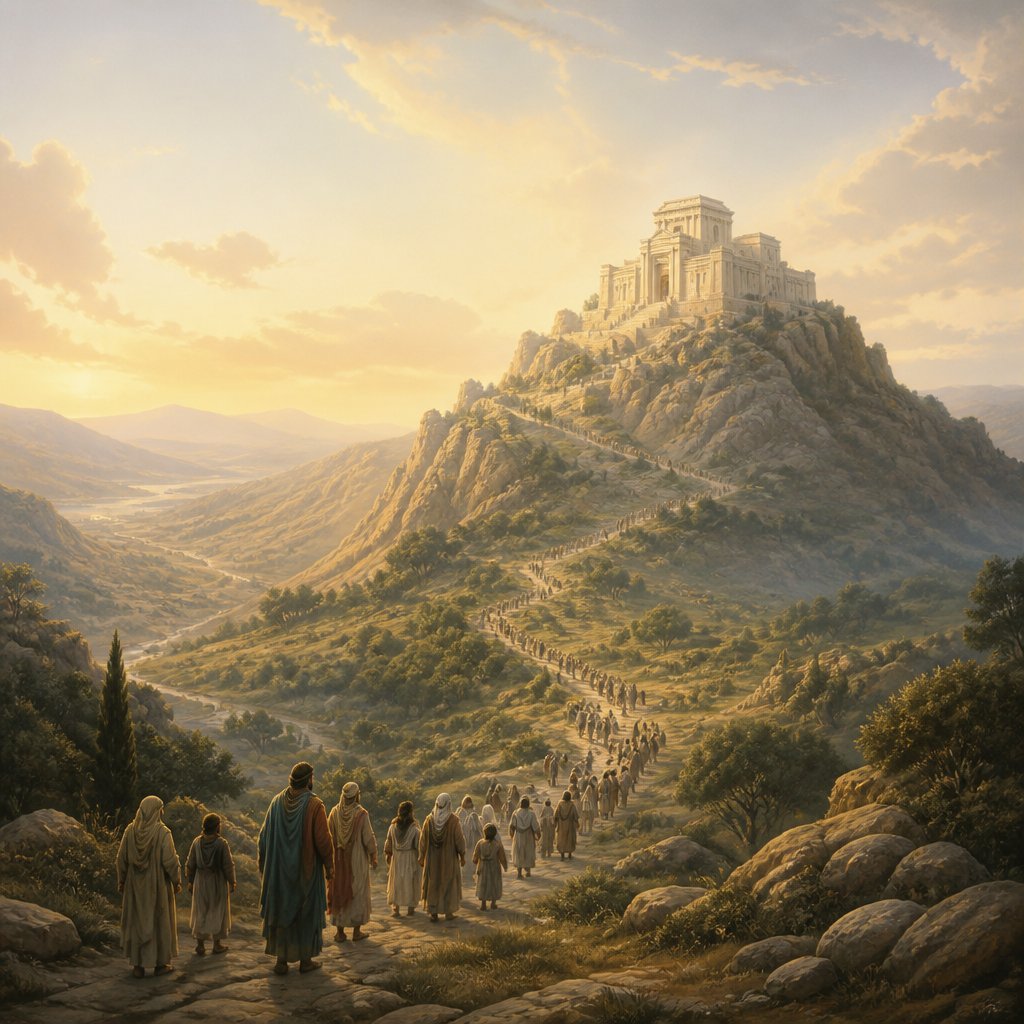
Isaiah 2:2 in the KJV reads, “And it shall come to pass in the last days, that the mountain of the Lord’s house shall be established in the top of the mountains, and shall be exalted above the hills; and all nations shall flow unto it.” In its plain sense the verse is a prophecy: it speaks of a future time “in the last days” when the LORD will openly set his worship and rule in a position of unrivaled prominence, drawing not merely Israel but “all nations” toward him. Isaiah is not describing a private revival or a local reform, but a world-facing elevation of the LORD’s house and the magnet-like gathering of peoples to it.
The context helps fix the tone and purpose. Isaiah 2 opens with “The word that Isaiah the son of Amoz saw concerning Judah and Jerusalem.” The prophet is addressing God’s covenant people, centered in Jerusalem, in a book that repeatedly confronts their sins, warns of judgment, and then lifts the eyes of the hearers to God’s ultimate restoration and reign. Isaiah 2:2 begins a vision of hope that stands in contrast to the moral and spiritual decline described immediately afterward in the same chapter. The placement is significant: before the chapter exposes the pride, idolatry, and self-sufficiency of the people, it first sets an end-point in view—God will not be thwarted; the LORD will have his worship, his order, and his peace established, and that establishment will be so public and so compelling that it will affect the nations. The prophecy therefore functions as both comfort and correction: comfort, because God’s purpose for Zion will stand; correction, because present unfaithfulness is measured against the coming reality of God’s exalted rule.
The phrase “in the last days” carries prophetic weight. In Isaiah’s idiom it points beyond immediate political events to the climactic era of God’s dealings, the time when his purposes reach their appointed fullness. It is not merely a reference to “later” in a vague sense; it signals a horizon where God’s kingdom reality is made manifest in a decisive way. By using “it shall come to pass,” the verse emphasizes certainty: this is not an aspiration, but a divine determination.
The central symbol is “the mountain of the Lord’s house.” In Israel’s life, the “house” of the LORD was associated with the temple in Jerusalem, situated on Mount Zion/Moriah. A mountain in Scripture frequently conveys stability, permanence, and dominion; it is elevated, unmovable, and visible. Here, Zion becomes the prophetic center of divine instruction and authority for the world. The text says this mountain “shall be established in the top of the mountains, and shall be exalted above the hills.” This is rich in symbolism. It is not necessarily a statement about geology so much as about supremacy. Mountains and hills often represent seats of power, kingdoms, and high places; for Isaiah’s hearers, hills could also evoke the “high places” where idolatrous worship occurred. To say the LORD’s mountain is established “in the top” and “exalted above” is to say that every rival elevation—every competing authority, every false sanctuary, every proud human structure—will be surpassed. The LORD’s worship and rule will be publicly vindicated as highest.
This exaltation also communicates reversal. In Isaiah and the wider prophetic witness, human pride is repeatedly brought low, while the LORD alone is lifted up. Isaiah 2 later underscores that theme by declaring that “the LORD alone shall be exalted in that day.” Isaiah 2:2 anticipates that outcome by portraying the LORD’s house as the preeminent height. The world’s centers of prestige and power do not finally set the agenda; God does.
The final clause is among the most striking: “and all nations shall flow unto it.” Nations do not normally “flow” uphill, and they do not “flow” at all; people flow like water. Isaiah uses a deliberate image of an impossible-yet-promised movement: the peoples of the earth will be drawn upward toward the LORD as if by a spiritual gravity. The verb suggests continuity and abundance, like a river’s steady stream. This is not a momentary visit but an ongoing convergence. It also signals universality. Isaiah’s vision is not narrowly ethnic; it sees the LORD’s purpose extending to “all nations.” That does not erase Israel’s role—Zion and “the Lord’s house” remain central in the picture—but it shows that Zion’s calling is ultimately outward-facing, a place from which the knowledge of God radiates.
In the immediate verses that follow (still within the same prophetic unit), Isaiah explains why the nations flow: they come to learn God’s ways, to “walk in his paths,” because “out of Zion shall go forth the law, and the word of the LORD from Jerusalem.” So Isaiah 2:2 is not only about worship but about instruction, moral order, and the establishment of divine justice. The exalted mountain is a seat of teaching; the gathering of nations implies that God’s truth becomes authoritative across cultural boundaries. The verse thus carries themes of mission and invitation: the nations are not merely subdued; they are drawn to receive God’s word.
The significance of Isaiah 2:2, then, is that it frames history as moving toward the public enthronement of the LORD’s worship and rule, centered in his chosen place, and radiating to the whole world. It promises that what seems small, contested, or despised in the present—the faithful worship of the LORD—will not remain so. God will “establish” it, lift it above all rivals, and make it the focal point of a worldwide turning. Read within Isaiah’s broader message, it calls the hearer away from trusting in human heights and false high places, and toward the coming day when the highest reality is the LORD himself, exalted, known, and sought by the nations.
Get our apps


Artwork for Isaiah 2:2
!["And it shall come to pass in the last days, [that] the mountain of the LORD’s house shall be established in the top of the mountains, and shall be exalted above the hills; and all nations shall flow unto it." - Isaiah 2:2](https://media.bible.art/f761edc3-68b8-490e-b2ad-199d46645c92-thumbnail.jpg)
"And it shall come to pass in the last days, [that] the mountain of the LORD’s house shall be established in the top of the mountains, and shall be exalted above the hills; and all nations shall flow unto it." - Isaiah 2:2

Isaiah 2:2 - "And it shall come to pass in the last days, that the mountain of the LORD'S house shall be established in the top of the mountains, and shall be exalted above the hills; and all nations shall flow unto it."
"And it shall come to pass in the last days, that the mountain of the LORD'S house shall be established in the top of the mountains, and shall be exalted above the hills; and all nations shall flow unto it." - Isaiah 2:2

Isaiah 2:1 - "The word that Isaiah the son of Amoz saw concerning Judah and Jerusalem."

Isaiah 12:2

Isaiah 43:2

Isaiah 45:2

Isaiah chapter 2

Isaiah 53:2

Isaiah 12:2-6

Isaiah 12:2-6

Isaiah 12:2-6

Isaiah 66:1-2

Isaiah 12:2-6

Isaiah 12:2-6

Isaiah 12:2-6

Isaiah 57:1-2

Isaiah 66:1-2

Isaiah 2:18 - "And the idols he shall utterly abolish."

2 Kings 19:2 - "And he sent Eliakim, which was over the household, and Shebna the scribe, and the elders of the priests, covered with sackcloth, to Isaiah the prophet the son of Amoz."

2 Kings 19:5 - "So the servants of king Hezekiah came to Isaiah."

Isaiah 37:2 - "And he sent Eliakim, who was over the household, and Shebna the scribe, and the elders of the priests covered with sackcloth, unto Isaiah the prophet the son of Amoz."

Isaiah 3:2 - "The mighty man, and the man of war, the judge, and the prophet, and the prudent, and the ancient,"

2 Kings 20:16 - "And Isaiah said unto Hezekiah, Hear the word of the LORD."

Isaiah 2:16 - "And upon all the ships of Tarshish, and upon all pleasant pictures."

Isaiah 27:2 - "In that day sing ye unto her, A vineyard of red wine."

Isaiah 2:15 - "And upon every high tower, and upon every fenced wall,"

Isaiah 38:2 - "Then Hezekiah turned his face toward the wall, and prayed unto the LORD,"

Isaiah 2:14 - "And upon all the high mountains, and upon all the hills that are lifted up,"

"The word that Isaiah the son of Amoz saw concerning Judah and Jerusalem." - Isaiah 2:1