What does Isaiah 36:8 mean?
“Now therefore give pledges, I pray thee, to my master the king of Assyria, and I will give thee two thousand horses, if thou be able on thy part to set riders upon them.” — Isaiah 36:8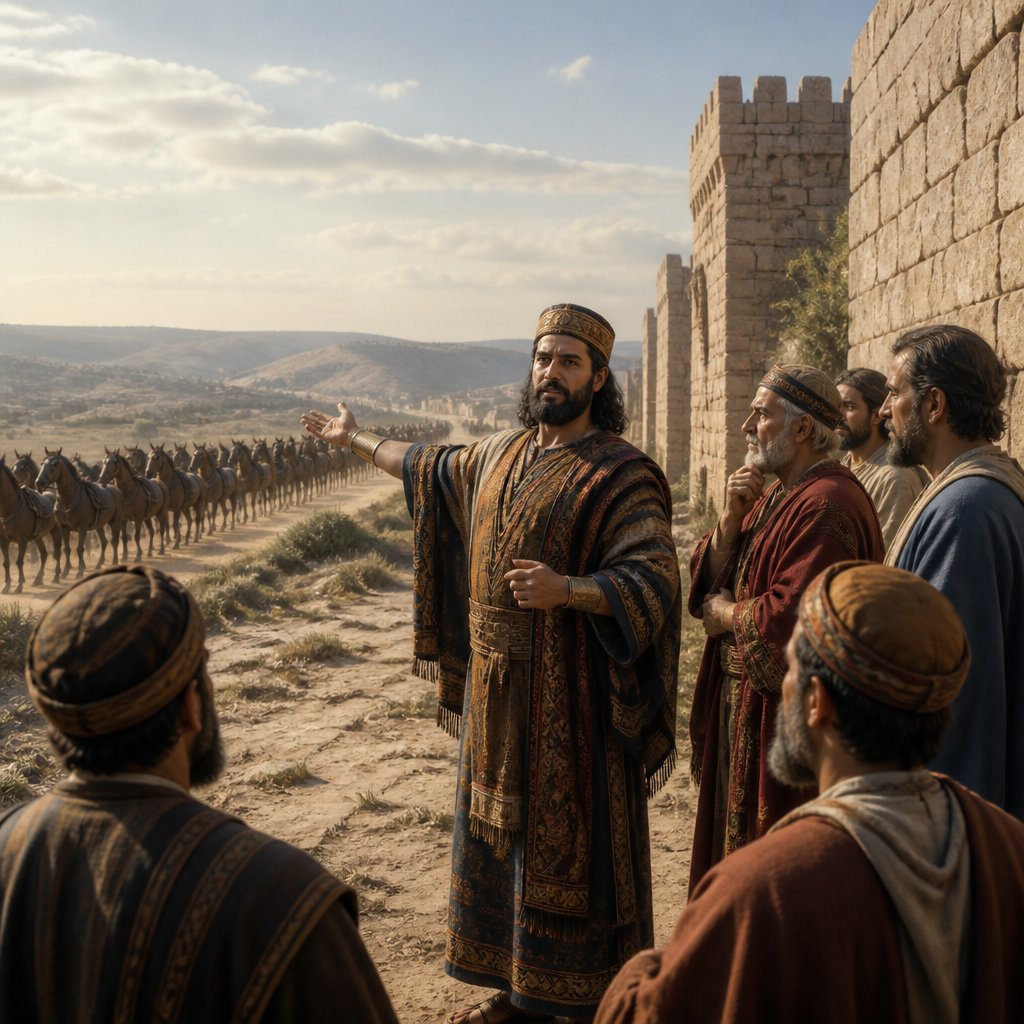
Isaiah 36:8 in the King James Version (KJV) of the Bible reads, "Now therefore give pledges, I pray thee, to my master the king of Assyria, and I will give thee two thousand horses, if thou be able on thy part to set riders upon them."
This verse is part of a larger passage in the book of Isaiah that records the events surrounding the invasion of Judah by the Assyrian army. In this particular verse, the Assyrian envoy is seeking to intimidate and manipulate the officials of King Hezekiah of Judah into surrendering to the Assyrian king, Sennacherib. The envoy is demanding military support from Judah in exchange for peace and offering horses as a gesture of goodwill.
The context of Isaiah 36:8 is one of fear and uncertainty for the people of Judah. The Assyrian army, known for its brutality and military might, had already conquered the northern kingdom of Israel and was now threatening the southern kingdom of Judah. The people of Judah were facing the imminent threat of invasion and the potential destruction of their homeland. King Hezekiah had tried to stall the Assyrian advance by offering to pay tribute, but the Assyrian forces continued to advance, leading to this pivotal moment in the confrontation.
One of the key themes in this verse is the reliance on worldly power and alliances versus trust in God. The Assyrian envoy is using the offer of military support as a means of manipulating the officials of Judah into surrendering to the Assyrian king. This reflects a mindset of relying on human strength and alliances to secure peace and safety, rather than trusting in God. Throughout the Bible, there is a consistent theme of the futility of relying on human strength and alliances apart from God. The prophet Isaiah repeatedly calls the people of Judah to trust in God and seek His protection, rather than putting their faith in political alliances or military strength.
Another theme in this verse is the idea of compromise and appeasement. The Assyrian envoy is asking the officials of Judah to give pledges to the Assyrian king as a sign of their submission and willingness to comply with his demands. This reflects the temptation to compromise one's beliefs and values in order to appease a powerful adversary. However, the Bible consistently teaches the importance of standing firm in one's faith and not compromising in the face of opposition.
The symbolism in this verse lies in the horses offered by the Assyrians. Horses were a symbol of military might and strength in ancient times. The offer of two thousand horses by the Assyrians was meant to demonstrate their military power and persuade the officials of Judah to submit to their demands. However, the Bible often uses the symbolism of horses to represent trust in worldly power and human strength, as opposed to relying on the strength and sovereignty of God.
In conclusion, Isaiah 36:8 is a poignant reminder of the constant struggle between trusting in worldly power and alliances versus placing one's trust in God. The verse conveys the fear and uncertainty faced by the people of Judah in the face of the Assyrian threat, and the temptation to compromise and appease their powerful adversary. Ultimately, this passage serves as a call to trust in God's protection and sovereignty, rather than relying on worldly power and compromise.
Get our apps


Artwork for Isaiah 36:8
Isaiah 36:8 - "Now therefore give pledges, I pray thee, to my master the king of Assyria, and I will give thee two thousand horses, if thou be able on thy part to set riders upon them."
"Now therefore give pledges, I pray thee, to my master the king of Assyria, and I will give thee two thousand horses, if thou be able on thy part to set riders upon them." - Isaiah 36:8

Proverbs 8:22-36

Proverbs 8:34-36

Job 36:8 - "And if they be bound in fetters, and be holden in cords of affliction;"

Isaiah 36:21 - "But they held their peace, and answered him not a word: for the king's commandment was, saying, Answer him not."

Genesis 36:8 - "Thus dwelt Esau in mount Seir: Esau is Edom."

Isaiah 36:14 - "Thus saith the king, Let not Hezekiah deceive you: for he shall not be able to deliver you."

Isaiah 36:19 - "Where are the gods of Hamath and Arphad? where are the gods of Sepharvaim? and have they delivered Samaria out of my hand?"

Isaiah 36:13 - "Then Rabshakeh stood, and cried with a loud voice in the Jews' language, and said, Hear ye the words of the great king, the king of Assyria."

John 8:36 - "If the Son therefore shall make you free, ye shall be free indeed."

Isaiah 36:3 - "Then came forth unto him Eliakim, Hilkiah's son, which was over the house, and Shebna the scribe, and Joah, Asaph's son, the recorder."

"They shall be abundantly satisfied with the fatness of thy house; and thou shalt make them drink of the river of thy pleasures." - Psalm 36:8

Luke 8:36 - "They also which saw it told them by what means he that was possessed of the devils was healed."

Isaiah 36:17 - "Until I come and take you away to a land like your own land, a land of corn and wine, a land of bread and vineyards."

Leviticus 8:36 - "So Aaron and his sons did all things which the LORD commanded by the hand of Moses."
"And if they be bound in fetters, and be holden in cords of affliction;" - Job 36:8

Romans 8:36 - "As it is written, For thy sake we are killed all the day long; we are accounted as sheep for the slaughter."

1 Chronicles 8:36 - "And Ahaz begat Jehoadah; and Jehoadah begat Alemeth, and Azmaveth, and Zimri; and Zimri begat Moza,"

Isaiah 36:20 - "Who are they among all the gods of these lands, that have delivered their land out of my hand, that the LORD should deliver Jerusalem out of my hand?"

Isaiah 36:15 - "Neither let Hezekiah make you trust in the LORD, saying, The LORD will surely deliver us: this city shall not be delivered into the hand of the king of Assyria."

Isaiah 36:9 - "How then wilt thou turn away the face of one captain of the least of my master's servants, and put thy trust on Egypt for chariots and for horsemen?"

Ezra 8:36 - "¶ And they delivered the king's commissions unto the king's lieutenants, and to the governors on this side the river: and they furthered the people, and the house of God."

Proverbs 8:36 - "But he that sinneth against me wrongeth his own soul: all they that hate me love death."

Mark 8:36 - "For what shall it profit a man, if he shall gain the whole world, and lose his own soul?"

Isaiah 36:4 - "¶ And Rabshakeh said unto them, Say ye now to Hezekiah, Thus saith the great king, the king of Assyria, What confidence is this wherein thou trustest?"

Isaiah 36:10 - "And am I now come up without the LORD against this land to destroy it? the LORD said unto me, Go up against this land, and destroy it."

Isaiah 36:1 - "Now it came to pass in the fourteenth year of king Hezekiah, that Sennacherib king of Assyria came up against all the defenced cities of Judah, and took them."

Isaiah 36:22 - "¶ Then came Eliakim, the son of Hilkiah, that was over the household, and Shebna the scribe, and Joah, the son of Asaph, the recorder, to Hezekiah with their clothes rent, and told him the words of Rabshakeh."

Isaiah 19:8