What does Isaiah 36:9 mean?
“How then wilt thou turn away the face of one captain of the least of my master’s servants, and put thy trust on Egypt for chariots and for horsemen?” — Isaiah 36:9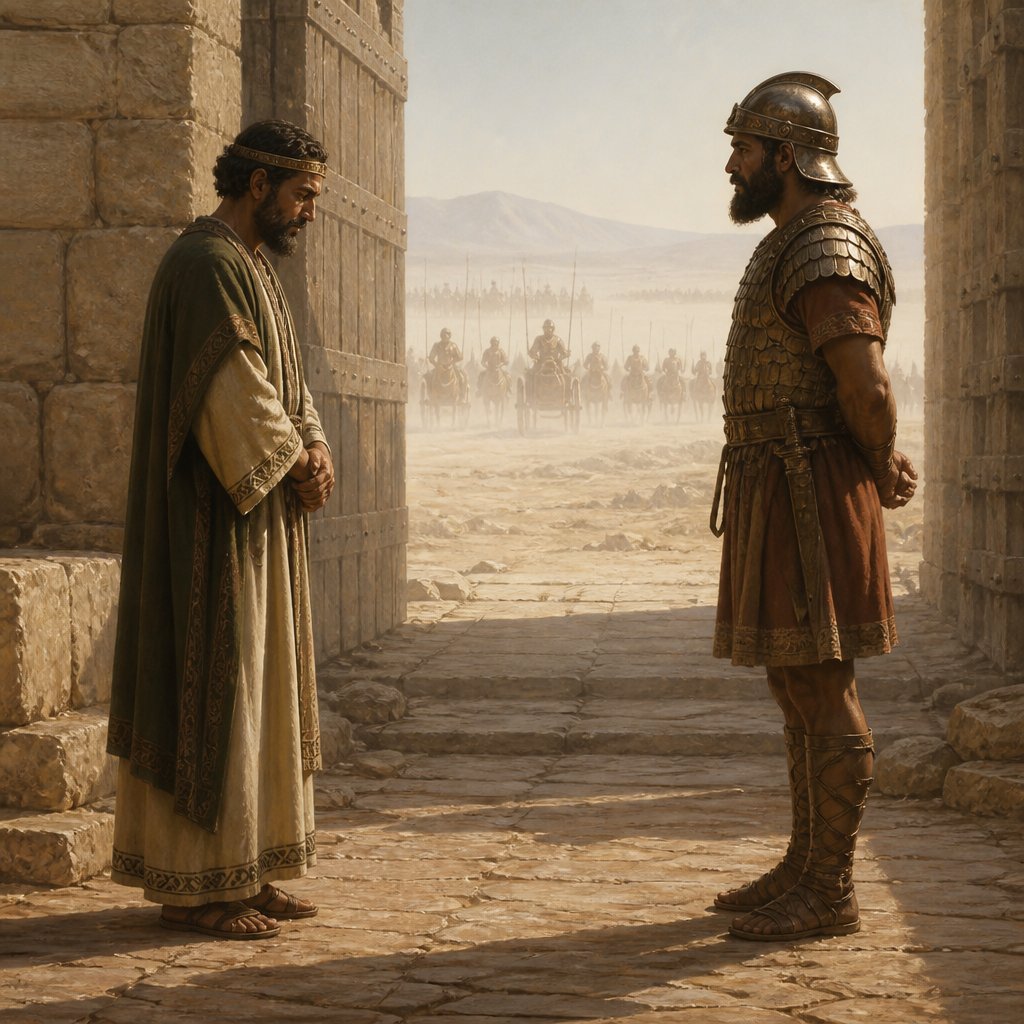
Isaiah 36:9 in the King James Version of the Bible states, "How then wilt thou turn away the face of one captain of the least of my master's servants, and put thy trust on Egypt for chariots and for horsemen?"
This verse is part of a passage that recounts the interaction between King Sennacherib of Assyria and the officials of King Hezekiah of Judah. Sennacherib's supreme commander had come to Judah, insulting the people and trying to convince them to surrender to Assyria. The verse itself is part of an argument presented by the Assyrian commander, who is trying to dissuade the people of Judah from putting their trust in Egypt for military aid.
From a contextual standpoint, this verse reflects the political and military turmoil that was prevalent in ancient times. It captures the power dynamics between nations and the struggle for control and dominance. At the time, Egypt was considered a formidable military force, and the Assyrians were trying to instill fear in the hearts of the people of Judah by questioning their reliance on Egypt for protection.
The underlying theme of this verse revolves around the concept of trust and reliance. The Assyrian commander is essentially asking the people of Judah how they could possibly turn away from the might of the Assyrian army, which is deemed superior to the forces of Egypt. The verse serves as a warning against misplaced trust and the potential consequences of relying on external powers for security and protection.
Symbolically, this verse can be interpreted as a cautionary tale about the dangers of placing one's faith in earthly powers rather than in God. Throughout the Bible, there is a consistent emphasis on the importance of trusting in God and relying on His strength and guidance. This verse echoes that sentiment, reminding believers that true security and protection can only be found in God.
Furthermore, the verse also serves as a reflection of the broader theme of obedience and faithfulness. By questioning the people of Judah's reliance on Egypt, the Assyrian commander is essentially challenging their loyalty to their own king and their obedience to God. This ties into the broader narrative of the Old Testament, in which the Israelites are repeatedly reminded of the importance of remaining faithful to God and following His commandments.
In a broader theological context, this verse also serves as a reminder of the constant spiritual battle between good and evil. The Assyrian commander represents the forces of evil, seeking to undermine the faith and trust of the people of Judah. In contrast, the people of Judah are challenged to remain steadfast in their trust in God, despite the external threats and temptations.
In conclusion, Isaiah 36:9 is a verse that captures the political, military, and spiritual tensions of its time. It serves as a cautionary tale about the dangers of misplaced trust and the importance of remaining faithful to God. It also reflects the broader themes of obedience, loyalty, and the struggle between good and evil. As believers, this verse reminds us to place our trust in God alone and to remain steadfast in our faith, regardless of the challenges and threats we may face.
Get our apps


Artwork for Isaiah 36:9

Isaiah 36:9 - "How then wilt thou turn away the face of one captain of the least of my master's servants, and put thy trust on Egypt for chariots and for horsemen?"
"How then wilt thou turn away the face of one captain of the least of my master's servants, and put thy trust on Egypt for chariots and for horsemen?" - Isaiah 36:9

Mark 9:36-37

Isaiah 36:21 - "But they held their peace, and answered him not a word: for the king's commandment was, saying, Answer him not."

2 kings 9:34-36

Genesis 36:9 - "¶ And these are the generations of Esau the father of the Edomites in mount Seir:"

Job 36:9 - "Then he sheweth them their work, and their transgressions that they have exceeded."

Isaiah 36:14 - "Thus saith the king, Let not Hezekiah deceive you: for he shall not be able to deliver you."

Isaiah 36:19 - "Where are the gods of Hamath and Arphad? where are the gods of Sepharvaim? and have they delivered Samaria out of my hand?"

Psalms 36:9 - "For with thee is the fountain of life: in thy light shall we see light."

Isaiah 36:13 - "Then Rabshakeh stood, and cried with a loud voice in the Jews' language, and said, Hear ye the words of the great king, the king of Assyria."

1 Chronicles 9:36 - "And his firstborn son Abdon, then Zur, and Kish, and Baal, and Ner, and Nadab,"

John 9:36 - "He answered and said, Who is he, Lord, that I might believe on him?"

Isaiah 36:3 - "Then came forth unto him Eliakim, Hilkiah's son, which was over the house, and Shebna the scribe, and Joah, Asaph's son, the recorder."

Isaiah 36:17 - "Until I come and take you away to a land like your own land, a land of corn and wine, a land of bread and vineyards."

Ezekiel 36:9 - "For, behold, I am for you, and I will turn unto you, and ye shall be tilled and sown:"

Matthew 9:36 (KJV) 36 But when he saw the multitudes, he was moved with compassion on them, because they fainted, and were scattered abroad, as sheep having no shepherd.

Isaiah 36:20 - "Who are they among all the gods of these lands, that have delivered their land out of my hand, that the LORD should deliver Jerusalem out of my hand?"

Isaiah 36:15 - "Neither let Hezekiah make you trust in the LORD, saying, The LORD will surely deliver us: this city shall not be delivered into the hand of the king of Assyria."

Isaiah 9:6

Isaiah 9:6

Isaiah 9:6

Isaiah 36:4 - "¶ And Rabshakeh said unto them, Say ye now to Hezekiah, Thus saith the great king, the king of Assyria, What confidence is this wherein thou trustest?"

Isaiah 9:6

Isaiah 36:10 - "And am I now come up without the LORD against this land to destroy it? the LORD said unto me, Go up against this land, and destroy it."

Isaiah 36:1 - "Now it came to pass in the fourteenth year of king Hezekiah, that Sennacherib king of Assyria came up against all the defenced cities of Judah, and took them."

Isaiah 36:22 - "¶ Then came Eliakim, the son of Hilkiah, that was over the household, and Shebna the scribe, and Joah, the son of Asaph, the recorder, to Hezekiah with their clothes rent, and told him the words of Rabshakeh."
"¶ And these are the generations of Esau the father of the Edomites in mount Seir:" - Genesis 36:9

Isaiah 36:18 - "Beware lest Hezekiah persuade you, saying, The LORD will deliver us. Hath any of the gods of the nations delivered his land out of the hand of the king of Assyria?"

Isaiah 37:36 - "Then the angel of the LORD went forth, and smote in the camp of the Assyrians a hundred and fourscore and five thousand: and when they arose early in the morning, behold, they were all dead corpses."