What does Job 11:9 mean?
“The measure thereof is longer than the earth, and broader than the sea.” — Job 11:9
The verse Job 11:9 in the King James Version of the Bible reads as follows: "The measure thereof is longer than the earth, and broader than the sea." This verse comes from the Book of Job, which is often regarded as one of the most profound and challenging books in the entire Bible. The book tells the story of Job, a man who faces immense suffering and loss, and wrestles with questions of faith and suffering, as well as the nature of God.
The context of this particular verse is within the larger conversation between Job and his friends, who have come to comfort and counsel him in the midst of his trials. Job's friends believe that his suffering must be a result of some sin he has committed, and thus they offer various explanations and exhortations to Job to repent and seek God's forgiveness. In this particular instance, the verse is part of a response from Job's friend Zophar.
The verse itself is part of a wider speech from Zophar in which he attempts to explain the infinite wisdom and knowledge of God. Zophar is using this imagery to provoke Job to acknowledge the greatness and wisdom of God and to repent of his sins in light of God's vast knowledge and power.
The imagery in the verse is striking and vivid. Zophar depicts the measure of God's wisdom and knowledge as longer than the earth and broader than the sea. In using these natural elements, Zophar emphasizes the vastness and incomprehensibility of God's knowledge. By comparing the measure of God's wisdom to the earth and sea, Zophar is highlighting the greatness and all-encompassing nature of God's knowledge.
One of the key themes in this verse is the greatness and magnificence of God. Zophar's speech is an attempt to call Job to a recognition and acknowledgment of the vastness and incomprehensibility of God's knowledge and wisdom. The verse is a reminder of the transcendence of God and the limitations of human understanding. It is a call for humility and reverence in the presence of the divine.
Another important theme in this verse is the contrast between God's knowledge and the limited understanding of humans. The imagery of the earth and sea serves to underscore the infinite nature of God's wisdom in comparison to the finite knowledge of human beings. This theme serves as a reminder of the limitations of human understanding and the need for humility and reverence in the face of God's great wisdom and knowledge.
The verse also serves as a reminder of the sovereignty and omnipotence of God. By using the imagery of the earth and sea, Zophar emphasizes the all-encompassing nature of God's knowledge and wisdom. This serves to underscore the idea that God is not bound by the limitations of time, space, or human understanding. Instead, God's wisdom and knowledge are infinite and all-encompassing, and nothing can escape His notice or understanding.
In conclusion, the verse Job 11:9 from the King James Version of the Bible is a powerful reminder of the greatness and all-encompassing nature of God's wisdom and knowledge. The imagery of the earth and sea serves to emphasize the vastness and incomprehensibility of God's knowledge in comparison to the limited understanding of human beings. This verse prompts reflection on the transcendence and sovereignty of God, as well as the need for humility and reverence in the face of His infinite wisdom.
Get our apps


Artwork for Job 11:9

Job 11:9 - "The measure thereof is longer than the earth, and broader than the sea."

"The measure thereof is longer than the earth, and broader than the sea." - Job 11:9

Job 9:1 - "Then Job answered and said,"

"Then Job answered and said," - Job 9:1
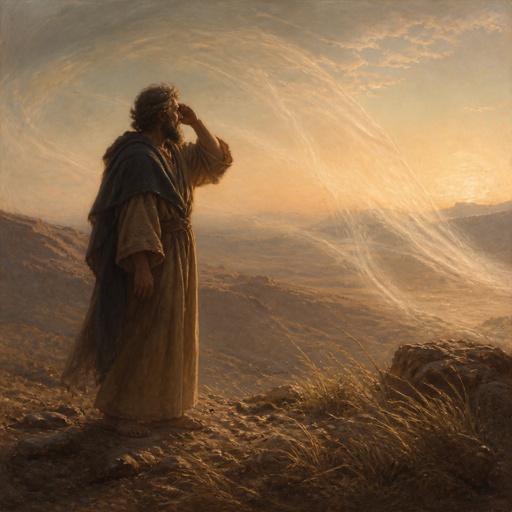
"Lo, he goeth by me, and I see him not: he passeth on also, but I perceive him not." - Job 9:11

Job 1:9 - "Then Satan answered the LORD, and said, Doth Job fear God for nought?"

Job 9:9 - "Which maketh Arcturus, Orion, and Pleiades, and the chambers of the south."

Job 11:11 - "For he knoweth vain men: he seeth wickedness also; will he not then consider it?"

Job 2:11-13

Job 1:9 no words

Job 2:11-13

Job 2:11-13

Job 1:9 no words

Job 11:1 - "Then answered Zophar the Naamathite, and said,"

Job 26:11 - "The pillars of heaven tremble and are astonished at his reproof."

Job 42:9 - "So Eliphaz the Temanite and Bildad the Shuhite and Zophar the Naamathite went, and did according as the LORD commanded them: the LORD also accepted Job."

Job 31:11 - "For this is an heinous crime; yea, it is an iniquity to be punished by the judges."

Job 9:29 - "If I be wicked, why then labour I in vain?"

Job 29:9 - "The princes refrained talking, and laid their hand on their mouth."

Job 12:9 - "Who knoweth not in all these that the hand of the LORD hath wrought this?"

Job 39:9 - "Will the unicorn be willing to serve thee, or abide by thy crib?"

Job 4:9 - "By the blast of God they perish, and by the breath of his nostrils are they consumed."

Job 37:9 - "Out of the south cometh the whirlwind: and cold out of the north."

Job 9:35 - "Then would I speak, and not fear him; but it is not so with me."

Job 24:9 - "They pluck the fatherless from the breast, and take a pledge of the poor."

Job 9:7 - "Which commandeth the sun, and it riseth not; and sealeth up the stars."

Job 36:9 - "Then he sheweth them their work, and their transgressions that they have exceeded."

Job 9:26 - "They are passed away as the swift ships: as the eagle that hasteth to the prey."

Job 9:23 - "If the scourge slay suddenly, he will laugh at the trial of the innocent."

"Which maketh Arcturus, Orion, and Pleiades, and the chambers of the south." - Job 9:9