What does Job 13:2 mean?
“What ye know, the same do I know also: I am not inferior unto you.” — Job 13:2
Job 13:2 in the King James Version of the Bible states, "What ye know, the same do I know also: I am not inferior unto you." This verse is spoken by Job, a righteous and blameless man who faces unimaginable suffering and loss. In this verse, Job is addressing his friends, who have come to comfort him, but end up accusing him of being guilty of some great sin. Job is defending himself against their accusations, asserting that he is not inferior to them in knowledge and understanding.
To understand the deeper meaning and commentary of this verse, it is important to consider the context in which it is spoken. The book of Job is renowned for its exploration of the problem of suffering and the mystery of God's justice. The narrative revolves around Job, a man who experiences extreme hardship and loss, including the deaths of his children and the destruction of his possessions. His friends, Eliphaz, Bildad, and Zophar, come to offer him comfort but end up engaging in a theological debate with him. They suggest that Job's suffering is a result of his sin, and they urge him to repent and seek God's forgiveness.
Job, on the other hand, maintains his innocence and refuses to accept the simplistic explanation offered by his friends. In this verse, Job is expressing his frustration with their accusations and asserting that he is not inferior to them in knowledge or understanding. He challenges their assumptions and insists that he has the same level of wisdom and insight as they do.
One of the key themes of this verse is the assertion of intellectual and moral equality. Job refuses to be condescended to by his friends, insisting that he is their equal in knowledge and understanding. This challenges the traditional hierarchy of wisdom and authority, where elders and those with more experience were typically seen as having superior wisdom. Job's bold assertion of his equality with his friends is a powerful statement against the social norms of his time.
Additionally, this verse also speaks to the broader theme of suffering and the human experience. Job's suffering is not just physical and emotional but also existential and spiritual. His friends' accusations only add to his pain and isolation, as they fail to understand the true nature of his suffering. Job's insistence on his equality with his friends is a way of asserting his humanity and dignity in the face of their judgment and misunderstanding.
The symbolism in this verse lies in the larger narrative of the book of Job. Job's suffering and the debate with his friends are not just a personal struggle but a profound exploration of the human condition. The book grapples with the age-old question of why the righteous suffer and the nature of God's justice. Job's assertion of his equality with his friends symbolizes the universal human desire for recognition, dignity, and understanding in times of suffering and hardship.
In conclusion, Job 13:2 is a powerful and poignant verse that captures the complex dynamics of the book of Job. It speaks to the themes of suffering, human dignity, and the quest for understanding. Job's assertion of equality with his friends challenges traditional hierarchies of wisdom and authority and symbolizes the universal longing for recognition and empathy in the face of adversity. This verse continues to resonate with readers today, offering profound insights into the nature of suffering and the human experience.
Get our apps


Artwork for Job 13:2
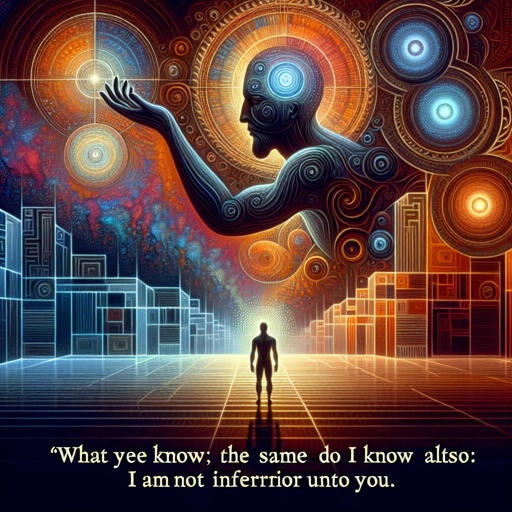
Job 13:2 - "What ye know, the same do I know also: I am not inferior unto you."

"What ye know, the same do I know also: I am not inferior unto you." - Job 13:2

Job 2:11-13

Job 2:11-13

Job 2:11-13

Job 2:13 - "So they sat down with him upon the ground seven days and seven nights, and none spake a word unto him: for they saw that his grief was very great."

Job 39:13-25

Job 3:2 - "And Job spake, and said,"

Job 13:13 - "Hold your peace, let me alone, that I may speak, and let come on me what will."

Genesis 46:13 - "¶ And the sons of Issachar; Tola, and Phuvah, and Job, and Shimron."

Job 42:13 - "He had also seven sons and three daughters."

Job 13:7 - "Will ye speak wickedly for God? and talk deceitfully for him?"

Job 12:13 - "With him is wisdom and strength, he hath counsel and understanding."

Job 40:13 - "Hide them in the dust together; and bind their faces in secret."

Job 13:4 - "But ye are forgers of lies, ye are all physicians of no value."

Job 13:28 - "And he, as a rotten thing, consumeth, as a garment that is moth eaten."

Job 21:13 - "They spend their days in wealth, and in a moment go down to the grave."

Job 13:8 - "Will ye accept his person? will ye contend for God?"

Job 35:13 - "Surely God will not hear vanity, neither will the Almighty regard it."

Job 13:17 - "Hear diligently my speech, and my declaration with your ears."

Job 13:6 - "Hear now my reasoning, and hearken to the pleadings of my lips."

Job 37:13 - "He causeth it to come, whether for correction, or for his land, or for mercy."

Job 6:13 - "Is not my help in me? and is wisdom driven quite from me?"

Job 28:13 - "Man knoweth not the price thereof; neither is it found in the land of the living."

Job 13:12 - "Your remembrances are like unto ashes, your bodies to bodies of clay."

Job 13:3 - "Surely I would speak to the Almighty, and I desire to reason with God."

Job 30:13 - "They mar my path, they set forward my calamity, they have no helper."

Job 13:10 - "He will surely reprove you, if ye do secretly accept persons."

Job 10:13 - "And these things hast thou hid in thine heart: I know that this is with thee."

Job 8:13 - "So are the paths of all that forget God; and the hypocrite's hope shall perish:"