What does Job 7:2 mean?
“As a servant earnestly desireth the shadow, and as an hireling looketh for the reward of his work:” — Job 7:2
Job 7:2 in the King James Version of the Bible reads, "As a servant earnestly desireth the shadow, and as an hireling looketh for the reward of his work." This verse is part of the book of Job, which tells the story of a man who experiences extreme suffering and loss, yet maintains his faith in God. The book addresses the age-old question of why bad things happen to good people and explores the nature of suffering.
In chapter 7, Job laments his suffering and expresses a deep sense of despair. The verse in question is part of Job's comparison of his own suffering to that of a servant or hireling. In this comparison, Job draws upon the universal experiences of longing for rest and seeking just reward for one's labor.
The overarching theme of this particular verse is the human experience of longing and expectation. Job uses the imagery of a servant earnestly desiring the shadow and a hireling seeking the reward of his work to illustrate his own sense of longing and anticipation. The shadow represents a moment of relief and respite from the toil and labor of the day, while the reward symbolizes the just compensation for one's work.
The context of Job 7:2 is important for understanding its deeper meaning. Job is speaking from a place of deep suffering and lamentation, as he has lost his wealth, health, and loved ones. In his despair, Job is searching for reasons for his suffering and questioning the fairness of his circumstances. The comparison to a servant and hireling underscores the universal nature of human experience, regardless of status or wealth.
The symbolism in this verse is significant. The servant and hireling represent different aspects of human longing and expectation. The servant, who earnestly desires the shadow, can be seen as a representation of the need for rest and relief from toil. The shadow symbolizes a temporary respite and relief from the harshness of daily life. This imagery reflects the universal human desire for rest and relief from suffering, which Job is expressing in his lamentation.
On the other hand, the hireling looking for the reward of his work symbolizes the expectation of just compensation for labor and effort. The hireling works diligently with the expectation of being rewarded for his efforts. Job draws upon this symbol to express his own sense of longing for justice and recompense for his suffering.
The verse also serves to highlight the fundamental human experiences of longing and expectation. These emotions are universal and transcend time and cultural boundaries. In using this imagery, Job is emphasizing that his suffering is part of the human condition and that his desire for relief and justice is a fundamental aspect of being human.
Furthermore, the verse can be interpreted as a reflection on the nature of suffering and the human response to it. Job's comparison to a servant and hireling reveals his understanding of the universal nature of suffering and the human longing for relief and justice. Job's lamentation is not just a personal expression of his own suffering, but a reflection on the broader human experience of longing and expectation.
In conclusion, Job 7:2 in the King James Version of the Bible is a powerful expression of human longing and expectation, as seen through the imagery of a servant and hireling. The verse serves as a reflection on the universal human experience of suffering and the longing for relief and justice. Job's comparison to these common experiences underscores the universality of his suffering and his deep longing for understanding and recompense.
Get our apps


Artwork for Job 7:2

Job 7:2 - "As a servant earnestly desireth the shadow, and as an hireling looketh for the reward of his work:"

"As a servant earnestly desireth the shadow, and as an hireling looketh for the reward of his work:" - Job 7:2

Job 2:7 - "¶ So went Satan forth from the presence of the LORD, and smote Job with sore boils from the sole of his foot unto his crown."

Job 34:7 - "What man is like Job, who drinketh up scorning like water?"

Job 1:7

Job 1:7

Job 1:7

"¶ So went Satan forth from the presence of the LORD, and smote Job with sore boils from the sole of his foot unto his crown." - Job 2:7

Job 3:2 - "And Job spake, and said,"

Job 7:7 - "O remember that my life is wind: mine eye shall no more see good."

Job 38:4-7

Job 13:7 - "Will ye speak wickedly for God? and talk deceitfully for him?"

Job 38:7 - "When the morning stars sang together, and all the sons of God shouted for joy?"

Job 9:7 - "Which commandeth the sun, and it riseth not; and sealeth up the stars."

"And Job spake, and said," - Job 3:2

Job 24:7 - "They cause the naked to lodge without clothing, that they have no covering in the cold."

Job 7:14 - "Then thou scarest me with dreams, and terrifiest me through visions:"

Job 42:7 - "¶ And it was so, that after the LORD had spoken these words unto Job, the LORD said to Eliphaz the Temanite, My wrath is kindled against thee, and against thy two friends: for ye have not spoken of me the thing that is right, as my servant Job hath."

Job 28:7 draw a hidden path

Job 30:7 - "Among the bushes they brayed; under the nettles they were gathered together."

Job 5:7 - "Yet man is born unto trouble, as the sparks fly upward."

Job 6:7 - "The things that my soul refused to touch are as my sorrowful meat."

Job 21:7 - "Wherefore do the wicked live, become old, yea, are mighty in power?"

Job 3:7 - "Lo, let that night be solitary, let no joyful voice come therein."

Job 39:7 - "He scorneth the multitude of the city, neither regardeth he the crying of the driver."

Job 7:12 - "Am I a sea, or a whale, that thou settest a watch over me?"
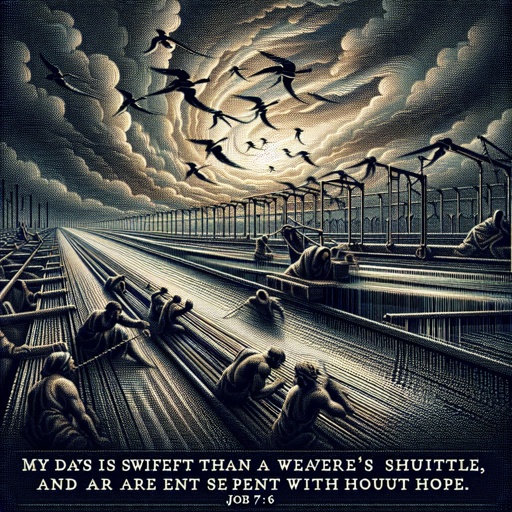
Job 7:6 - "My days are swifter than a weaver's shuttle, and are spent without hope."

Job 28:7 - "There is a path which no fowl knoweth, and which the vulture's eye hath not seen:"

"What man is like Job, who drinketh up scorning like water?" - Job 34:7

Job 32:7 - "I said, Days should speak, and multitude of years should teach wisdom."