What does John 12:5 mean?
“Why was not this ointment sold for three hundred pence, and given to the poor?” — John 12:5
John 12:5 (KJV) reads, "Why was not this ointment sold for three hundred pence, and given to the poor?"
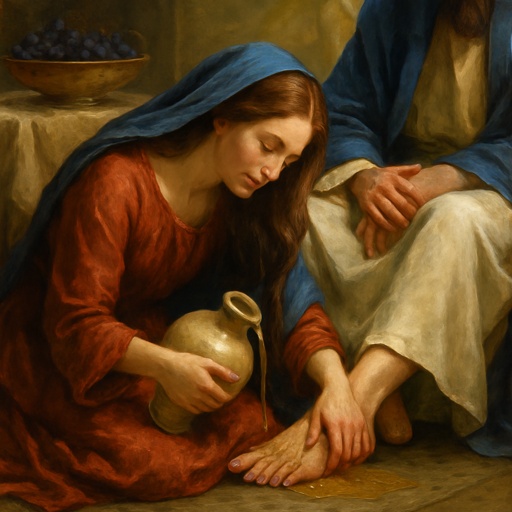
This verse is part of a larger passage in the book of John, where Jesus is in Bethany, at the home of Mary, Martha, and Lazarus. This particular verse is spoken by Judas Iscariot, one of Jesus' disciples, in response to Mary anointing Jesus' feet with expensive perfume. Judas raises the question of why the perfume was not sold and the money given to the poor. In the following verse, John explains that Judas did not genuinely care for the poor, but was actually a thief who would steal from the money bag.
The deeper meaning of this verse and the larger passage surrounding it is multi-layered and can be interpreted in a number of ways. On the surface level, it addresses the issue of charity and the treatment of the poor. Judas's question implies a concern for the poor and raises the ethical dilemma of using expensive resources for personal use versus using them for charitable purposes. This raises the important theme of social justice and compassion for the less fortunate, a message that is consistent throughout the teachings of Jesus.
Furthermore, the passage can also be seen as a commentary on the nature of true devotion and sacrifice for Jesus. Mary's act of anointing Jesus' feet with expensive perfume can be seen as a symbol of her deep love and reverence for him. In response to Judas's criticism, Jesus defends Mary's actions, implying that her gesture was a meaningful act of devotion and preparation for his impending death. This highlights the theme of sacrifice and devotion, emphasizing the idea that true love for Jesus should be demonstrated through acts of selflessness and generosity, even at personal cost.
Symbolically, the perfume itself can be seen as a representation of the valuable gift of love and devotion that Mary offers to Jesus. The fact that the perfume is described as being worth three hundred pence emphasizes its great value, which parallels the immeasurable worth of the love and devotion that Mary demonstrates for Jesus. This symbolizes the idea that love for Jesus is priceless and cannot be measured in earthly terms.
From a contextual perspective, this passage also foreshadows the betrayal of Jesus by Judas. Judas's criticism and lack of understanding serve as an indication of his true character and his eventual betrayal of Jesus. This serves as a warning about the dangers of greed and selfishness, and the potential for even those close to Jesus to fall into temptation and turn against him.
Overall, John 12:5 and the passage it is a part of encompass a range of important themes, including social justice, sacrificial love, true devotion, and the dangers of greed and betrayal. The symbolism of the perfume accentuates these themes and highlights the value of genuine love and devotion for Jesus. The passage serves as a powerful reminder of the importance of selfless love, compassion for the less fortunate, and unwavering devotion to Jesus, which are all central teachings of Christianity.
Get our apps


Artwork for John 12:5

John 12:5 - "Why was not this ointment sold for three hundred pence, and given to the poor?"

"Why was not this ointment sold for three hundred pence, and given to the poor?" - John 12:5

1 John 5:12 - "He that hath the Son hath life; and he that hath not the Son of God hath not life."

John 5:12 - "Then asked they him, What man is that which said unto thee, Take up thy bed, and walk?"

"He that hath the Son hath life; and he that hath not the Son of God hath not life." - 1 John 5:12

"Then asked they him, What man is that which said unto thee, Take up thy bed, and walk?" - John 5:12
John 6:12

John 8:12

John 12:25

John 8:12

John 8:12

John 8:12
John 12:3

John 8:12

John 15:5

John 5:2

John 15:5

John 5:33 - "Ye sent unto John, and he bare witness unto the truth."

John 5:5 - "And a certain man was there, which had an infirmity thirty and eight years."

John 20:11-12

John 5:28

John 5:28

John 5:28

1 John 5:5 - "Who is he that overcometh the world, but he that believeth that Jesus is the Son of God?"

John 12:12 - "¶ On the next day much people that were come to the feast, when they heard that Jesus was coming to Jerusalem,"

John 3:5-8

John 1:1-5

John 1:1-5

John 3:5-8

1 John 5:18