What does John 19:1 mean?
“Then Pilate therefore took Jesus, and scourged him.” — John 19:1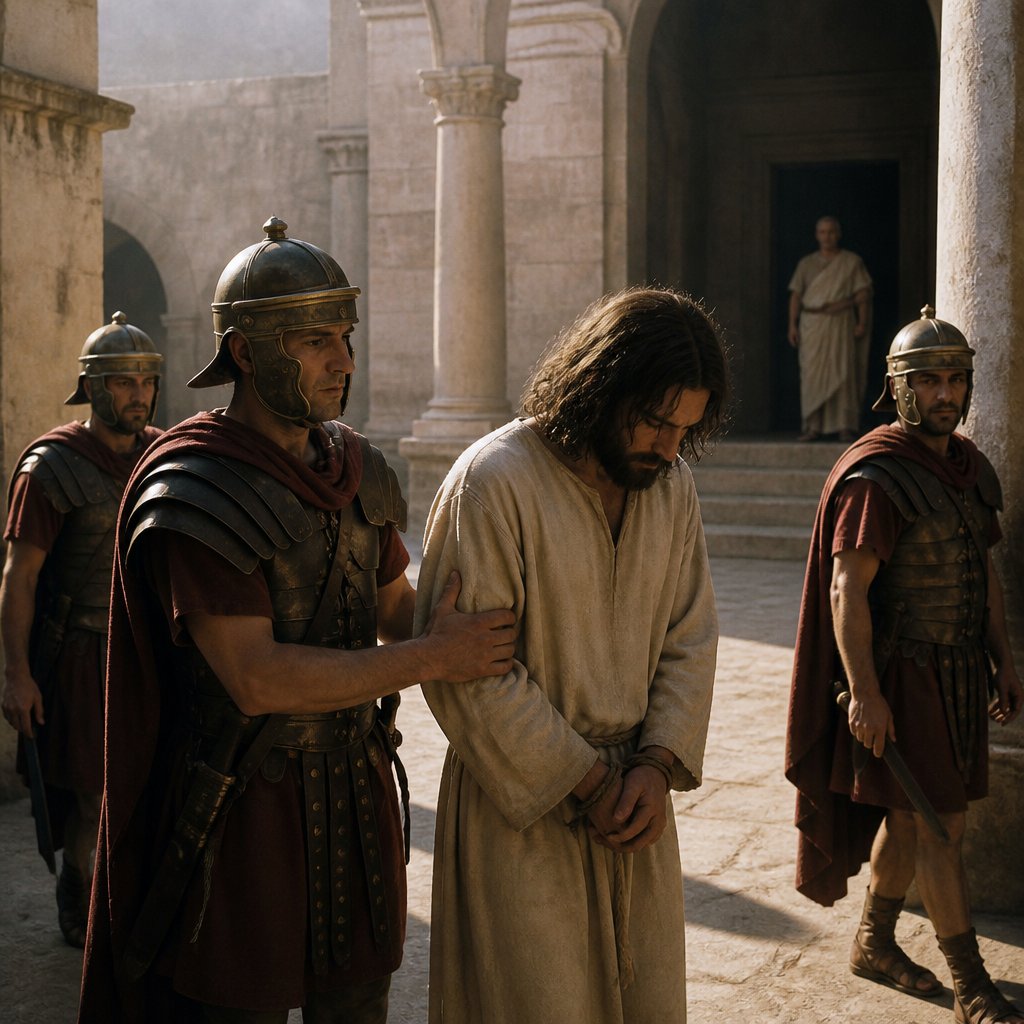
John 19:1 (KJV) reads: "Then Pilate therefore took Jesus, and scourged him." This verse marks a pivotal moment in the Gospel of John, as it depicts the physical and emotional suffering that Jesus endured before his crucifixion. To fully understand the significance of this verse, it is important to consider the historical and cultural context in which it takes place, as well as the broader themes of sacrifice, redemption, and the sovereignty of God.
The scene described in John 19:1 takes place during the trial of Jesus before the Roman governor Pontius Pilate. In the preceding chapters, Jesus has been arrested, interrogated, and brought before various religious and political authorities. Now, Pilate has taken Jesus into his custody and orders him to be scourged. This act of scourging was a common form of punishment in the Roman Empire, typically involving a brutal flogging with a whip or a rod. The purpose of this punishment was to humiliate, weaken, and inflict intense physical pain on the victim.
From a historical perspective, the crucifixion of Jesus was a common form of execution utilized by the Roman authorities for individuals deemed to be enemies of the state. The act of scourging served as a prelude to the crucifixion, furthering the suffering and degradation of the condemned individual. In this context, the fact that Pilate took Jesus and scourged him underscores the severity of the punishment that Jesus was about to endure.
The significance of this verse extends beyond the physical suffering of Jesus. In the broader narrative of the Gospels, Jesus' crucifixion and death were intended to serve as a sacrificial atonement for the sins of humanity. The act of scourging serves as a symbol of the suffering and sacrifice that Jesus willingly underwent in order to fulfill this redemptive purpose. This theme is central to Christian theology, as it emphasizes the belief that Jesus' death on the cross was a necessary and selfless act that offers the possibility of salvation and reconciliation with God.
Furthermore, the verse reflects the sovereignty of God in the face of human injustice and cruelty. Despite the unjust treatment that Jesus endured at the hands of Pilate and the Roman authorities, the narrative of the Gospels emphasizes that these events were part of a larger divine plan. In the Gospel of John, Jesus willingly submits to this suffering in accordance with the will of God, demonstrating his obedience and trust in the ultimate purpose of his mission.
Symbolically, the act of scourging serves as a representation of the physical and emotional torment that Jesus endured for the sake of humanity. It underscores the idea that Jesus' sacrifice was not only a means of atonement for sin, but also a demonstration of his love and compassion for all people. This symbolism serves as a powerful reminder of the depth of Jesus' commitment to his mission and the extent of his willingness to endure suffering on behalf of others.
In conclusion, John 19:1 provides a poignant and significant moment in the Gospel narrative, capturing the physical and emotional suffering that Jesus endured before his crucifixion. Through its historical, theological, and symbolic dimensions, this verse underscores the themes of sacrifice, redemption, and the sovereignty of God. It serves as a reminder of the profound implications of Jesus' suffering and the ultimate purpose of his mission in the Christian faith.
Get our apps


Artwork for John 19:1

John 19:1

John 19:1 - "Then Pilate therefore took Jesus, and scourged him."

John 19:1-3

"Then Pilate therefore took Jesus, and scourged him." - John 19:1

John 19:1-16 - "Then Pilate took Jesus and had him flogged. The soldiers twisted together a crown of thorns and put it on his head. They clothed him in a purple robe and went up to him again and again, saying, “Hail, king of the Jews!” And they slapped him in the face. Once more Pilate came out and said to the Jews gathered there, “Look, I am bringing him out to you to let you know that I find no basis for a charge against him.” When Jesus came out wearing the crown of thorns and the purple robe, Pilate said to them, “Here is the man!” As soon as the chief priests and their officials saw him, they shouted, “Crucify! Crucify!” But Pilate answered, “You take him and crucify him. As for me, I find no basis for a charge against him.” The Jewish leaders insisted, “We have a law, and according to that law he must die, because he claimed to be the Son of God.” When Pilate heard this, he was even more afraid, and he went back inside the palace. “Where do you come from?” he asked Jesus, but Jesus gave him no answer. “Do you refuse to speak to me?” Pilate said. “Don’t you realize I have power either to free you or to crucify you?” Jesus answered, “You would have no power over me if it were not given to you from above. Therefore the one who handed me over to you is guilty of a greater sin.” From then on, Pilate tried to set Jesus free, but the Jewish leaders kept shouting, “If you let this man go, you are no friend of Caesar. Anyone who claims to be a king opposes Caesar.” When Pilate heard this, he brought Jesus out and sat down on the judge’s seat at a place known as the Stone Pavement (which in Aramaic is Gabbatha). It was the day of Preparation of the Passover; it was about noon. “Here is your king,” Pilate said to the Jews. But they shouted, “Take him away! Take him away! Crucify him!” “Shall I crucify your king?” Pilate asked. “We have no king but Caesar,” the chief priests answered. Finally Pilate handed him over to them to be crucified."
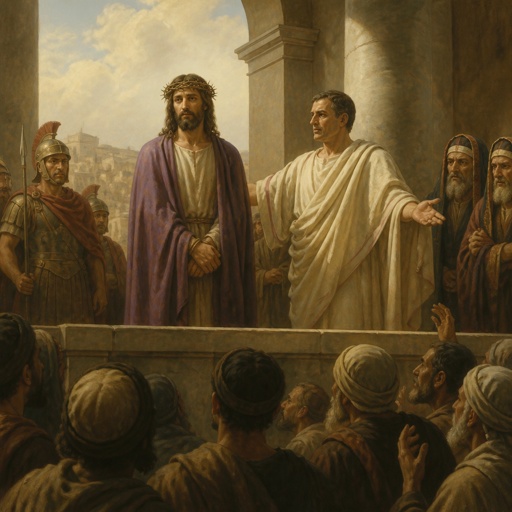
"Then Pilate took Jesus and had him flogged. The soldiers twisted together a crown of thorns and put it on his head. They clothed him in a purple robe and went up to him again and again, saying, “Hail, king of the Jews!” And they slapped him in the face. Once more Pilate came out and said to the Jews gathered there, “Look, I am bringing him out to you to let you know that I find no basis for a charge against him.” When Jesus came out wearing the crown of thorns and the purple robe, Pilate said to them, “Here is the man!” As soon as the chief priests and their officials saw him, they shouted, “Crucify! Crucify!” But Pilate answered, “You take him and crucify him. As for me, I find no basis for a charge against him.”" - John 19:1-6
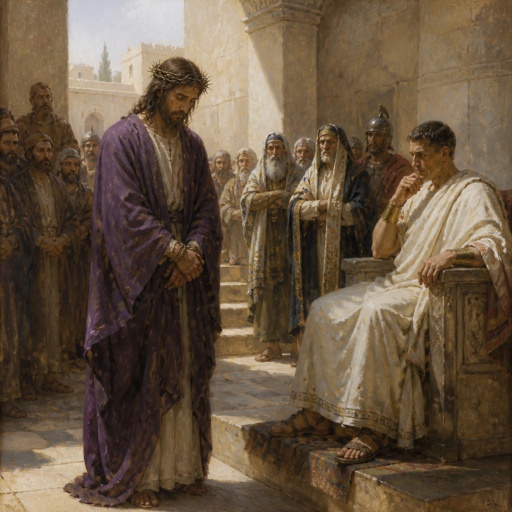
"Then Pilate took Jesus and had him flogged. The soldiers twisted together a crown of thorns and put it on his head. They clothed him in a purple robe and went up to him again and again, saying, “Hail, king of the Jews!” And they slapped him in the face. Once more Pilate came out and said to the Jews gathered there, “Look, I am bringing him out to you to let you know that I find no basis for a charge against him.” When Jesus came out wearing the crown of thorns and the purple robe, Pilate said to them, “Here is the man!” As soon as the chief priests and their officials saw him, they shouted, “Crucify! Crucify!” But Pilate answered, “You take him and crucify him. As for me, I find no basis for a charge against him.” The Jewish leaders insisted, “We have a law, and according to that law he must die, because he claimed to be the Son of God.” When Pilate heard this, he was even more afraid, and he went back inside the palace. “Where do you come from?” he asked Jesus, but Jesus gave him no answer. “Do you refuse to speak to me?” Pilate said. “Don’t you realize I have power either to free you or to crucify you?” Jesus answered, “You would have no power over me if it were not given to you from above. Therefore the one who handed me over to you is guilty of a greater sin.” From then on, Pilate tried to set Jesus free, but the Jewish leaders kept shouting, “If you let this man go, you are no friend of Caesar. Anyone who claims to be a king opposes Caesar.” When Pilate heard this, he brought Jesus out and sat down on the judge’s seat at a place known as the Stone Pavement (which in Aramaic is Gabbatha). It was the day of Preparation of the Passover; it was about noon. “Here is your king,” Pilate said to the Jews. But they shouted, “Take him away! Take him away! Crucify him!” “Shall I crucify your king?” Pilate asked. “We have no king but Caesar,” the chief priests answered. Finally Pilate handed him over to them to be crucified." - John 19:1-16

John 19:1-6 - "Then Pilate took Jesus and had him flogged. The soldiers twisted together a crown of thorns and put it on his head. They clothed him in a purple robe and went up to him again and again, saying, “Hail, king of the Jews!” And they slapped him in the face. Once more Pilate came out and said to the Jews gathered there, “Look, I am bringing him out to you to let you know that I find no basis for a charge against him.” When Jesus came out wearing the crown of thorns and the purple robe, Pilate said to them, “Here is the man!” As soon as the chief priests and their officials saw him, they shouted, “Crucify! Crucify!” But Pilate answered, “You take him and crucify him. As for me, I find no basis for a charge against him.”"

John 1:19 - "¶ And this is the record of John, when the Jews sent priests and Levites from Jerusalem to ask him, Who art thou?"

1 John 4:19 - "We love him, because he first loved us."

1 John 5:19 - "And we know that we are of God, and the whole world lieth in wickedness."

1 John 3:19 - "And hereby we know that we are of the truth, and shall assure our hearts before him."

1 John 4;19

John 19:38

"We love him, because he first loved us." - 1 John 4:19

John 19:19 - "¶ And Pilate wrote a title, and put it on the cross. And the writing was, JESUS OF NAZARETH THE KING OF THE JEWS."

"¶ And this is the record of John, when the Jews sent priests and Levites from Jerusalem to ask him, Who art thou?" - John 1:19

"We love him, because he first loved us." - 1 John 4:19

John 17.6-19

Mark 1:19 - "And when he had gone a little further thence, he saw James the son of Zebedee, and John his brother, who also were in the ship mending their nets."

"And we know that we are of God, and the whole world lieth in wickedness." - 1 John 5:19

John 19:25-27

1 John 2:19 - "They went out from us, but they were not of us; for if they had been of us, they would no doubt have continued with us: but they went out, that they might be made manifest that they were not all of us."

John 19:25-27

John 19:26-27

John 21:15-19

The Source of Our Love New Testament 1 John 4:7: "Dear friends, let us love one another, for love comes from God. Everyone who loves has been born of God and knows God." 1 John 4:19: "We love because he first loved us."

1 John 3:18-19 - "My little children, let us not love in word, neither in tongue; but in deed and in truth. And hereby we know that we are of the truth, and shall assure our hearts before him."

1 John 3:19-20 - "By this we know that we are of the truth, and shall assure our hearts before Him. For if our heart condemns us, God is greater than our heart, and knows all things."

The Source of Our Love New Testament 1 John 4:7: "Dear friends, let us love one another, for love comes from God. Everyone who loves has been born of God and knows God." 1 John 4:19: "We love because he first loved us."