
John 4:3 in the King James Version (KJV) reads, "He left Judaea, and departed again into Galilee." While this verse may seem simple on the surface, there is a depth of meaning and significance to be explored within its context. To truly understand the depth of this verse, we must delve into the themes, context, and symbolism within the Gospel of John.
The Gospel of John is one of the four Gospels in the New Testament and is unique in its portrayal of Jesus Christ. John's Gospel focuses on Jesus as the divine Son of God and emphasizes the importance of belief in him for eternal life. Throughout the Gospel, John presents Jesus as the Word made flesh, the light of the world, and the source of living water. These themes of belief, light, and life are foundational to the narrative of the Gospel.
In the immediate context of John 4:3, the verse is part of the narrative of Jesus' encounter with the Samaritan woman at the well. The verse follows the statement that Jesus "left Judaea," which highlights his departure from a region and sets the stage for his journey into Galilee. This movement from Judaea to Galilee serves as a transition in the narrative, leading Jesus to encounter the Samaritan woman and reveal his identity as the Messiah to her.
The journey from Judaea to Galilee also holds symbolic significance within the broader context of John's Gospel. Judaea was the region where Jerusalem, the religious center of Judaism, was located. In contrast, Galilee was a region known for its diverse population and was often viewed with skepticism by the religious elite. By leaving Judaea and traveling to Galilee, Jesus demonstrates his mission to reach all people with the message of salvation, regardless of their background or social status.
Furthermore, the journey from Judaea to Galilee embodies the larger theme of Jesus' ministry. Throughout the Gospel of John, Jesus consistently reaches out to those who are marginalized or excluded by society. His encounter with the Samaritan woman at the well is a prime example of this, as he defies social norms and engages in a meaningful conversation with a woman who is an outsider in multiple ways. Thus, Jesus' departure from Judaea and entrance into Galilee reflects his mission to bring the message of salvation to all people, transcending cultural and societal barriers.
In addition to its thematic significance, John 4:3 also holds symbolic meaning within the broader biblical context. The movement from Judaea to Galilee can be seen as a metaphor for Jesus' overarching mission and purpose. Throughout the New Testament, Galilee is often associated with Jesus' ministry and the proclamation of the gospel. It is in Galilee that Jesus calls his disciples, performs miracles, and delivers some of his most profound teachings. By departing from Judaea and heading to Galilee, Jesus is aligning himself with a region that will become a focal point for his earthly ministry.
Overall, John 4:3 in the King James Version holds rich layers of meaning and significance within its themes, context, and symbolism. The verse serves as a pivotal point in the narrative of the Gospel of John, marking the transition from one region to another and highlighting Jesus' mission to reach all people with the message of salvation. As readers, we are invited to ponder the deeper implications of this journey and consider the profound implications of Jesus' ministry for our own lives.
Get our apps


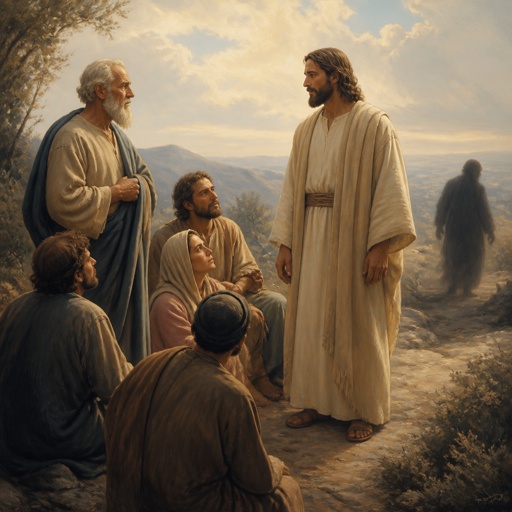
Artwork for John 4:3

John 4:3 - "He left Judaea, and departed again into Galilee."

"He left Judaea, and departed again into Galilee." - John 4:3

1 John 4:3 - "And every spirit that confesseth not that Jesus Christ is come in the flesh is not of God: and this is that spirit of antichrist, whereof ye have heard that it should come; and even now already is it in the world."
"And every spirit that confesseth not that Jesus Christ is come in the flesh is not of God: and this is that spirit of antichrist, whereof ye have heard that it should come; and even now already is it in the world." - 1 John 4:3

John 3:4

John 3:4

John 3:4

John 3:4

John 3:4

Acts 3:4 - "And Peter, fastening his eyes upon him with John, said, Look on us."

1 John 3:4 - "Whosoever committeth sin transgresseth also the law: for sin is the transgression of the law."

3 John 1:4 - "I have no greater joy than to hear that my children walk in truth."

3 John 1:3-4 - "For I rejoiced greatly when brethren came and testified of the truth that is in you, just as you walk in the truth. I have no greater joy than to hear that my children walk in truth."

Matthew 3:4 - "And the same John had his raiment of camel's hair, and a leathern girdle about his loins; and his meat was locusts and wild honey."

John 3:4 - "Nicodemus saith unto him, How can a man be born when he is old? can he enter the second time into his mother's womb, and be born?"

"And Peter, fastening his eyes upon him with John, said, Look on us." - Acts 3:4

"Whosoever committeth sin transgresseth also the law: for sin is the transgression of the law." - 1 John 3:4

John 3:3

"I have no greater joy than to hear that my children walk in truth." - 3 John 1:4

John 3:24 - "For John was not yet cast into prison."

John 3:3-8

John 4:4 - "And he must needs go through Samaria."

John 3

1 John 3:1-3

1 John 1:3-4 - "We proclaim to you what we have seen and heard, so that you also may have fellowship with us. And our fellowship is with the Father and with his Son, Jesus Christ. We write this to make our joy complete."

John 4:16

John 4:16

John 4:16

John 4:16

John 4:16