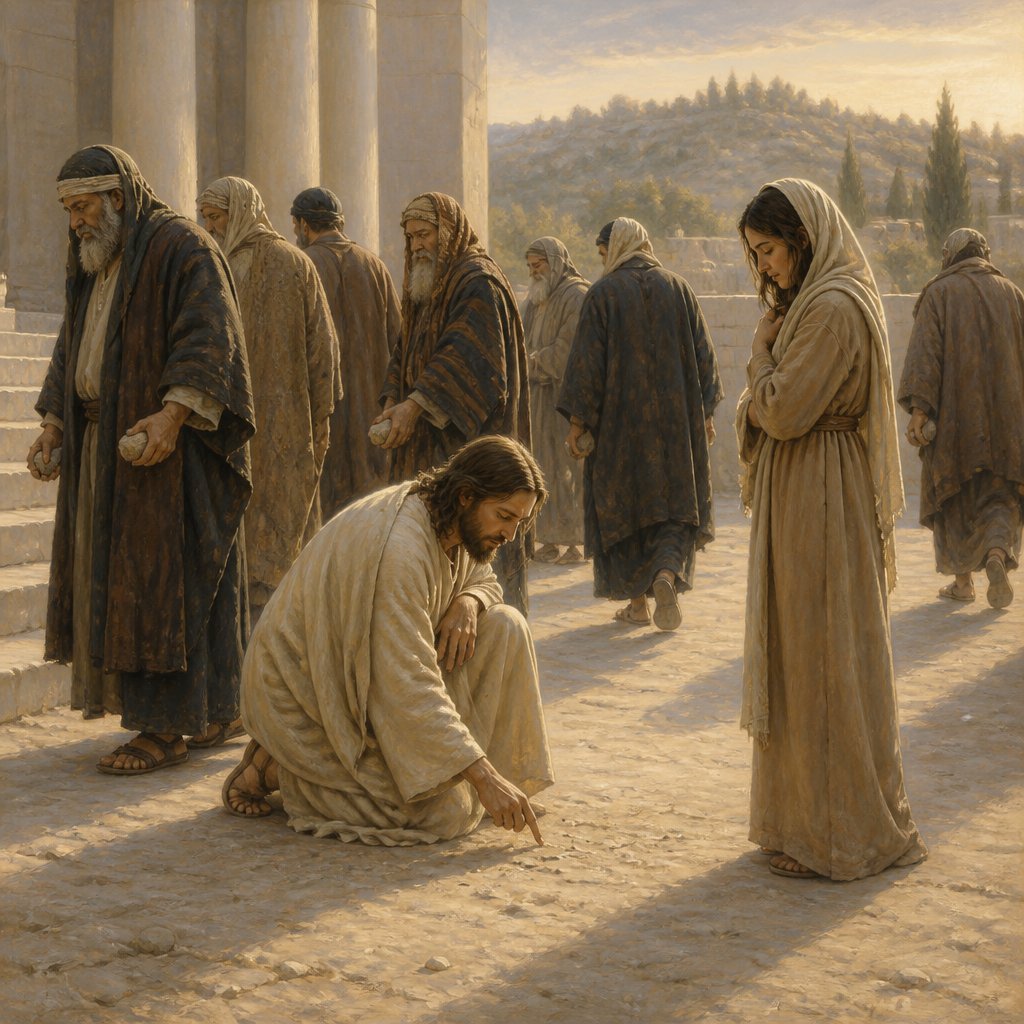
John 8:1-11 from the King James Version (KJV) tells the story of the woman caught in adultery and brought before Jesus by the scribes and Pharisees. The passage reads:
1 Jesus went unto the mount of Olives. 2 And early in the morning he came again into the temple, and all the people came unto him; and he sat down, and taught them. 3 And the scribes and Pharisees brought unto him a woman taken in adultery; and when they had set her in the midst, 4 They say unto him, Master, this woman was taken in adultery, in the very act. 5 Now Moses in the law commanded us, that such should be stoned: but what sayest thou? 6 This they said, tempting him, that they might have to accuse him. But Jesus stooped down, and with his finger wrote on the ground, as though he heard them not. 7 So when they continued asking him, he lifted up himself, and said unto them, He that is without sin among you, let him first cast a stone at her. 8 And again he stooped down, and wrote on the ground. 9 And they which heard it, being convicted by their own conscience, went out one by one, beginning at the eldest, even unto the last: and Jesus was left alone, and the woman standing in the midst. 10 When Jesus had lifted up himself, and saw none but the woman, he said unto her, Woman, where are those thine accusers? hath no man condemned thee? 11 She said, No man, Lord. And Jesus said unto her, Neither do I condemn thee: go, and sin no more.
This passage presents a powerful and profound message about forgiveness, compassion, and the grace of God. The story takes place in the temple, where Jesus is teaching a crowd of people. The scribes and Pharisees, who were known for their strict adherence to the Mosaic Law, bring a woman to Jesus who was caught in the act of adultery. They present her to Jesus, posing a question that is intended to test him - they ask whether she should be stoned, as the Law of Moses commands.
Jesus responds by stooping down and writing on the ground with his finger, a gesture that is not explained in the text but is often interpreted as a sign of divine wisdom and discernment. When the scribes and Pharisees continue to press him for an answer, Jesus stands and delivers his famous response: "He that is without sin among you, let him first cast a stone at her." This statement exposes the hypocrisy of the accusers and reminds them that they themselves are not without sin.
The scribes and Pharisees, convicted by their own consciences, begin to leave one by one, from the eldest to the youngest, until no one is left but Jesus and the woman. Jesus then asks the woman where her accusers are, and she responds that there are none. He then declares, "Neither do I condemn thee: go, and sin no more."
This story is rich with symbolism and themes that are central to the Christian faith. One of the most prominent themes is the idea of forgiveness and grace. Jesus' response to the woman demonstrates the boundless mercy and compassion of God. Despite her sin, Jesus does not condemn her but offers her the opportunity for a fresh start, urging her to "go and sin no more." This exemplifies the Christian belief in the redemptive power of forgiveness and the transformative nature of God's love.
Additionally, the passage highlights the hypocrisy and self-righteousness of the scribes and Pharisees. By challenging them to examine their own lives before passing judgment on the woman, Jesus exposes their moral shortcomings and underscores the importance of humility and self-reflection.
The story also serves as a reminder of the universal experience of sin and the universal need for grace. Both the woman caught in adultery and the scribes and Pharisees are depicted as sinners in need of forgiveness. This underscores the Christian belief that all have sinned and fallen short of the glory of God, and that it is only through the grace of Jesus Christ that we can find redemption and restoration.
In addition to these themes, the passage also offers insight into the character of Jesus. His response to the situation reflects his wisdom, compassion, and unwavering commitment to justice. His refusal to condemn the woman and his call for her to change her ways speaks to his desire for the restoration and well-being of all people.
Overall, John 8:1-11 is a powerful and poignant story that speaks to the heart of the Christian faith. It offers a profound reflection on the themes of forgiveness, grace, humility, and the transformative power of Jesus Christ. It serves as a reminder of the universal need for compassion and mercy, and the universal call to live in accordance with the teachings of Christ.
Get our apps


Artwork for John 8:1-11

John 8:1-11 - "But Jesus went to the Mount of Olives. Early in the morning he came again to the temple. All the people came to him, and he sat down and taught them. The scribes and the Pharisees brought a woman who had been caught in adultery, and placing her in the midst they said to him, “Teacher, this woman has been caught in the act of adultery. Now in the Law Moses commanded us to stone such women. So what do you say?” This they said to test him, that they might have some charge to bring against him. Jesus bent down and wrote with his finger on the ground. And as they continued to ask him, he stood up and said to them, “Let him who is without sin among you be the first to throw a stone at her.” And once more he bent down and wrote on the ground. But when they heard it, they went away one by one, beginning with the older ones, and Jesus was left alone with the woman standing before him. Jesus stood up and said to her, “Woman, where are they? Has no one condemned you?” She said, “No one, Lord.” And Jesus said, “Neither do I condemn you; go, and from now on sin no more.”"
"But Jesus went to the Mount of Olives. Early in the morning he came again to the temple. All the people came to him, and he sat down and taught them. The scribes and the Pharisees brought a woman who had been caught in adultery, and placing her in the midst they said to him, “Teacher, this woman has been caught in the act of adultery. Now in the Law Moses commanded us to stone such women. So what do you say?” This they said to test him, that they might have some charge to bring against him. Jesus bent down and wrote with his finger on the ground. And as they continued to ask him, he stood up and said to them, “Let him who is without sin among you be the first to throw a stone at her.” And once more he bent down and wrote on the ground. But when they heard it, they went away one by one, beginning with the older ones, and Jesus was left alone with the woman standing before him. Jesus stood up and said to her, “Woman, where are they? Has no one condemned you?” She said, “No one, Lord.” And Jesus said, “Neither do I condemn you; go, and from now on sin no more.”" - John 8:1-11

John 8:1 - "Jesus went unto the mount of Olives."

"Jesus went unto the mount of Olives." - John 8:1

John 8:4-11

John 15:1-8

John 3:3-8

John 11:8 - "His disciples say unto him, Master, the Jews of late sought to stone thee; and goest thou thither again?"

John 1:8 - "He was not that Light, but was sent to bear witness of that Light."

John 8:11 - "She said, No man, Lord. And Jesus said unto her, Neither do I condemn thee: go, and sin no more."

Romans 8:11

1 John 1:8 - "If we say that we have no sin, we deceive ourselves, and the truth is not in us."

Acts 1:1-11

1 John 4:8 - "He that loveth not knoweth not God; for God is love."

Romans 8:1

John 1:11 - "He came unto his own, and his own received him not."

Acts 1:1-11

Psalm 80:8-11

3 John 1:8 - "We therefore ought to receive such, that we might be fellowhelpers to the truth."

2 John 1:11 - "For he that biddeth him God speed is partaker of his evil deeds."

1 Corinthians 11:8 - "For the man is not of the woman; but the woman of the man."

1 John 3:11 - "For this is the message that ye heard from the beginning, that we should love one another."

1 John 5:11 - "And this is the record, that God hath given to us eternal life, and this life is in his Son."

1 Chronicles 8:11 - "And of Hushim he begat Abitub, and Elpaal."

1 Corinthians 15:8-11

1 John 5:8 - "And there are three that bear witness in earth, the Spirit, and the water, and the blood: and these three agree in one."

1 John 4:11 - "Beloved, if God so loved us, we ought also to love one another."

John 11:1 - "Now a certain man was sick, named Lazarus, of Bethany, the town of Mary and her sister Martha."

"He was not that Light, but was sent to bear witness of that Light." - John 1:8

Revelation 1:11