What does Joshua 13:16 mean?
“And their coast was from Aroer, that is on the bank of the river Arnon, and the city that is in the midst of the river, and all the plain by Medeba;” — Joshua 13:16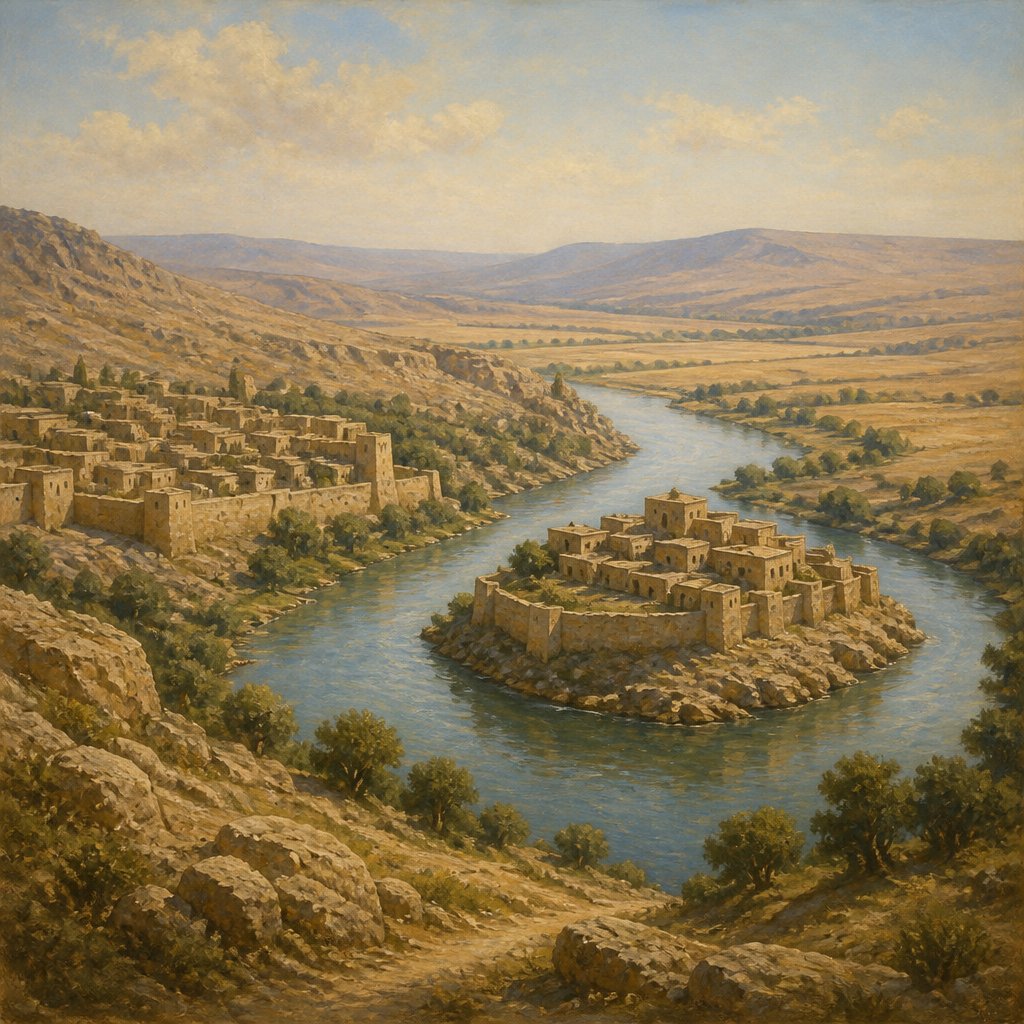
Joshua 13:16 from the King James Version (KJV) of the Bible reads, "And their coast was from Aroer, that is on the bank of the river Arnon, and the city that is in the midst of the river, and all the plain by Medeba."
This verse is part of a detailed account of the division of the land of Canaan among the tribes of Israel, as commanded by God through Moses and Joshua. It comes in the context of the Israelites' conquest and settlement of the Promised Land. The specific allotment described here is that of the tribe of Reuben, as part of the inheritance for the descendants of Reuben.
The verse speaks to the geographical boundaries of the territory assigned to the tribe of Reuben, delineating the extent of their land from Aroer on the bank of the river Arnon, including the city in the midst of the river, and all the plain by Medeba. These specific locations were significant landmarks within the territory handed over to the tribe of Reuben. The inclusion of such details serves to legitimize the boundaries of the tribe's inheritance and would have been vital for administrating and establishing their possession of the land.
On a deeper level, this verse serves as a reminder of God's faithfulness in fulfilling his promises to the Israelites. The division of the land among the tribes was a tangible manifestation of God's fulfillment of the covenant he made with Abraham, Isaac, and Jacob. It underscores the importance of obedience and faithfulness to God's commands, as the Israelites' possession of the land was contingent on their adherence to God's laws and instructions.
Symbolically, the allocation of territory to the tribes of Israel also conveys the idea of individual and collective responsibility. Each tribe was given a specific portion of the land, which they were expected to cultivate and steward. This reflects the concept of stewardship and the idea that the land ultimately belonged to God, with the Israelites being entrusted as caretakers of the land.
Furthermore, the verse also underscores the significance of specific geographic locations within the biblical narrative. Aroer, the river Arnon, and Medeba were not merely arbitrary places but held historical and symbolic significance for the Israelites. Aroer was a city located on the northern bank of the river Arnon, which served as a boundary between the territories of the Moabites and the Amorites. Medeba was an ancient city within the land of Moab. These locations were not only important for geographical reasons but were also imbued with historical and cultural significance, contributing to the overall narrative of Israel's conquest and settlement of the Promised Land.
In conclusion, Joshua 13:16 serves as a testament to God's faithfulness in fulfilling his promises and emphasizes the importance of obedience and stewardship in the context of the Israelites' possession of the Promised Land. The verse also highlights the historical and symbolic significance of specific geographic locations within the biblical narrative. It invites readers to reflect on the broader themes of faithfulness, stewardship, and the fulfillment of God's promises, all of which are enduring and relevant messages for believers today.
Get our apps


Artwork for Joshua 13:16

Joshua 13:16 - "And their coast was from Aroer, that is on the bank of the river Arnon, and the city that is in the midst of the river, and all the plain by Medeba;"
"And their coast was from Aroer, that is on the bank of the river Arnon, and the city that is in the midst of the river, and all the plain by Medeba;" - Joshua 13:16

Joshua 3:16

Joshua 7:16 - "¶ So Joshua rose up early in the morning, and brought Israel by their tribes; and the tribe of Judah was taken:"

Joshua 14:13 - "And Joshua blessed him, and gave unto Caleb the son of Jephunneh Hebron for an inheritance."

Joshua 5:13

Joshua 1:12-16

Joshua 1:12-16

Joshua 1:16 (KJVA) 16 And they answered Joshua, saying, All that thou commandest us we will do, and whithersoever thou sendest us, we will go.

Joshua 1:16 - "¶ And they answered Joshua, saying, All that thou commandest us we will do, and whithersoever thou sendest us, we will go."

Joshua 13:18 - "And Jahazah, and Kedemoth, and Mephaath,"

Joshua 11:13 - "But as for the cities that stood still in their strength, Israel burned none of them, save Hazor only; that did Joshua burn."

Joshua 6:16 - "And it came to pass at the seventh time, when the priests blew with the trumpets, Joshua said unto the people, Shout; for the LORD hath given you the city."

Joshua And The Walls Of Jericho 16:9

Joshua 8:16 - "And all the people that were in Ai were called together to pursue after them: and they pursued after Joshua, and were drawn away from the city."

Joshua 11:16 - "So Joshua took all that land, the hills, and all the south country, and all the land of Goshen, and the valley, and the plain, and the mountain of Israel, and the valley of the same;"

Joshua 5:13 (KJVA) 13 And it came to pass, when Joshua was by Jericho, that he lifted up his eyes and looked, and, behold, there stood a man over against him with his sword drawn in his hand: and Joshua went unto him, and said unto him, Art thou for us, or for our adversaries?

Joshua 8:13 - "And when they had set the people, even all the host that was on the north of the city, and their liers in wait on the west of the city, Joshua went that night into the midst of the valley."

Joshua 13:13 - "Nevertheless the children of Israel expelled not the Geshurites, nor the Maachathites: but the Geshurites and the Maachathites dwell among the Israelites until this day."

Joshua 13:20 - "And Beth-peor, and Ashdoth-pisgah, and Beth-jeshimoth,"

Joshua 19:16 - "This is the inheritance of the children of Zebulun according to their families, these cities with their villages."

Joshua 12:16 - "The king of Makkedah, one; the king of Beth-el, one;"

Joshua 16:4 - "So the children of Joseph, Manasseh and Ephraim, took their inheritance."

Joshua 10:16 - "But these five kings fled, and hid themselves in a cave at Makkedah."

Joshua 12:13 - "The king of Debir, one; the king of Geder, one;"

Joshua 13:19 - "And Kirjathaim, and Sibmah, and Zareth-shahar in the mount of the valley,"

Exodus 17:13 - "And Joshua discomfited Amalek and his people with the edge of the sword."

Joshua 13:28 - "This is the inheritance of the children of Gad after their families, the cities, and their villages."

Joshua 13:1 - "Now Joshua was old and stricken in years; and the LORD said unto him, Thou art old and stricken in years, and there remaineth yet very much land to be possessed."

Joshua 4:16 - "Command the priests that bear the ark of the testimony, that they come up out of Jordan."