What does Joshua 3:13 mean?
“And it shall come to pass, as soon as the soles of the feet of the priests that bear the ark of the LORD, the Lord of all the earth, shall rest in the waters of Jordan, that the waters of Jordan shall be cut off from the waters that come down from above; and they shall stand upon an heap.” — Joshua 3:13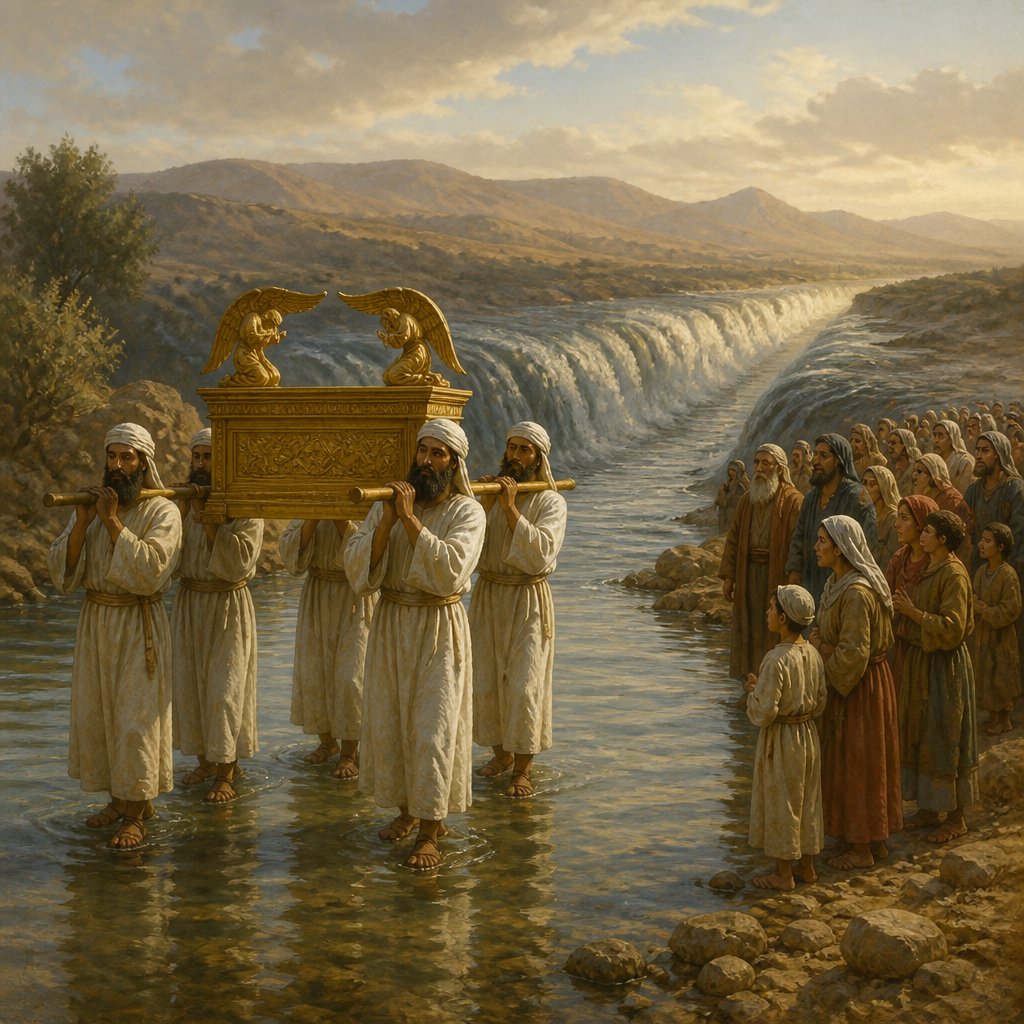
The verse Joshua 3:13 in the King James Version of the Bible reads: "And it shall come to pass, as soon as the soles of the feet of the priests that bear the ark of the Lord, the Lord of all the earth, shall rest in the waters of Jordan, that the waters of Jordan shall be cut off from the waters that come down from above; and they shall stand upon an heap."
This verse is part of the Book of Joshua, which tells the story of the Israelites crossing the Jordan River into the Promised Land after their exodus from Egypt. In this particular verse, the Israelites are about to cross the Jordan River to enter the land that God had promised to give them.
The context of this verse is the preparation for the crossing of the Jordan River. The priests are carrying the ark of the covenant, which is a sacred chest that contains the stone tablets inscribed with the Ten Commandments. The ark represented the presence of God among the Israelites, and it played a central role in their worship and in their military campaigns.
Symbolically, the crossing of the Jordan River represents a transition for the Israelites. They are leaving behind the wilderness, where they wandered for 40 years, and entering the land that God had promised to them. This transition represents a new beginning for the Israelites, and it is a pivotal moment in their history.
The verse also underscores the idea of God's power and his faithfulness to his promises. The priests carrying the ark of the Lord step into the waters of the Jordan River, and as soon as their feet touch the water, the flow of the river is miraculously cut off. This demonstrates God's ability to intervene in the natural world and to accomplish his purposes through supernatural means.
The symbolism of the river is also important in this verse. Throughout the Bible, water is often used as a symbol of purification, renewal, and life. In this context, the crossing of the Jordan River represents the Israelites' passage into a new phase of their journey, both physically and spiritually. It signifies their readiness to leave behind their old way of life and embrace the new life that God has prepared for them in the Promised Land.
In addition, the ark of the covenant itself is rich in symbolism. It represents the presence of God among his people and his faithfulness to his covenant with them. The fact that the priests are carrying the ark demonstrates their role as mediators between God and the people, and it emphasizes the central place of worship and obedience in the Israelites' relationship with God.
Overall, this verse conveys several important themes, including the faithfulness of God, the symbolism of water and the crossing of the river, and the importance of the ark of the covenant in the Israelites' religious life. It also serves as a reminder of the Israelites' dependence on God and his power to sustain and guide them as they enter a new phase of their journey.
Get our apps


Artwork for Joshua 3:13

Joshua 3:13 - "And it shall come to pass, as soon as the soles of the feet of the priests that bear the ark of the LORD, the Lord of all the earth, shall rest in the waters of Jordan, that the waters of Jordan shall be cut off from the waters that come down from above; and they shall stand upon an heap."
"And it shall come to pass, as soon as the soles of the feet of the priests that bear the ark of the LORD, the Lord of all the earth, shall rest in the waters of Jordan, that the waters of Jordan shall be cut off from the waters that come down from above; and they shall stand upon an heap." - Joshua 3:13

Joshua 13:3 - "From Sihor, which is before Egypt, even unto the borders of Ekron northward, which is counted to the Canaanite: five lords of the Philistines; the Gazathites, and the Ashdothites, the Eshkalonites, the Gittites, and the Ekronites; also the Avites:"

Joshua 14:13 - "And Joshua blessed him, and gave unto Caleb the son of Jephunneh Hebron for an inheritance."

Joshua 5:13

Joshua 13:18 - "And Jahazah, and Kedemoth, and Mephaath,"

Joshua 11:13 - "But as for the cities that stood still in their strength, Israel burned none of them, save Hazor only; that did Joshua burn."

Joshua 5:3 - "And Joshua made him sharp knives, and circumcised the children of Israel at the hill of the foreskins."

Joshua 9:3 - "¶ And when the inhabitants of Gibeon heard what Joshua had done unto Jericho and to Ai,"

Joshua 3:4

Joshua 3:16

Joshua 3:14

Joshua 3:14

Joshua 1:3

Joshua 3:14

Joshua 3:14

Joshua 3:4

Joshua 3:5 - "And Joshua said unto the people, Sanctify yourselves: for to morrow the LORD will do wonders among you."

Joshua 3:9 - "¶ And Joshua said unto the children of Israel, Come hither, and hear the words of the LORD your God."

Joshua 5:13 (KJVA) 13 And it came to pass, when Joshua was by Jericho, that he lifted up his eyes and looked, and, behold, there stood a man over against him with his sword drawn in his hand: and Joshua went unto him, and said unto him, Art thou for us, or for our adversaries?

Zechariah 3:3 - "Now Joshua was clothed with filthy garments, and stood before the angel."

Joshua 8:13 - "And when they had set the people, even all the host that was on the north of the city, and their liers in wait on the west of the city, Joshua went that night into the midst of the valley."

Joshua 13:13 - "Nevertheless the children of Israel expelled not the Geshurites, nor the Maachathites: but the Geshurites and the Maachathites dwell among the Israelites until this day."

Joshua 13:20 - "And Beth-peor, and Ashdoth-pisgah, and Beth-jeshimoth,"

Joshua 8:3 - "¶ So Joshua arose, and all the people of war, to go up against Ai: and Joshua chose out thirty thousand mighty men of valour, and sent them away by night."

Joshua 12:13 - "The king of Debir, one; the king of Geder, one;"

Joshua 13:19 - "And Kirjathaim, and Sibmah, and Zareth-shahar in the mount of the valley,"

Exodus 17:13 - "And Joshua discomfited Amalek and his people with the edge of the sword."

Joshua 13:28 - "This is the inheritance of the children of Gad after their families, the cities, and their villages."

Joshua 3:1-17