What does Judges 1:3 mean?
“And Judah said unto Simeon his brother, Come up with me into my lot, that we may fight against the Canaanites; and I likewise will go with thee into thy lot. So Simeon went with him.” — Judges 1:3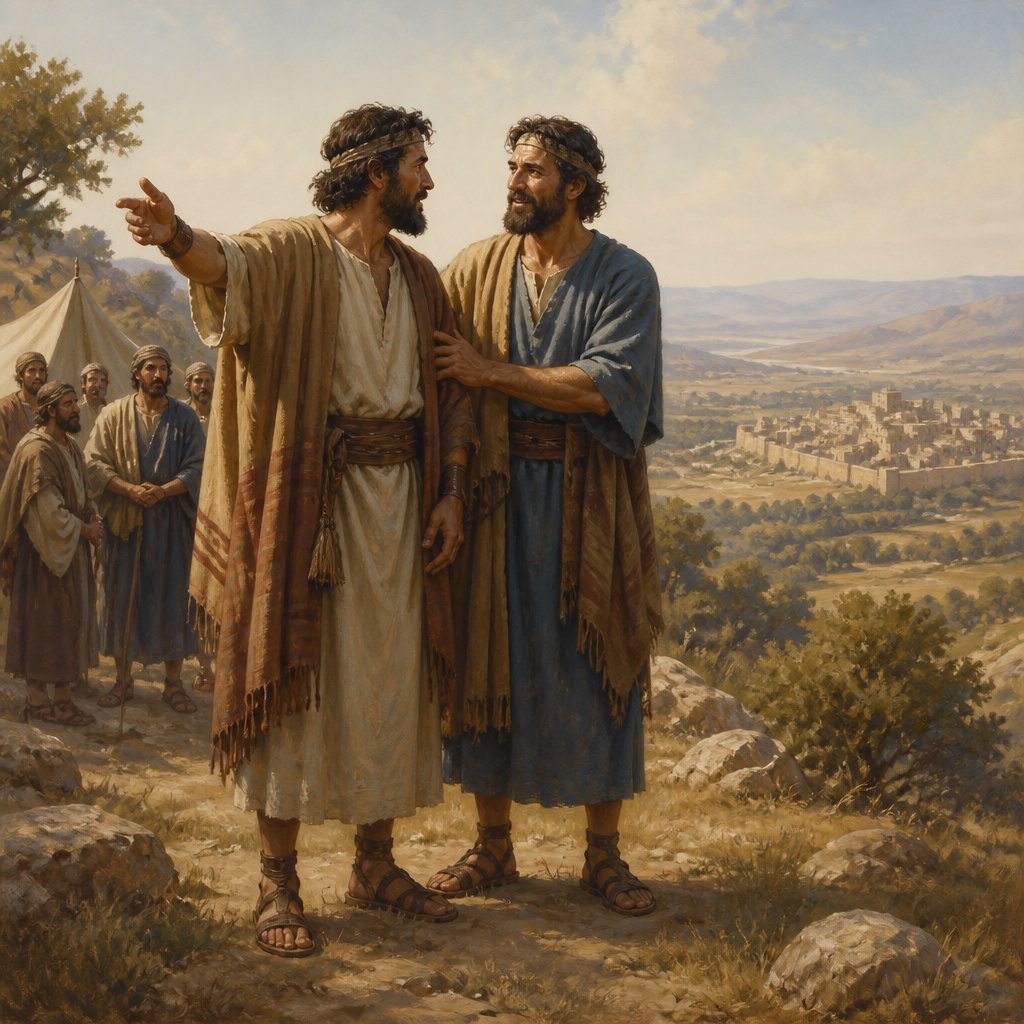
The verse Judges 1:3 in the King James Version (KJV) of the Bible reads, "And Judah said unto Simeon his brother, Come up with me into my lot, that we may fight against the Canaanites; and I likewise will go with thee into thy lot. So Simeon went with him." This verse is part of the larger narrative found in the book of Judges, which recounts the history of the Israelites after their entrance into the Promised Land.
In order to fully understand the meaning and significance of this verse, it is important to consider the context in which it is situated. The book of Judges follows the Israelites as they settle in the land of Canaan after their exodus from Egypt and their wandering in the wilderness. The Israelites are organized into twelve tribes, each of which is given a specific portion of land as an inheritance. The verse in question takes place as the Israelites are beginning to conquer and claim the land that has been promised to them by God.
In this particular verse, we see the tribe of Judah inviting the tribe of Simeon to join them in battle against the Canaanites. This is significant because it demonstrates the unity and cooperation between the tribes of Israel in their effort to claim and possess the land that has been promised to them. The fact that Judah extends an invitation to Simeon, and that Simeon accepts and joins Judah in the fight, speaks to the solidarity and mutual support among the people of Israel.
One of the themes that can be extracted from this verse is that of unity and collaboration. The Israelite tribes are not acting alone, but are instead coming together to achieve a common goal. This is reflective of the broader message found throughout the Bible, which emphasizes the importance of community and working together towards a shared purpose. The collaboration between Judah and Simeon also speaks to the idea of strength in numbers and the power that comes from standing united.
Additionally, this verse highlights the concept of mutual assistance and support. Judah offers to help Simeon in his own endeavors after Simeon has agreed to join Judah in battle. This sense of reciprocity and willingness to aid one another is indicative of the strong bonds that exist between the tribes of Israel. It also serves as a reminder of the importance of helping one another and extending a hand to those in need.
Symbolically, this verse can be seen as representing the larger story of the Israelite conquest of the Promised Land. The actions of Judah and Simeon are a microcosm of the broader effort to drive out the Canaanites and take possession of the land that God had promised to Abraham and his descendants. The unity and cooperation between these two tribes foreshadow the eventual success of the Israelites in claiming their inheritance, and serves as a reminder of the faithfulness of God in fulfilling his promises to his people.
Overall, Judges 1:3 in the King James Version of the Bible carries a message of unity, collaboration, and mutual support. It is a verse that speaks to the importance of coming together as a community to achieve common goals, and reminds us of the strength and power that comes from standing united. Through the actions of Judah and Simeon, we are given a powerful example of the value of solidarity and the benefits that come from working together towards a shared purpose.
Get our apps


Artwork for Judges 1:3

Judges 1:3 - "And Judah said unto Simeon his brother, Come up with me into my lot, that we may fight against the Canaanites; and I likewise will go with thee into thy lot. So Simeon went with him."
"And Judah said unto Simeon his brother, Come up with me into my lot, that we may fight against the Canaanites; and I likewise will go with thee into thy lot. So Simeon went with him." - Judges 1:3

Judges 3:31

1 Corinthians 4:3 - "But with me it is a very small thing that I should be judged of you, or of man's judgment: yea, I judge not mine own self."

Judges 3:1 - "Now these are the nations which the LORD left, to prove Israel by them, even as many of Israel as had not known all the wars of Canaan;"

1 Kings 3:9 - "Give therefore thy servant an understanding heart to judge thy people, that I may discern between good and bad: for who is able to judge this thy so great a people?"

1 Corinthians 6:3 - "Know ye not that we shall judge angels? how much more things that pertain to this life?"

1 Kings 3:28 - "And all Israel heard of the judgment which the king had judged; and they feared the king: for they saw that the wisdom of God was in him, to do judgment."

Zephaniah 3:3 - "Her princes within her are roaring lions; her judges are evening wolves; they gnaw not the bones till the morrow."

Judges 10:3 - "¶ And after him arose Jair, a Gileadite, and judged Israel twenty and two years."

Judges 3:6 - "And they took their daughters to be their wives, and gave their daughters to their sons, and served their gods."

1 Corinthians 5:3 - "For I verily, as absent in body, but present in spirit, have judged already, as though I were present, concerning him that hath so done this deed,"

Judges 3:11 - "And the land had rest forty years. And Othniel the son of Kenaz died."

Judges 3:14 - "So the children of Israel served Eglon the king of Moab eighteen years."

Judges 13:3 make the Angel of the Lord male

Judges 3:3 - "Namely, five lords of the Philistines, and all the Canaanites, and the Sidonians, and the Hivites that dwelt in mount Lebanon, from mount Baal-hermon unto the entering in of Hamath."
"But with me it is a very small thing that I should be judged of you, or of man's judgment: yea, I judge not mine own self." - 1 Corinthians 4:3

Judges 3:5 - "¶ And the children of Israel dwelt among the Canaanites, Hittites, and Amorites, and Perizzites, and Hivites, and Jebusites:"

Judges 3:26 - "And Ehud escaped while they tarried, and passed beyond the quarries, and escaped unto Seirath."

Matthew 7:1 - "Judge not, that ye be not judged."

1 Samuel 3:13 - "For I have told him that I will judge his house for ever for the iniquity which he knoweth; because his sons made themselves vile, and he restrained them not."

Judges 4:4

Judges 3:17 - "And he brought the present unto Eglon king of Moab: and Eglon was a very fat man."

Judges 2:31

Judges 3:30 - "So Moab was subdued that day under the hand of Israel. And the land had rest fourscore years."

Matthew 7:1-2 - "Do not judge, or you too will be judged. For in the same way you judge others, you will be judged, and with the measure you use, it will be measured to you."

Judges 3:23 - "Then Ehud went forth through the porch, and shut the doors of the parlour upon him, and locked them."

Judges 3:7 - "And the children of Israel did evil in the sight of the LORD, and forgat the LORD their God, and served Baalim and the groves."

Judges 3:18 - "And when he had made an end to offer the present, he sent away the people that bare the present."

Judges 3:29 - "And they slew of Moab at that time about ten thousand men, all lusty, and all men of valour; and there escaped not a man."