What does Luke 2:13-14 mean?
“And suddenly there was with the angel a multitude of the heavenly host praising God, and saying, Glory to God in the highest, and on earth peace, good will toward men.” — Luke 2:13-14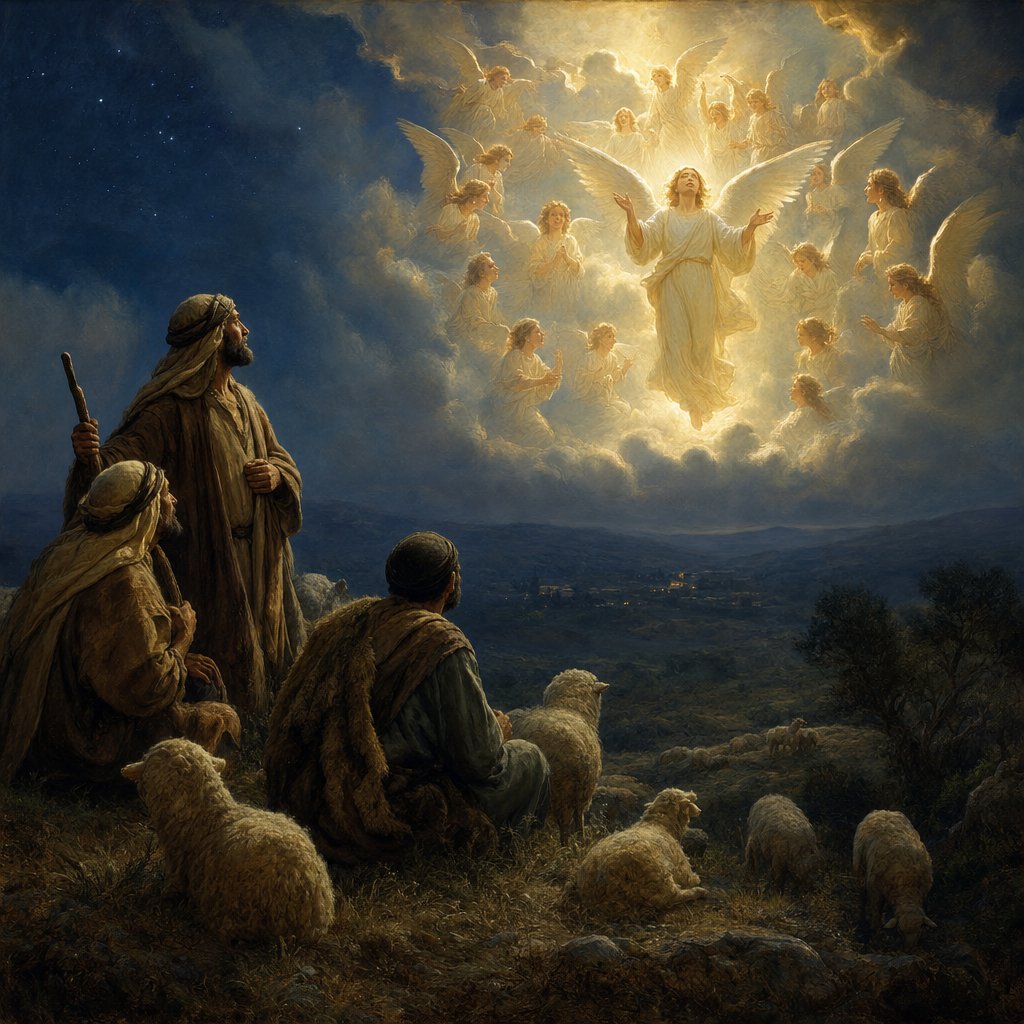
Luke 2:13–14 in the King James Version stands at the center of the nativity account as heaven’s own interpretation of what the birth of Jesus means. The passage reads, “And suddenly there was with the angel a multitude of the heavenly host praising God, and saying, Glory to God in the highest, and on earth peace, good will toward men.” These two verses gather up the hidden mystery of the incarnation and let it be heard aloud, not first in palaces or temples, but in the open fields where shepherds keep watch by night.
The immediate context is the announcement to shepherds that “there is born to you this day in the city of David a Saviour, which is Christ the Lord” and the sign that they will find “the babe wrapped in swaddling clothes, lying in a manger” (Luke 2:11–12, KJV). The solitary angelic messenger is suddenly joined by “a multitude of the heavenly host.” The suddenness matters. It suggests that the birth of Christ is not merely a local event in Bethlehem, but a cosmic turning point that draws the attention and worship of heaven itself. “Heavenly host” speaks of an army, not because the angels come to fight earthly nations, but because this birth begins a conquest of a deeper kind: the overthrow of sin and death and the securing of God’s saving purpose. The first response of heaven is not strategy but praise, because what is happening is fundamentally God’s work and God’s victory.
The angelic song has three great notes that interpret the whole gospel: God’s glory, earth’s peace, and God’s goodwill toward men. “Glory to God in the highest” places the highest aim of Christ’s coming where Scripture consistently places it: the vindication and display of God’s greatness. The phrase “in the highest” points beyond the visible skies to the highest heavens, the supreme realm where God’s majesty is unchallenged. Yet it also implies that what is unfolding in a manger belongs to that highest realm. The lowliness of the infant does not diminish God; it reveals Him. The glory of God is shown not only in power but in holy condescension, in mercy that stoops. The angels praise because the birth of Christ is the revelation of God’s character—His faithfulness to promises, His compassion toward the fallen, and His sovereignty arranging history so that the promised “city of David” becomes the birthplace of David’s greater Son.
“And on earth peace” must be heard in light of the fear and darkness that frame the scene. The shepherds are “sore afraid” when the angel appears (Luke 2:9, KJV), and the world into which Christ is born is marked by Roman rule, hardship, and spiritual longing. The peace announced is therefore not merely a pause in political conflict, but the arrival of a reconciling work that reaches to the roots of human unrest. In the wider witness of Scripture, peace with God is the fountain from which all other true peace flows. Luke’s nativity narrative immediately implies this by pairing “peace” with the coming of “a Saviour” (Luke 2:11, KJV). The child is not introduced as a philosopher of serenity but as a redeemer. The angels proclaim peace because the One who brings salvation has arrived; the conditions for reconciliation have begun to be established in history.
The final phrase, “good will toward men,” clarifies the source and direction of this peace. It is not first humanity’s goodwill toward God, as though earth finally decided to be better, but God’s gracious disposition reaching down toward humanity. The goodwill is divine in origin and human in its object. It declares that God’s approach to men in Christ is not hostile but saving; not distant but near. In this, the angels interpret the incarnation as a movement of favor. God’s purpose is not simply to display glory and demand homage, but to display glory by giving mercy. The song therefore holds together what people often separate: God’s glory and man’s good. In the gospel, the highest glory of God and the true good of men are not rivals; they meet in Christ.
The setting among shepherds adds further significance. Shepherds are ordinary, working men, not religious elites, and they live on the margins of public honor. That heaven chooses them as first hearers symbolizes the pattern of Christ’s kingdom: God begins with the lowly and makes them witnesses. It hints that the promised blessing is not confined to the socially powerful. The “good will toward men” is heard first by men who might expect least to be addressed by heaven. This anticipates the later Luke themes of reversal, mercy to the humble, and good news to the poor.
Symbolically, the “multitude” of angels suggests that this birth repairs a fracture between heaven and earth. Scripture often portrays angels as messengers moving between God and man; here they do more than deliver a message—they worship at the boundary of the two realms, as if to announce that in Christ the distance is being overcome. The praise itself is a kind of bridge: heaven’s worship spills onto earth, and earth is invited into heaven’s understanding of what has happened. The shepherds are not merely given information; they are placed within a moment of worship that interprets reality. The angels do not say, “Glory to the child,” but “Glory to God,” teaching that the baby in the manger is the means by which God is glorified. The child is the sign; God is the end; peace is the gift; goodwill is the motive.
Taken as a whole, Luke 2:13–14 functions like a divine headline over the entire life, death, and resurrection that will follow. The incarnation is proclaimed as God’s highest glory, the beginning of earth’s true peace, and the expression of God’s favorable purpose toward mankind. The angels’ song does not deny the sorrow and conflict that still exist; rather, it announces that the decisive act of God has begun, and that the final meaning of this birth is worship, reconciliation, and grace. In a night field outside Bethlehem, the hosts of heaven declare that the world is changing, not by human ascent to God, but by God’s descent to man, so that God may be glorified “in the highest,” and peace may come “on earth,” by His “good will toward men.”
Get our apps


Artwork for Luke 2:13-14

Luke 2:13-14

Luke 2:13-14

Luke 2:13-14 fine pointillism sytle

Luke 2:13-14 - "And suddenly there was with the angel a multitude of the heavenly host praising God, and saying, Glory to God in the highest, and on earth peace, good will toward men."
"And suddenly there was with the angel a multitude of the heavenly host praising God, and saying, Glory to God in the highest, and on earth peace, good will toward men." - Luke 2:13-14

"And suddenly there was with the angel a multitude of the heavenly host praising God, and saying, Glory to God in the highest, and on earth peace, good will toward men." - Luke 2:13-14

Luke 2:13

Luke 14:13 - "But when thou makest a feast, call the poor, the maimed, the lame, the blind:"

Luke 2:13 - "And suddenly there was with the angel a multitude of the heavenly host praising God, and saying,"

Luke 14:2 - "And, behold, there was a certain man before him which had the dropsy."

Luke 2:14 - "Glory to God in the highest, and on earth peace, good will toward men."

"But when thou makest a feast, call the poor, the maimed, the lame, the blind:" - Luke 14:13

"And suddenly there was with the angel a multitude of the heavenly host praising God, and saying," - Luke 2:13

Luke 13:14 - "And the ruler of the synagogue answered with indignation, because that Jesus had healed on the sabbath day, and said unto the people, There are six days in which men ought to work: in them therefore come and be healed, and not on the sabbath day."

Luke 13:2 - "And Jesus answering said unto them, Suppose ye that these Galilaeans were sinners above all the Galilaeans, because they suffered such things?"

Luke 2:14 - "Glory to God in the highest, and on earth peace, good will toward men."

Luke 2:14 - "Glory to God in the highest, and on earth peace, good will toward men."

2 Corinthians 13:14 - "The grace of the Lord Jesus Christ, and the love of God, and the communion of the Holy Ghost, be with you all. Amen."

"And, behold, there was a certain man before him which had the dropsy." - Luke 14:2

"Glory to God in the highest, and on earth peace, good will toward men." - Luke 2:14

2 Chronicles 13:14 - "And when Judah looked back, behold, the battle was before and behind: and they cried unto the LORD, and the priests sounded with the trumpets."

Luke 13:18-19

Luke 13:20-21

Luke 13:18-19

Luke 13:20-21
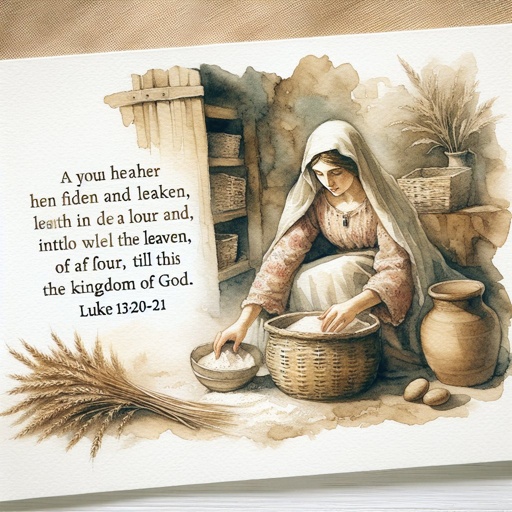
Luke 13:20-21

Luke 13:20-21

Luke 13:20-21

Luke 8:13

Luke 1:13