What does Luke 22:64 mean?
“And when they had blindfolded him, they struck him on the face, and asked him, saying, Prophesy, who is it that smote thee?” — Luke 22:64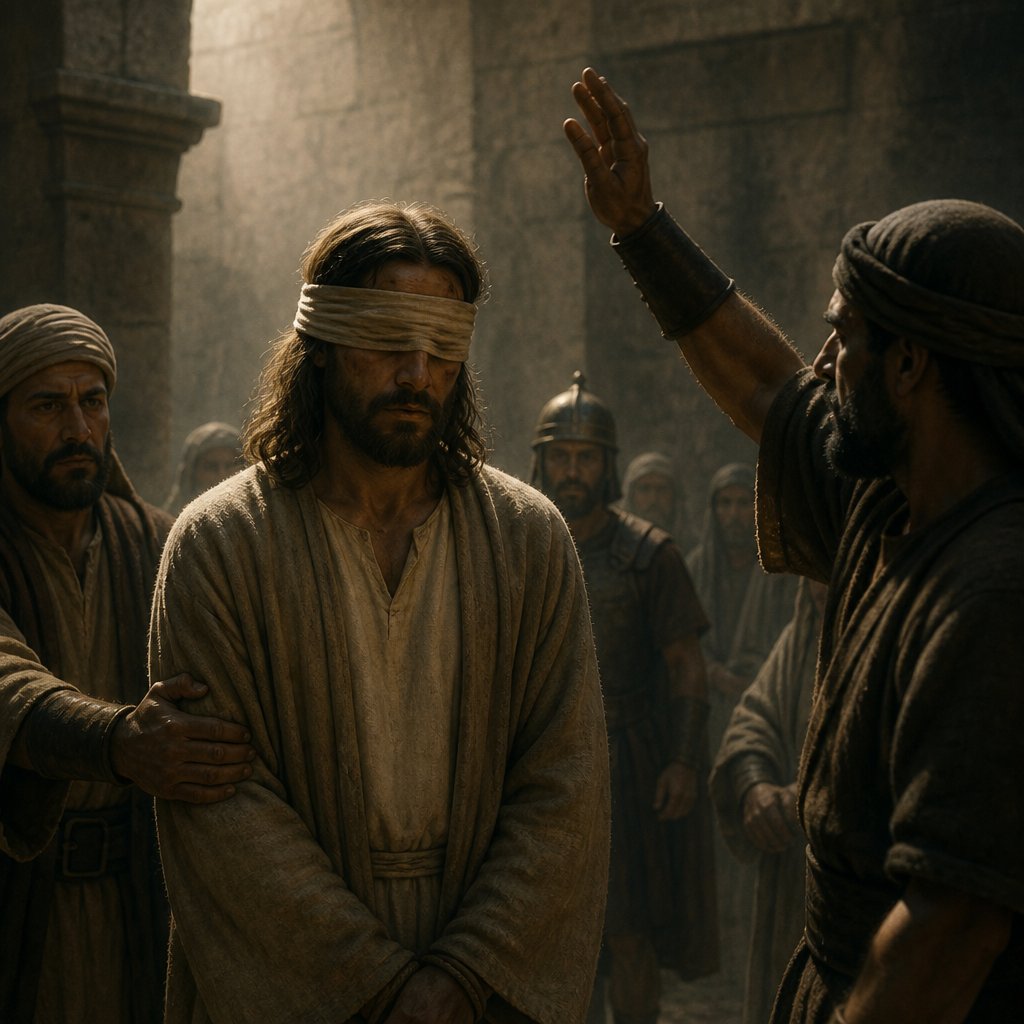
Luke 22:64 in the King James Version of the Bible reads, "And when they had blindfolded him, they struck him on the face, and asked him, saying, Prophesy, who is it that smote thee?"
This verse is part of the narrative of Jesus' betrayal, arrest, and trial leading up to his crucifixion. In this particular verse, Jesus is being mocked and physically abused by the Roman soldiers who have arrested him. The soldiers blindfold Jesus, strike him in the face, and then demand that he identify who had hit him. This verse is a powerful and poignant portrayal of the unjust and brutal treatment that Jesus endured as he was betrayed and arrested.
The context of this verse is important for understanding its significance within the broader narrative of the Passion of Christ. In the preceding verses, Jesus has been praying in the Garden of Gethsemane when Judas arrives with a group of armed men sent by the religious leaders to arrest Jesus. Judas identifies Jesus with a kiss, and Jesus is then taken into custody. The verses that follow this one describe the derision, mockery, and abuse that Jesus suffers at the hands of the Roman soldiers and the religious leaders.
This verse highlights several important themes that are central to the Christian faith. One of these themes is the idea of suffering and persecution. Jesus' unjust treatment at the hands of the soldiers is a manifestation of the suffering that he experiences as part of his mission to redeem humanity. This theme of suffering is central to the Christian understanding of Jesus as the Suffering Servant who takes on the sins of the world.
Another theme that emerges from this verse is the idea of injustice and the abuse of power. The Roman soldiers, who are meant to uphold law and order, instead mock and abuse Jesus, who is innocent of any crime. This serves as a powerful commentary on the ways in which those in positions of authority can abuse their power and mistreat the vulnerable. This theme of injustice is a recurring motif throughout the Gospels and is a central concern of Jesus' ministry.
The symbolism in this verse is also significant. The act of blindfolding Jesus and striking him on the face can be seen as symbolic of the world's rejection of the truth and the suffering of the innocent. The demand for Jesus to prophesy who had struck him is also symbolic of the skepticism and disbelief that Jesus faced throughout his ministry. In this verse, Jesus embodies the suffering servant described in the book of Isaiah, who is "despised and rejected by men, a man of sorrows and acquainted with grief" (Isaiah 53:3).
Overall, Luke 22:64 is a powerful and evocative verse that captures the unjust and brutal treatment that Jesus endured during his Passion. It highlights important themes of suffering, injustice, and the abuse of power, and it serves as a poignant reminder of the deep love and sacrifice that Jesus demonstrated through his willingness to endure such mistreatment for the sake of humanity's redemption. This verse ultimately points to the profound significance of Jesus' suffering and its transformative power within the Christian faith.
Get our apps


Artwork for Luke 22:64

Luke 22:64 - "And when they had blindfolded him, they struck him on the face, and asked him, saying, Prophesy, who is it that smote thee?"

"And when they had blindfolded him, they struck him on the face, and asked him, saying, Prophesy, who is it that smote thee?" - Luke 22:64

Luke 1:64 - "And his mouth was opened immediately, and his tongue loosed, and he spake, and praised God."

"And his mouth was opened immediately, and his tongue loosed, and he spake, and praised God." - Luke 1:64

luke 22:42

Luke 22:39

Luke 22:61,62

Luke 22:39

luke 22 44
luke 22:42

Luke 22:42

Luke 16:22-26

Luke 22:62 - "And Peter went out, and wept bitterly."

Luke 20:22 - "Is it lawful for us to give tribute unto Caesar, or no?"

Luke 22:5 - "And they were glad, and covenanted to give him money."

Luke 22:28 - "Ye are they which have continued with me in my temptations."

Luke 22:63 - "¶ And the men that held Jesus mocked him, and smote him."

Luke 22:65 - "And many other things blasphemously spake they against him."

Luke 22:31-32 - "Luke 22:31-32: And the Lord said, Simon, Simon, behold, Satan hath desired to have you, that he may sift you as wheat: But I have prayed for thee, that thy faith fail not: and when thou art converted, strengthen thy brethren."

Luke 22:21 - "¶ But, behold, the hand of him that betrayeth me is with me on the table."

Luke 22:43 - "And there appeared an angel unto him from heaven, strengthening him."

Luke 22:3 - "¶ Then entered Satan into Judas surnamed Iscariot, being of the number of the twelve."

Luke 22:57 - "And he denied him, saying, Woman, I know him not."

Luke 22:7 - "¶ Then came the day of unleavened bread, when the passover must be killed."

Luke 21:22 - "For these be the days of vengeance, that all things which are written may be fulfilled."

Luke 22:9 - "And they said unto him, Where wilt thou that we prepare?"

Luke 22:24 - "¶ And there was also a strife among them, which of them should be accounted the greatest."

Luke 22:14 - "And when the hour was come, he sat down, and the twelve apostles with him."

Luke 22:69 - "Hereafter shall the Son of man sit on the right hand of the power of God."

Luke 13:22 - "And he went through the cities and villages, teaching, and journeying toward Jerusalem."