What does Luke 23:28 mean?
“But Jesus turning unto them said, Daughters of Jerusalem, weep not for me, but weep for yourselves, and for your children.” — Luke 23:28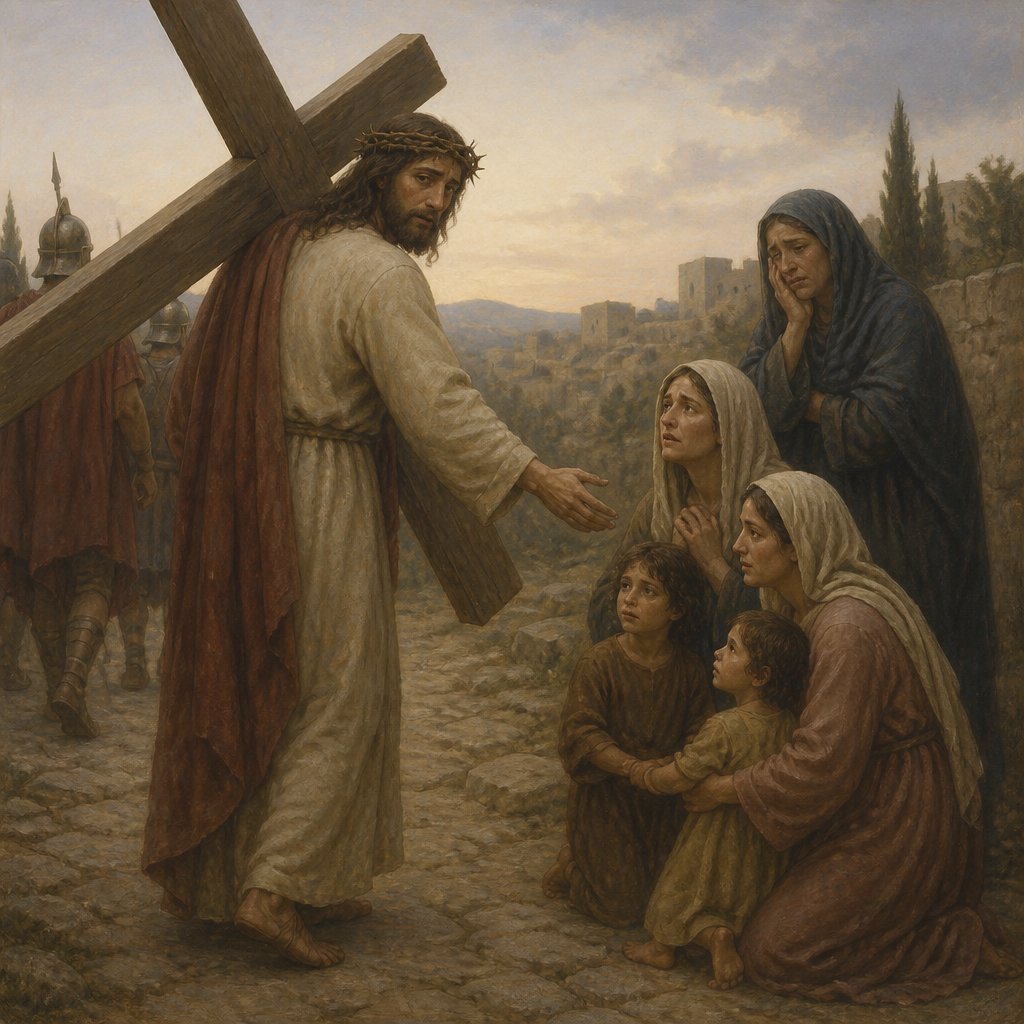
Luke 23:28 (KJV) reads, "But Jesus turning unto them said, Daughters of Jerusalem, weep not for me, but weep for yourselves, and for your children."
This verse is part of the narrative of Jesus' crucifixion in the Gospel of Luke. It takes place as Jesus is being led to his crucifixion, and a crowd, including women, are mourning for him. And in his response, Jesus shifts their focus from his suffering to the larger implications of what is happening.
One of the most striking aspects of this verse is Jesus' empathy and concern for the women who are mourning for him. Despite his own impending agony, he is able to look beyond himself and express compassion for others. This speaks to Jesus' selflessness and his concern for the well-being of those around him, even in the midst of his own suffering.
In instructing the women to weep for themselves and their children, Jesus is alluding to the future judgment that will come upon Jerusalem. He is urging them to recognize the larger spiritual significance of his crucifixion and to repent for their sins. This is consistent with Jesus' broader message of repentance and salvation.
Additionally, Jesus' words in this verse also point to the coming destruction of Jerusalem, which is a powerful and somber theme that runs throughout the Gospel of Luke. In the preceding verses, Jesus prophesies about the destruction of Jerusalem, and here he seems to be warning the women about the impending judgment and calling them to repentance.
This verse also sheds light on the theme of empathy and understanding of human suffering. Jesus, in the midst of his own immense suffering, is able to empathize with the pain of others. This serves as a powerful example of how Christians should endeavor to show compassion and understanding towards others, even in the midst of their own trials and tribulations.
The symbolism in this verse is rich and multi-layered. On one level, Jesus' words point to the broader significance of his crucifixion and the need for repentance and spiritual renewal. On another level, they also serve as a powerful reminder of the importance of empathy and compassion in the face of human suffering.
In the larger context of the Gospel of Luke, this verse fits into the broader narrative of Jesus' crucifixion and the events leading up to it. It is part of a series of teachings and interactions that Jesus has during his final hours, and it serves to underscore the gravity of the situation and the urgency of his message.
In conclusion, Luke 23:28 is a powerful and poignant verse that captures the essence of Jesus' compassion and concern for others, as well as the larger spiritual significance of his crucifixion. It reminds Christians of the need for empathy and understanding towards others, as well as the call to repentance and spiritual renewal. It is a verse that invites deep reflection and contemplation on the nature of human suffering and the redemptive power of Jesus' sacrifice.
Get our apps


Artwork for Luke 23:28

Luke 23:28 - "But Jesus turning unto them said, Daughters of Jerusalem, weep not for me, but weep for yourselves, and for your children."
"But Jesus turning unto them said, Daughters of Jerusalem, weep not for me, but weep for yourselves, and for your children." - Luke 23:28

Exodus 23:28

Luke 20:28

Luke 19:28

MATTHEW 28: 23

Matthew 23:28

Exodus 23:28

Matthew 23:28

Exodus 23:27-28

luke 13:28-37

Luke 13:28-27

Luke 13:28-27

Luke 9:28-45

Luke 13:28-27

luke 13:28-37

Exodus 23:28-29

Luke 23:53

Luke 19:23

luke 11:23

Luke 19:23

2 Samuel 23:28 - "Zalmon the Ahohite, Maharai the Netophathite,"

luke 11:23

Luke 15:23

luke 11:23

luke 11:23

Luke 5:28 - "And he left all, rose up, and followed him."

Luke 22:28 - "Ye are they which have continued with me in my temptations."

Luke 23:54 - "And that day was the preparation, and the sabbath drew on."

Luke 23:23 - "And they were instant with loud voices, requiring that he might be crucified. And the voices of them and of the chief priests prevailed."