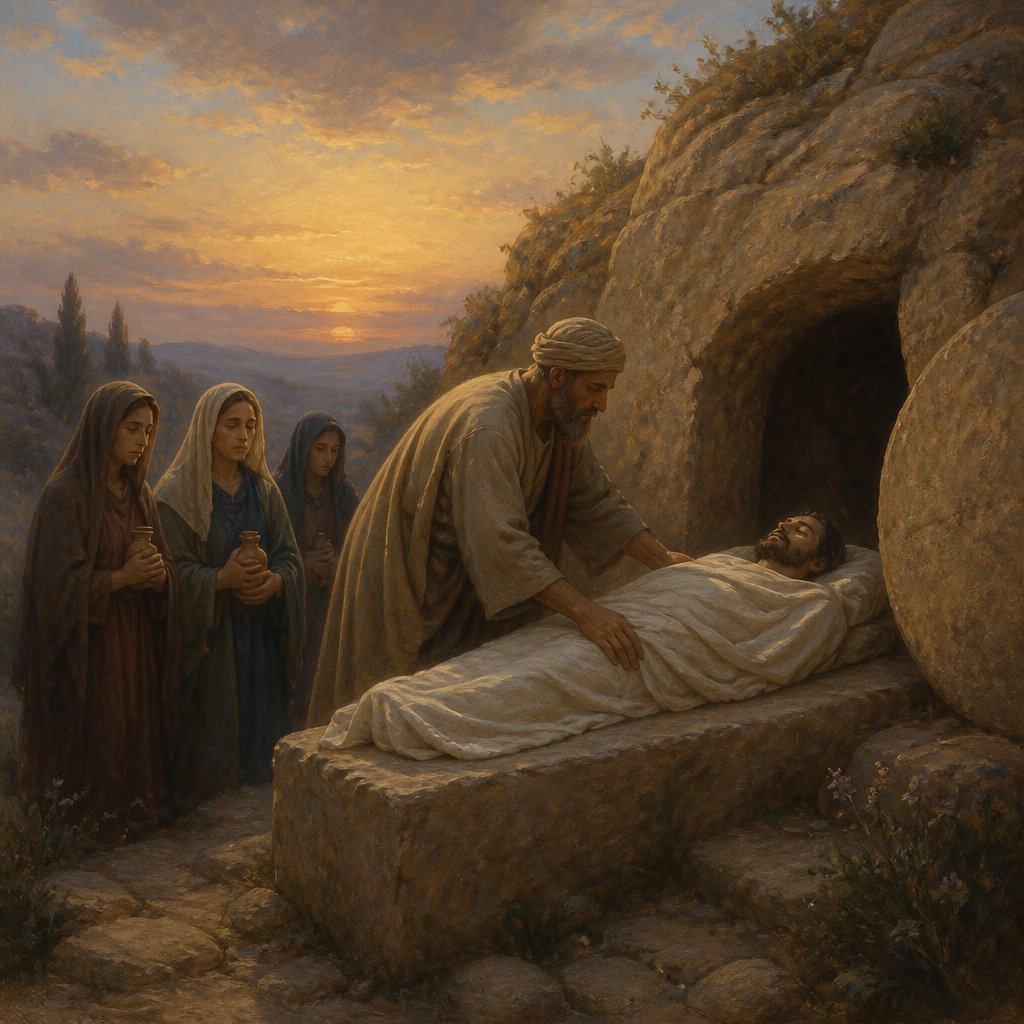
Luke 23:50-56 from the King James Version (KJV) of the Bible recounts the events following the crucifixion of Jesus Christ. This passage describes the actions of Joseph of Arimathaea, a member of the council and a good and just man who had not consented to the counsel and deed of the Sanhedrin in condemning Jesus to death. The passage also mentions the preparation of Jesus' body for burial and the observance of the Sabbath by the women who followed Jesus from Galilee.
Verse 50 begins by introducing Joseph of Arimathaea, who is described as a member of the council, a body of Jewish leaders responsible for religious and civil matters. Despite being a part of the council, Joseph is depicted as a good and just man, and someone who had not agreed with the decision of the council to crucify Jesus. This makes him a notable figure in the story, as he is willing to go against the actions of the council, perhaps risking his own position or reputation in doing so.
Joseph's actions underscore the theme of opposition to injustice and the importance of standing up for what is right, even when it goes against the accepted norms or authorities of the time. This theme is prevalent throughout the New Testament, as Jesus himself consistently challenged the religious leaders and their practices, often advocating for the marginalized and oppressed. Joseph's decision to take a stand against the actions of the council aligns with the broader message of justice and righteousness that is central to the teachings of Jesus.
In verse 51, Joseph is described as not having consented to the counsel and deed of the Sanhedrin, which refers to the council's decision to have Jesus crucified. This further emphasizes Joseph's disapproval of the council's actions and solidifies his character as a just and righteous figure. It also serves as a contrast to the actions of the religious leaders, highlighting the moral integrity of Joseph in contrast to the corruption and injustice of the council.
The passage then transitions to the preparation of Jesus' body for burial in verses 52-53. Joseph is depicted as a disciple of Jesus, as he takes the initiative to request the body of Jesus from Pilate, the Roman governor, and proceeds to wrap it in linen and lay it in a sepulcher or tomb. This act of caring for Jesus' body in death reflects the respect and honor that Joseph has for Jesus, as well as his recognition of Jesus' significance as the Messiah.
The act of preparing Jesus' body for burial also serves as a symbol of love, reverence, and devotion to Jesus, even in his death. It demonstrates the deep impact that Jesus had on his followers and the lengths to which they were willing to go to honor him. This theme of love and devotion is a central tenet of Christianity, as Jesus himself taught the importance of loving others and serving with humility and selflessness.
Verses 54-56 conclude the passage by describing the observance of the Sabbath by the women who had followed Jesus from Galilee. These women are mentioned as witnesses to the burial of Jesus, and they make note of where his body was laid in the tomb. This detail serves as a testament to the historical authenticity of Jesus' death and burial, as it is attested to by multiple witnesses.
The observance of the Sabbath by the women also aligns with the Jewish religious customs and practices of the time, highlighting the continuity between Jesus' ministry and the traditions of Judaism. It also foreshadows the events of the following day, when the women would return to the tomb to find it empty, thus marking the resurrection of Jesus.
In conclusion, Luke 23:50-56 from the King James Version (KJV) of the Bible incorporates themes of justice, righteousness, love, and devotion, as it recounts the actions of Joseph of Arimathaea and the women who followed Jesus. Through these individuals, the passage illustrates the contrast between moral integrity and corruption, the significance of caring for Jesus in life and death, and the continuity of Jesus' ministry with Jewish tradition. Overall, this passage serves as a poignant and thought-provoking depiction of the events following Jesus' crucifixion, and it underscores the enduring impact of Jesus' life, teachings, and sacrifice.
Get our apps


Artwork for Luke 23:50-56

Luke 23:50-56 - "Now there was a man named Joseph, a member of the Council, a good and upright man, who had not consented to their decision and action. He came from the Judean town of Arimathea, and he himself was waiting for the kingdom of God. Going to Pilate, he asked for Jesus’ body. Then he took it down, wrapped it in linen cloth and placed it in a tomb cut in the rock, one in which no one had yet been laid. It was Preparation Day, and the Sabbath was about to begin. The women who had come with Jesus from Galilee followed Joseph and saw the tomb and how his body was laid in it. Then they went home and prepared spices and perfumes. But they rested on the Sabbath in obedience to the commandment."
"Now there was a man named Joseph, a member of the Council, a good and upright man, who had not consented to their decision and action. He came from the Judean town of Arimathea, and he himself was waiting for the kingdom of God. Going to Pilate, he asked for Jesus’ body. Then he took it down, wrapped it in linen cloth and placed it in a tomb cut in the rock, one in which no one had yet been laid. It was Preparation Day, and the Sabbath was about to begin. The women who had come with Jesus from Galilee followed Joseph and saw the tomb and how his body was laid in it. Then they went home and prepared spices and perfumes. But they rested on the Sabbath in obedience to the commandment." - Luke 23:50-56

Luke 23:56 - "And they returned, and prepared spices and ointments; and rested the sabbath day according to the commandment."

Luke 23:50 - "¶ And, behold, there was a man named Joseph, a counsellor; and he was a good man, and a just:"
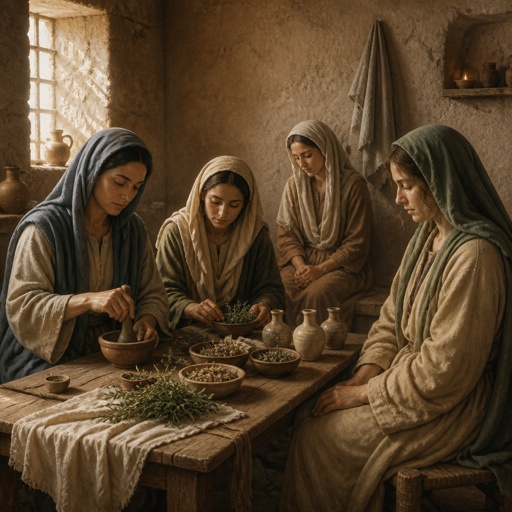
"And they returned, and prepared spices and ointments; and rested the sabbath day according to the commandment." - Luke 23:56

Luke 23:55-56 - "The women who had come with Jesus from Galilee followed Joseph and saw the tomb and how his body was laid in it. Then they went home and prepared spices and perfumes. But they rested on the Sabbath in obedience to the commandment."

"¶ And, behold, there was a man named Joseph, a counsellor; and he was a good man, and a just:" - Luke 23:50

Luke 7:50

Luke 7:50

Luke 12:50

Luke 7:36–50

Luke 1:56 - "And Mary abode with her about three months, and returned to her own house."

Luke 7:36-50

Luke 12:56 - "Ye hypocrites, ye can discern the face of the sky and of the earth; but how is it that ye do not discern this time?"

Luke 9:56 - "For the Son of man is not come to destroy men's lives, but to save them. And they went to another village."

Luke 8:56 - "And her parents were astonished: but he charged them that they should tell no man what was done."

Luke 2:50 - "And they understood not the saying which he spake unto them."

Luke 22:56 - "But a certain maid beheld him as he sat by the fire, and earnestly looked upon him, and said, This man was also with him."

Luke 1:50 - "And his mercy is on them that fear him from generation to generation."

Luke 11:50 - "That the blood of all the prophets, which was shed from the foundation of the world, may be required of this generation;"

Luke 22:50 - "¶ And one of them smote the servant of the high priest, and cut off his right ear."

Luke 7:50 - "And he said to the woman, Thy faith hath saved thee; go in peace."

Luke 12:50 - "But I have a baptism to be baptized with; and how am I straitened till it be accomplished!"

Luke 9:50 - "And Jesus said unto him, Forbid him not: for he that is not against us is for us."

Luke 24:50 - "¶ And he led them out as far as to Bethany, and he lifted up his hands, and blessed them."

Jeremiah 50:23 - "How is the hammer of the whole earth cut asunder and broken! how is Babylon become a desolation among the nations!"

Salmo 45, 2-3. 5-6. 8-9

Luke 8:50 - "But when Jesus heard it, he answered him, saying, Fear not: believe only, and she shall be made whole."

Psalms 50:23 - "Whoso offereth praise glorifieth me: and to him that ordereth his conversation aright will I shew the salvation of God."

Luke 8:54-56 (KJVA) 54 And he put them all out, and took her by the hand, and called, saying, Maid, arise. 55 And her spirit came again, and she arose straightway: and he commanded to give her meat. 56 And her parents were astonished: but he charged them that they should tell no man what was done.