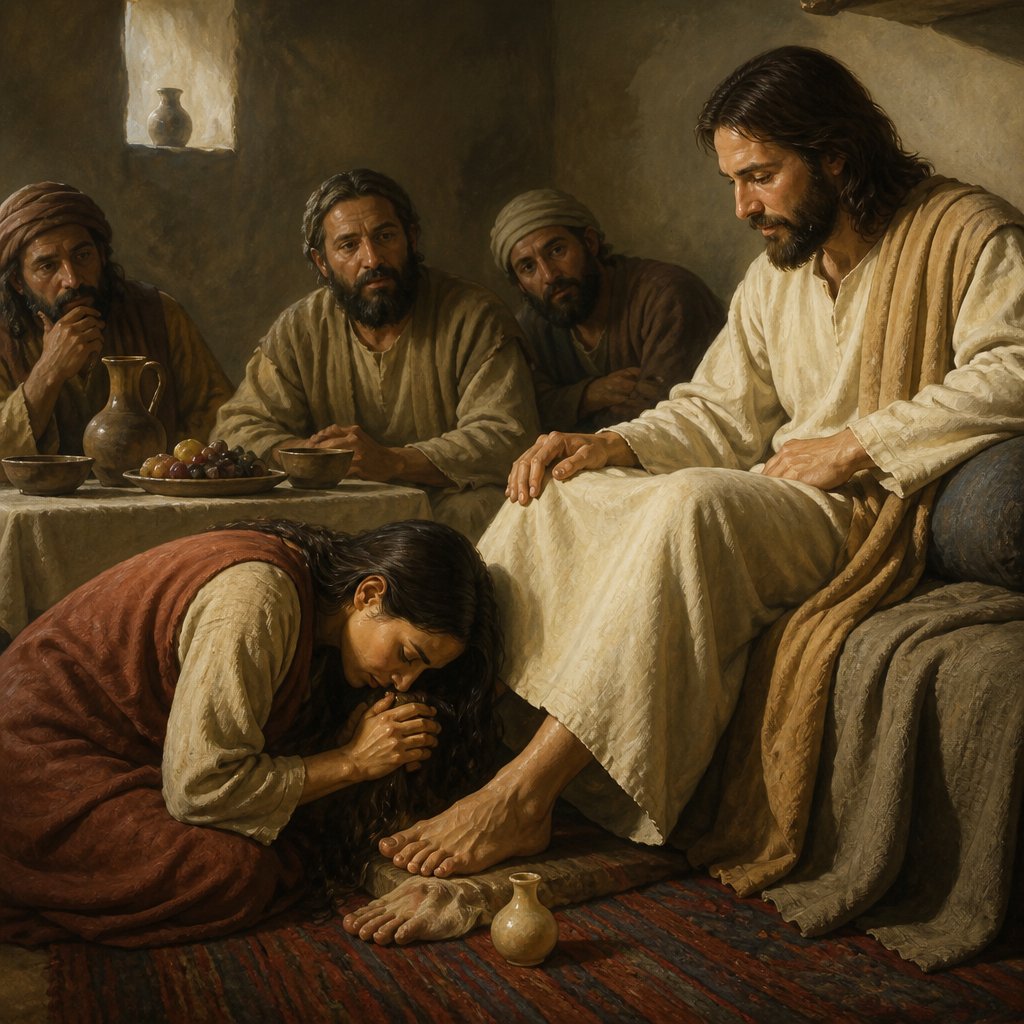
Luke 7:37-38 in the King James Version reads: "And, behold, a woman in the city, which was a sinner, when she knew that Jesus sat at meat in the Pharisee's house, brought an alabaster box of ointment, and stood at his feet behind him weeping, and began to wash his feet with tears, and did wipe them with the hairs of her head, and kissed his feet, and anointed them with the ointment."
This passage from the book of Luke is a powerful and poignant moment in the life of Jesus Christ. It speaks to the themes of repentance, forgiveness, and the transformative power of grace and love. The context of this verse takes place in the home of a Pharisee, where Jesus has been invited for a meal. A woman, who is described as a sinner, enters the house and approaches Jesus, carrying an alabaster box of expensive ointment. Her actions and the powerful symbolism of this passage reveal deep spiritual truths and lessons for believers.
The themes of repentance and forgiveness are central to this passage. The woman, who is unnamed in the text, is identified as a sinner. This label suggests that she was known in the community for living a life of moral wrongdoing. However, her actions in this scene demonstrate a deep sense of remorse and contrition for her sins. Instead of concealing her shame or trying to justify her past actions, she openly approaches Jesus, acknowledging her sinfulness. The fact that she brings an alabaster box of ointment, which was a precious and costly possession, indicates her desire to express her repentance and seek forgiveness from Jesus.
The act of washing Jesus' feet with her tears, wiping them with her hair, and anointing them with ointment is a powerful symbol of humility, love, and devotion. In the culture of that time, feet were considered to be the lowest part of the body, and it was customary to wash the feet of guests as a sign of hospitality. However, the woman goes above and beyond this custom by using her own tears and hair in a deeply intimate and personal gesture of love and reverence towards Jesus. Her actions reveal a profound sense of humility and an understanding of her own unworthiness in the presence of the divine. The use of ointment to anoint Jesus' feet further signifies her acknowledgement of his divinity and her desire to honor and worship him.
The response of the Pharisee who hosted the meal and the onlookers in the house adds another layer of meaning to this passage. The Pharisee questions Jesus' identity as a prophet, reasoning that if Jesus truly knew the woman's sinful nature, he would not allow her to touch him. Jesus responds with a parable about forgiveness, highlighting the contrast between the woman's humble repentance and the Pharisee's lack of hospitality and love. This serves as a powerful lesson about God's grace and forgiveness being available to all, regardless of their past sins or societal status.
Ultimately, this passage is a profound demonstration of God's love and mercy. It shows that no one is beyond the reach of God's forgiveness and that genuine repentance and humility are the keys to receiving God's grace. The woman's actions serve as a model of true faith and devotion, and her story continues to inspire believers to seek reconciliation and forgiveness through Christ.
In conclusion, Luke 7:37-38 is a rich and multi-layered passage that speaks to the profound themes of repentance, forgiveness, and the transformative power of grace and love. It offers a timeless lesson about the beauty of humility, the depth of God's mercy, and the possibility of redemption for all who seek it. This powerful encounter between Jesus and the repentant woman continues to resonate with believers, reminding them of the boundless love and forgiveness that God offers to all who come to him in sincere contrition and faith.
Get our apps


Artwork for Luke 7:37-38

Luke 7:37-38 - "And behold, a woman in the city who was a sinner, when she knew that Jesus was sitting at the table in the Pharisee's house, brought an alabaster flask of fragrant oil, and stood at His feet behind Him weeping; and she began to wash His feet with her tears, and wiped them with the hair of her head; and she kissed His feet and anointed them with the fragrant oil."
"And behold, a woman in the city who was a sinner, when she knew that Jesus was sitting at the table in the Pharisee's house, brought an alabaster flask of fragrant oil, and stood at His feet behind Him weeping; and she began to wash His feet with her tears, and wiped them with the hair of her head; and she kissed His feet and anointed them with the fragrant oil." - Luke 7:37-38

Matthew 9:37-38

Luke 7:37 - "And, behold, a woman in the city, which was a sinner, when she knew that Jesus sat at meat in the Pharisee's house, brought an alabaster box of ointment,"

John 7:37-38 - "On the last and greatest day of the festival, Jesus stood and said in a loud voice, “Let anyone who is thirsty come to me and drink. Whoever believes in me, as Scripture has said, rivers of living water will flow from within them.”"

Psalms 37:38 - "But the transgressors shall be destroyed together: the end of the wicked shall be cut off."

Luke 7:38 - "And stood at his feet behind him weeping, and began to wash his feet with tears, and did wipe them with the hairs of her head, and kissed his feet, and anointed them with the ointment."

Job 38:37 - "Who can number the clouds in wisdom? or who can stay the bottles of heaven,"

Luke 2:37

Luke 2:37

Luke 2:37

Luke 2:37

Luke 2:37

Luke 6:27-38

Luke (1:37) For nothing will be impossible with God.”

Luke (1:37) For nothing will be impossible with God.”

Luke (1:37) For nothing will be impossible with God.”

Luke (1:37) For nothing will be impossible with God.”

Luke (1:37) For nothing will be impossible with God.”

Luke (1:37) For nothing will be impossible with God.”

Luke (1:37) For nothing will be impossible with God.”

Luke (1:37) For nothing will be impossible with God.”

Luke 6: 27-38

Luke (1:37) For nothing will be impossible with God.”

Luke (1:37) For nothing will be impossible with God.”

Luke (1:37) For nothing will be impossible with God.”

Luke (1:37) For nothing will be impossible with God.”

Luke (1:37) For nothing will be impossible with God.”

Luke (1:37) For nothing will be impossible with God.”

Luke (1:37) For nothing will be impossible with God.”