What does Luke 8:50 mean?
“But when Jesus heard it, he answered him, saying, Fear not: believe only, and she shall be made whole.” — Luke 8:50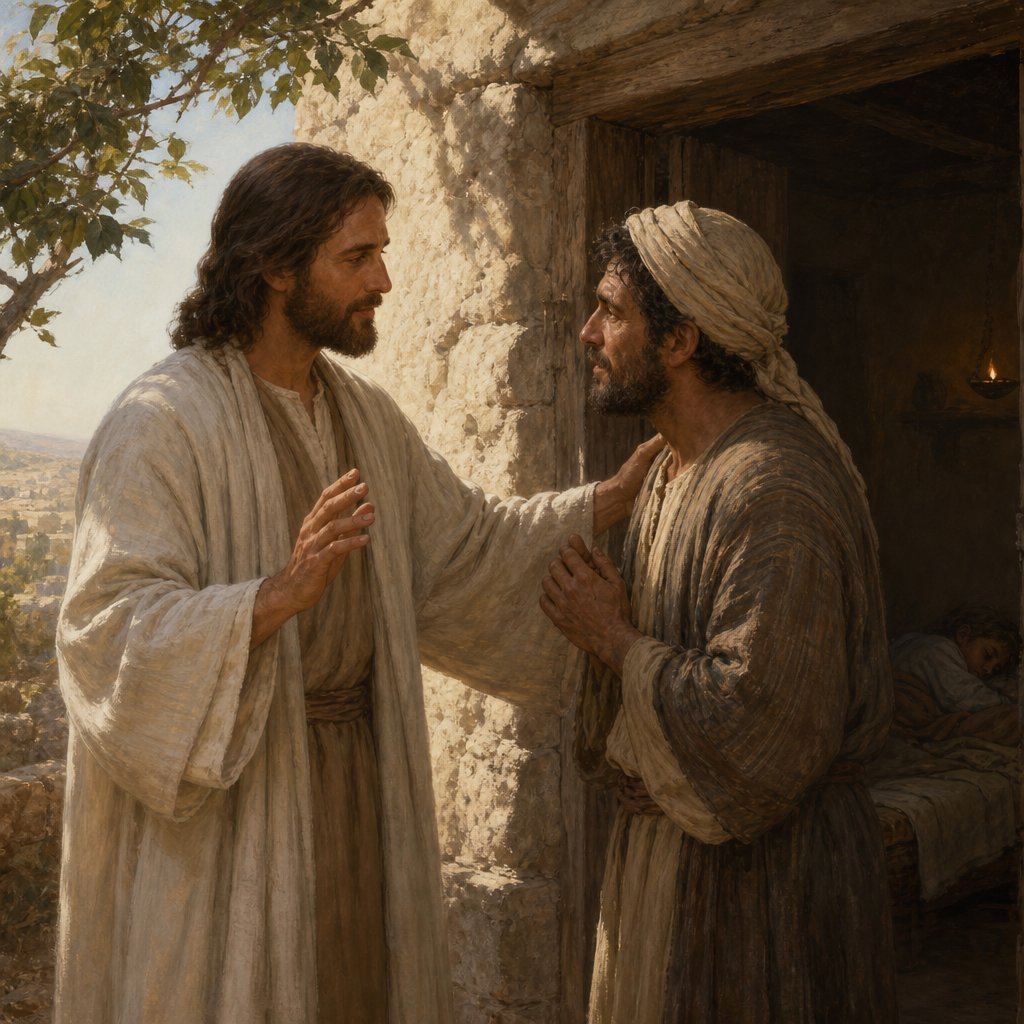
Luke 8:50 in the King James Version reads, “But when Jesus heard it, he answered him, saying, Fear not: believe only, and she shall be made whole.” In the flow of Luke’s narrative, these words fall at the most crushing moment for Jairus, a ruler of the synagogue who has begged Jesus to come to his house because his only daughter, about twelve years old, “lay a dying.” While Jesus is on the way, the woman with the issue of blood touches him and is healed, and the delay becomes the stage on which Jairus’s faith is tested. Then comes the report that appears final: “Thy daughter is dead; trouble not the Master.” Luke 8:50 is Christ’s immediate reply to that sentence of despair. It is not offered as a general proverb detached from life, but as a command spoken into a real crisis where hope seems to have expired.
The verse turns on a sharp contrast between two voices and two responses. One voice says, in effect, the situation is beyond remedy and Jesus is no longer worth troubling. The other voice is Jesus’ own, and he does not argue about the facts as men perceive them; he addresses the inward collapse that those facts provoke. “Fear not” is a direct prohibition of the emotion that would govern Jairus’s next move. Fear here is not merely feeling afraid; it is the spiritual surrender that agrees with death as ultimate and treats the word of God as powerless. Jesus cuts off that surrender. Then he replaces it with a single alternative: “believe only.” The phrase is strikingly exclusive. Christ does not tell Jairus to calculate odds, to gather more reports, to brace himself for loss, or to do anything to earn a miracle. He calls for faith that rests solely on him, faith that does not share the throne with fear. In that sense, “only” functions like a doorway that closes behind Jairus: to proceed with Jesus, Jairus must proceed by trust.
The promise, “and she shall be made whole,” is equally significant because of the particular wording Luke preserves. In the immediate story it points to the girl’s restoration from death to life, as the passage soon shows when Jesus takes her by the hand and calls her to arise. Yet the language of being “made whole” echoes the healing vocabulary that has already filled the chapter, especially the earlier miracle of the woman who had an issue of blood twelve years and could not be healed by any. She too is told she is made whole. By using this expression, the verse quietly links the two miracles: a prominent synagogue ruler’s child and an anonymous, ceremonially unclean sufferer are both beyond human remedy, both are met by Christ, and in both cases wholeness is not partial improvement but a complete restoration that only his authority can accomplish. Wholeness in this setting is more than physical repair; it is the reordering of a life by the presence and power of the Lord.
The context also heightens the meaning by showing the pressure under which faith must operate. Jairus’s request is urgent, and the delay caused by another person’s need could easily be interpreted as divine neglect. Luke places the interruption deliberately: the woman’s healing becomes a living parable in front of Jairus. She comes trembling, yet believing; she is publicly acknowledged; she receives peace. Her story answers Jairus before Jairus has time to ask: Jesus is not hindered by time, uncleanness, social distance, or hopeless diagnoses. Therefore, when the announcement of death arrives, Jesus can rightly say, “believe only,” because Jairus has just witnessed what faith in Christ does in an impossible case. The narrative teaches that what seems like delay is not absence, and what seems like finality is not beyond Christ’s reach.
Symbolically, the verse sets fear and faith as rival masters. Fear speaks in the language of final words: “dead,” “trouble not,” “too late.” Faith, as Jesus defines it here, is not denial of circumstances but submission to his word over circumstances. The human messenger’s counsel, “trouble not the Master,” suggests that Jesus is limited, that he is only helpful within certain boundaries. Jesus’ response exposes that boundary as false. The story that follows proves the point: he enters the house, dismisses the tumult, declares the child not dead but sleeping, and raises her. Thus Luke 8:50 functions as the hinge between the announcement of death and the manifestation of resurrection power. It is the sentence that carries Jairus across the threshold from natural expectation into dependence on Christ.
The verse also reveals something of Jesus’ pastoral authority. He does not merely sympathize; he commands. “Fear not” and “believe only” are imperatives. This shows that, in Luke’s portrayal, faith is not simply a spontaneous mood but an act of obedience to the word of Christ. Jairus is being called to trust when every social and emotional force would make distrust feel reasonable. In that light, Luke 8:50 is not only comfort; it is a summons. Jesus is asking for a kind of faith that continues to follow him even after the worst news has arrived, a faith that keeps walking with him to the house even when the crowd, the mourners, and the messenger all imply the journey is pointless.
Finally, the significance of “she shall be made whole” reaches beyond the immediate miracle to Luke’s broader portrait of salvation. Throughout the Gospel, Jesus brings wholeness where sin, sickness, oppression, and death fragment human life. Here he confronts death itself, the great divider and the great fear. Luke 8:50 therefore carries a quiet proclamation: the authority of Jesus is not confined to healing the sick but extends to undoing death’s claim, and the proper human response to his authority is to refuse fear’s rule and to believe his word. In one short sentence, spoken in a hallway between bad news and a closed door, Christ names the spiritual battle, commands the posture of the heart, and promises a restoration that only he can give.
Get our apps


Artwork for Luke 8:50

Luke 8:50 - "But when Jesus heard it, he answered him, saying, Fear not: believe only, and she shall be made whole."

"But when Jesus heard it, he answered him, saying, Fear not: believe only, and she shall be made whole." - Luke 8:50
"But when Jesus heard it, he answered him, saying, Fear not: believe only, and she shall be made whole." - Luke 8:50

Luke 7:50

Luke 7:50

Luke 12:50

Luke 7:36–50

Luke 7:36-50

Luke 2:50 - "And they understood not the saying which he spake unto them."

Luke 23:50 - "¶ And, behold, there was a man named Joseph, a counsellor; and he was a good man, and a just:"

Luke 1:50 - "And his mercy is on them that fear him from generation to generation."

Luke 11:50 - "That the blood of all the prophets, which was shed from the foundation of the world, may be required of this generation;"

Luke 22:50 - "¶ And one of them smote the servant of the high priest, and cut off his right ear."

Luke 7:50 - "And he said to the woman, Thy faith hath saved thee; go in peace."

Luke 12:50 - "But I have a baptism to be baptized with; and how am I straitened till it be accomplished!"

Luke 9:50 - "And Jesus said unto him, Forbid him not: for he that is not against us is for us."

Luke 24:50 - "¶ And he led them out as far as to Bethany, and he lifted up his hands, and blessed them."

John 8:50 - "And I seek not mine own glory: there is one that seeketh and judgeth."

"And they understood not the saying which he spake unto them." - Luke 2:50

"And his mercy is on them that fear him from generation to generation." - Luke 1:50

Psalms 50:8 - "I will not reprove thee for thy sacrifices or thy burnt offerings, to have been continually before me."

Jeremiah 50:8 - "Remove out of the midst of Babylon, and go forth out of the land of the Chaldeans, and be as the he goats before the flocks."

"But I have a baptism to be baptized with; and how am I straitened till it be accomplished!" - Luke 12:50

"And he said to the woman, Thy faith hath saved thee; go in peace." - Luke 7:50

"¶ And, behold, there was a man named Joseph, a counsellor; and he was a good man, and a just:" - Luke 23:50

"And I seek not mine own glory: there is one that seeketh and judgeth." - John 8:50

Genesis 50:8 - "And all the house of Joseph, and his brethren, and his father's house: only their little ones, and their flocks, and their herds, they left in the land of Goshen."

"That the blood of all the prophets, which was shed from the foundation of the world, may be required of this generation;" - Luke 11:50

"And Jesus said unto him, Forbid him not: for he that is not against us is for us." - Luke 9:50

Luke 8:5-8